


A Democratic Congress would not control the government, but it could fundamentally change the final two years of the Trump presidency
By Bear Howard and Associates,
Sedona, AZ — HERE IS A BRIEF SUMMARY OF THE FULL ARTICLE. THE FULL ARTICLE FOLLOWS.
The November 2026 election could dramatically change the final two years of Donald Trump’s presidency. If Democrats win both the House and Senate, Trump would remain president, but for the first time in his second term he would face a Congress controlled entirely by the opposition.
The immediate result would probably be legislative gridlock. But the more consequential change could be congressional oversight.
Democratic committees would gain the power to launch investigations, hold hearings, issue subpoenas, demand documents and examine actions taken throughout the first two years of the Trump administration. If investigators uncovered evidence of possible criminal conduct, Congress could refer the matter to the Justice Department for prosecution, although prosecution would remain the responsibility of the Justice Department.
And then there is impeachment.
A Democratic House could impeach Trump by simple majority, but removing him would require a two-thirds Senate vote. That means Democrats would almost certainly need substantial Republican support. Today, there is no evidence of anything close to that Republican coalition.
But 2027 could create a political environment America has never experienced. Trump would be a lame-duck president who cannot run again. Republicans would already be looking toward 2028. Vice President JD Vance would become president if Trump were removed.
Would Republicans continue defending Trump regardless of what congressional investigations uncovered? Or could there come a point when enough Republicans decided their party’s future would be better served by moving beyond him?
That is the question at the heart of this analysis.
A Democratic Congress could not simply take control of the Trump presidency. But it could fundamentally change its final two years, and potentially reshape the battle over who controls America after Trump.
FULL ARTICLE
What Would Washington Look Like If Democrats Take Congress in 2026?
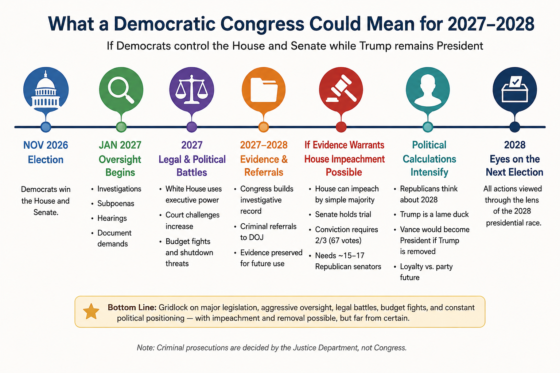
The November 2026 midterm elections could be among the most consequential congressional elections in recent history.
If Democrats win control of both the House of Representatives and the Senate, Donald Trump would remain president until January 20, 2029. Republicans would continue to control the executive branch. The Supreme Court would retain its current composition.
But beginning in January 2027, Democrats would control two of the three major constitutional centers of elected federal power: the House and Senate.
That would not allow Democrats to govern as though they controlled the presidency. It would, however, dramatically change the environment in which the Trump administration operates.
For the first two years of Trump’s second term, a Republican Congress has generally served as the administration’s legislative partner. A Democratic Congress would instead become an institutional counterweight.
The difference could be enormous.
The Trump legislative agenda would largely end
The most immediate consequence would probably be legislative gridlock.
A Democratic House and Senate could pass legislation, but Trump could veto it. Unless Democrats somehow achieved two-thirds majorities in both chambers, which is extraordinarily unlikely, they could not override those vetoes.
Trump, conversely, could propose legislation, but Democrats would control whether it moved through Congress.
Major elements of the Trump legislative agenda would therefore become extremely difficult to enact.
The battles would shift toward government funding, appropriations, executive authority, regulation, foreign policy and oversight.
That last category could become the defining feature of 2027.
Congress would regain an aggressive oversight role
Congress has substantial constitutional investigative authority.
Democratic committee chairs could investigate executive agencies, Cabinet departments and White House activities. They could demand documents and testimony and, where legally appropriate, issue subpoenas.
Congressional subpoenas are not simply invitations. A recipient of a valid subpoena generally has a legal obligation to comply unless there is a legitimate privilege or other legal justification for refusing. Enforcement becomes considerably more complicated when executive privilege and separation-of-powers questions arise.
A Democratic Congress could therefore investigate questions involving the Department of Justice, immigration enforcement, government contracts, federal expenditures, conflicts of interest, the use of presidential authority, compliance with court orders and actions of Cabinet officials.
Officials could be questioned publicly and under oath.
The distinction between political disagreement and legal wrongdoing would be critical. A policy can be controversial, aggressive or even ultimately found unlawful by a court without constituting a crime.
But if congressional investigators discovered evidence suggesting that federal criminal statutes had been violated, Congress would have another option.
Congress can investigate crimes, but it cannot prosecute them
This is one of the most misunderstood parts of the system.
Congress is not a criminal prosecutor.
The Congressional Research Service notes that Congress cannot bring federal criminal prosecutions itself. Criminal enforcement is an executive function. Congress can investigate, collect evidence and make criminal referrals, but the Justice Department ultimately decides whether to prosecute federal crimes.
That produces a fascinating problem under divided government.
Imagine that a Democratic congressional committee spent six months investigating a senior Trump administration official and concluded that substantial evidence existed of criminal wrongdoing.
The committee could issue a report and refer the matter to the Department of Justice.
But it would still be Trump’s Justice Department.
The attorney general would not automatically be required to prosecute the person simply because Congress requested it.
That does not necessarily make the congressional investigation meaningless.
Congress could establish an evidentiary record. It could preserve documents, testimony and investigative findings. And depending upon the particular offense and applicable statute of limitations, that evidence could potentially remain available to a future Justice Department after Trump leaves office.
In other words, 2027 congressional investigations could conceivably have consequences extending well beyond 2027.
Congress possesses another extraordinary power: impeachment
The House has the constitutional authority to impeach the president, vice president and other federal civil officers.
Impeachment does not require proof of an ordinary statutory crime. The constitutional standard is “Treason, Bribery, or other high Crimes and Misdemeanors,” a phrase whose meaning has been debated throughout American history.
The mechanics are straightforward.
A simple majority of the House can approve articles of impeachment.
The Senate then conducts a trial.
Conviction requires two-thirds of senators present. If all 100 senators participate, that normally means 67 votes. Upon conviction, the official is removed from office.
And therein lies the political obstacle.
A Democratic takeover of Congress could make another Trump impeachment quite possible.
It would not make Trump’s removal likely.
The number 67 changes everything
Suppose Democrats emerged from the 2026 election with 52 Senate seats.
They would still need approximately 15 Republican senators to convict Trump.
With 51 Democrats, they would need 16 Republicans.
That is an enormous hurdle.
After January 6 and Trump’s first presidency, only seven Republican senators voted to convict him in his second impeachment trial.
There is currently no credible evidence that something approaching 15 or 16 Republican senators is prepared to remove Trump.
There are, however, signs of Republican independence from the White House on individual matters. Most recently, the Senate adjourned for its August recess without delivering Trump’s voting legislation despite presidential pressure, while other Republicans have broken with the administration on particular nominations and policies.
Those disagreements should not be mistaken for support for impeachment.
Voting against a president on legislation or a nominee is one thing.
Voting to end his presidency is another universe entirely.
But 2027 would contain a political circumstance that did not exist before
Donald Trump cannot constitutionally be elected president again in 2028.
That seemingly simple fact could eventually alter Republican political calculations.
During Trump’s previous confrontations with Congress, Republican politicians had to consider Trump’s enormous influence over their voters and his potential political future.
After the 2026 election, Republicans would begin confronting a different question:
What does the Republican Party look like after Trump?
The 2028 presidential campaign would already be approaching.
Republican governors, senators, donors and presidential hopefuls would begin maneuvering for control of the post-Trump Republican Party.
And then there is Vice President JD Vance.
If Trump were impeached by the House, convicted by the Senate and removed from office, Democrats would not take control of the presidency.
Vance would become president.
That creates a political scenario fundamentally different from simply asking Republicans whether they would help Democrats remove a Republican president.
Republicans contemplating Trump’s removal would know that the presidency would remain Republican.
They could theoretically replace an 80-year-old lame-duck president with a younger Republican president who might then enter the 2028 election as the incumbent.
That possibility has produced political chatter and speculation. It should not be confused with evidence that Republican senators presently intend to do it.
At this point, there is no evidence of a Republican Senate coalition remotely approaching the number required for Trump’s conviction.
But political incentives can change rapidly after elections.
The November election could change the calculation
Imagine that Republicans suffer a severe defeat in November 2026.
They lose the House.
They lose the Senate.
Exit polling and subsequent political analysis indicate that dissatisfaction with Trump contributed significantly to those losses.
Republican senators would then confront a political reality they have rarely faced during the Trump era.
Trump would still control the presidency, but he would never again appear on a presidential ballot.
Republicans would have to determine whether continuing absolute loyalty to Trump helped or damaged their chances of winning in 2028.
Even that probably would not produce 67 votes for impeachment.
Something else would almost certainly be necessary.
The missing ingredient would be a triggering event
For a Republican impeachment coalition to become realistic, congressional investigations would probably have to uncover something sufficiently serious that Republican senators concluded defending Trump had become more dangerous than abandoning him.
That is the point at which impeachment could move from partisan exercise to genuine constitutional crisis.
The early indications would probably be subtle.
Republican senators would not walk before television cameras and announce that they had decided to end Trump’s presidency.
Political separations generally happen incrementally.
Republican senators who had reliably defended Trump might begin saying that allegations were “serious.”
They might demand that the White House provide documents.
They might insist that the president answer questions.
They might say that Congress needed to “follow the evidence.”
Most importantly, Republican Senate leadership might stop demanding party-line opposition and tell senators to judge the evidence individually.
Those seemingly mundane statements would matter far more than another angry television interview by a politician who already opposes Trump.
They would indicate that Trump’s political protection inside his own party was weakening.
There is also a difference between impeachment and criminal liability
Impeachment is a constitutional political process, not a criminal prosecution.
The Senate’s principal punishment following conviction is removal from office, with the possibility of disqualification from holding federal office. Criminal liability is a separate matter.
Consequently, congressional investigations during 2027 and 2028 could operate on several tracks simultaneously.
Congress could investigate alleged misconduct.
It could legislate in response to what it discovered.
It could refer evidence of suspected crimes to the Justice Department.
The House could impeach officials when it believed the constitutional standard had been met.
And Congress could preserve an investigative record potentially relevant to future law enforcement.
Trump’s Justice Department could resist some congressional demands and decline criminal referrals. That would produce additional confrontations over subpoenas, executive privilege and congressional authority, some of which would almost certainly reach federal courts.
The White House would probably respond by becoming more executive-centered
Faced with an opposition Congress, Trump would probably rely increasingly upon presidential authority rather than legislation.
Executive orders, administrative actions, agency regulations and assertions of presidential authority would become even more important.
That would generate litigation.
The courts would therefore become the third battlefield alongside Congress and the executive branch.
Meanwhile, the Senate could make presidential appointments considerably more difficult. A Democratic Senate could block or delay Cabinet replacements, judges and numerous senior executive appointments.
Congress would also possess enormous leverage through appropriations.
The Constitution gives Congress control over federal spending. A Democratic Congress could refuse funding for certain administration priorities, impose conditions on expenditures and demand reporting and oversight.
The result could be repeated confrontations over government funding and possible shutdowns.
Foreign policy would be different
Presidents traditionally possess considerably greater freedom in foreign affairs than domestic legislation.
Trump would remain commander in chief and would continue directing diplomacy and much of national security policy.
But Congress controls appropriations and possesses important war powers and oversight authority.
A Democratic Congress could therefore challenge military expenditures, impose reporting requirements, investigate military actions and attempt to limit funding for policies it opposed.
Whether those restrictions survived presidential objections and court challenges would depend upon the circumstances.
Washington would begin looking toward 2028 almost immediately
By the middle of 2027, American government would increasingly operate in the shadow of the next presidential election.
Democratic presidential candidates would begin positioning themselves.
Republican candidates would begin competing to inherit Trump’s political coalition.
Vance would occupy a particularly unusual position because he would simultaneously be vice president and a potential successor.
Every major congressional investigation would consequently have two dimensions.
One would be constitutional and legal:
What happened, was it lawful, and who was responsible?
The other would inevitably be political:
What does this mean for 2028?
That mixture would make 2027 an extraordinarily contentious year.
The bottom line
A Democratic victory in both houses of Congress in November 2026 would not transfer control of the federal government to Democrats.
Donald Trump would remain president.
His administration would continue running the executive branch.
But the institutional environment surrounding the presidency would change almost overnight.
Major Trump legislation would become extremely difficult.
Congressional investigations would multiply.
Cabinet officials and agency heads would face substantially more aggressive oversight.
Subpoenas and document demands could produce prolonged constitutional battles.
Federal spending would become a negotiating weapon.
Senate confirmation of presidential nominees would become much more difficult.
Congress could investigate suspected crimes and make criminal referrals, although Trump’s Justice Department would retain prosecutorial authority.
And impeachment would again become a genuine possibility if the House concluded that evidence justified it.
Removal would remain another matter entirely.
Without roughly 15 to 17 Republican senators joining Democrats, depending upon the post-election Senate composition, Trump would survive another impeachment.
There is currently no evidence that such a Republican coalition exists.
But that is not quite the end of the story.
Trump would enter 2027 as something America has never previously experienced: a twice-elected president, constitutionally barred from another election, governing during the final two years of his presidency while potentially confronting an opposition Congress and a Republican Party already thinking about who comes next.
If Republicans suffer badly in November, the political value of loyalty to Trump could begin changing.
If Democratic investigations subsequently uncovered evidence of serious misconduct, the calculation could change further.
And Republicans would know that removing Trump would not turn the presidency over to Democrats. It would elevate JD Vance.
That is what makes the scenario worth watching, without pretending it is likely at present.
A Democratic Congress alone probably could not end the Trump presidency. A Democratic Congress combined with serious evidence of wrongdoing, declining public support, Republican electoral losses and a Republican Party anxious to begin the post-Trump era could create circumstances unlike either of Trump’s previous impeachments.
The decisive question would no longer simply be whether Democrats wanted Trump removed.
It would be whether enough Republicans eventually concluded that their political future was better served without him.
That threshold has not been reached.
But if November 2026 produces a Democratic sweep, January 2027 would begin the experiment.