

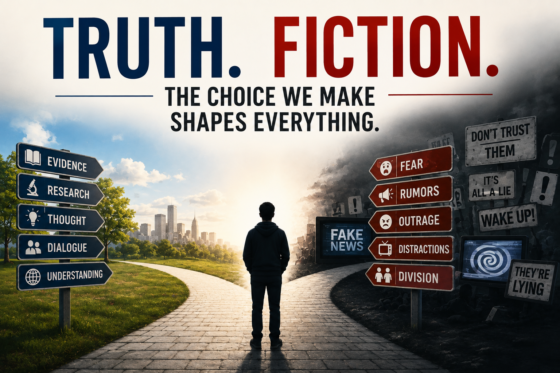
Listen to this essay here:
By Bear Howard and Associates,
Sedona, Az — One of the great misunderstandings of American life is the belief that everyone sees the same world and merely reaches different conclusions about it. In reality, people often begin with different versions of the world itself.
Each person is shaped by family, religion, neighborhood, income, education, occupation, race, geography, opportunity, disappointment, fear, and experience. A child raised in a financially secure household where books, travel, and discussion are ordinary learns a different relationship with the world than a child raised in a household where survival is uncertain, institutions are distrusted, and change usually means disruption. Neither child consciously chooses those early lessons. They absorb them before they are old enough to question them.
Economic circumstances matter because insecurity changes how people experience risk. Someone with savings, health insurance, and professional mobility may view social or economic change as an opportunity. Someone living one emergency away from financial collapse may view the same change as a threat. Political language about transformation, global competition, immigration or new technology lands differently depending on whether a person expects to benefit from the future or fears being discarded by it.
Upbringing matters just as much. Some families teach children that respectable people obey established authority. Others teach them that authority must continually justify itself. Some religious traditions encourage inquiry and reinterpretation. Others present truth as settled and doubt as moral weakness. Some communities expose children to many kinds of people. Others provide a tightly controlled social environment in which outsiders are discussed more often than encountered.
By adulthood, these experiences become what people call common sense. But common sense is often merely the accumulated assumptions of one’s surroundings.
As people become more intellectually engaged, whether through formal schooling, reading, travel, work, or exposure to different lives, they often discover that the world is less orderly than they were taught. History becomes more complicated. Science becomes less certain but more reliable. Human behavior becomes harder to categorize as either heroes or villains. Institutions reveal both achievements and failures.
This broader perspective often fosters greater openness to social change. It does not guarantee liberal politics, but statistically it often moves people toward positions described as progressive: greater tolerance of difference, stronger acceptance of scientific and medical expertise, more willingness to revise social traditions and more recognition that individual outcomes are affected by systems as well as personal choices.
That is not because educated people are automatically wiser or morally superior. Degrees can certify expertise, vanity or merely the ability to survive committee meetings. Nor does conservatism necessarily indicate ignorance. Thoughtful conservatism provides an essential warning that societies can destroy valuable institutions while pursuing improvement.
The deeper distinction is between two relationships with knowledge.
One sees truth as something inherited and defended.
The other sees truth as something investigated and revised.
That difference now runs through nearly every part of American public life.
Museums offer a visible example because they preserve the physical evidence of the national story. The Smithsonian is expected to celebrate American accomplishment while also explaining slavery, displacement, war, exclusion, industrial power, immigration, scientific achievement and the long struggle over who was permitted to participate fully in the country. Those histories do not fit comfortably into a simple tale of uninterrupted greatness.
The Trump administration has treated that complexity not merely as a scholarly disagreement but as an institutional problem requiring presidential intervention. In March 2025, President Trump issued an executive order accusing the Smithsonian of promoting a “divisive, race-centered ideology” and directing officials to remove what the administration considered improper ideology from museums, monuments, and historical sites. The order said federal museums should be “solemn and uplifting” and should emphasize American greatness rather than content that “inappropriately disparage[s]” Americans of the past.
That policy escalated on July 24, 2026, when the president issued another order declaring that Smithsonian leadership could not be trusted to tell American history with “honesty and gratitude.” It directed federal officials to use available funding, regulatory, and contractual powers to force changes and ordered the installation of government signs outside the National Museum of American History, warning visitors about what the administration called its ideological capture.
This is an extraordinary development. A presidential administration is no longer simply criticizing an exhibit or proposing additional historical material. It is using executive authority to place the government’s preferred interpretation outside a museum and to warn the public against the museum’s professional judgment.
The administration describes this as a restoration of truth. But the order reveals a different philosophy of history. It assumes that national institutions should strengthen gratitude, unity and pride. Those are understandable civic goals, but they are not the same as historical inquiry.
History does not exist to improve national morale. It exists to explain what happened.
Sometimes what happened is inspiring. Sometimes it is shameful. Frequently, it is both at once.
A museum that explains how Thomas Jefferson helped articulate principles of liberty while enslaving human beings is not necessarily attacking Jefferson or America. It presents the contradiction that defines both the man and the nation. Removing one side of that contradiction does not create neutrality. It creates comfort.
This struggle is not limited to museums. State legislatures have increasingly attempted to determine how teachers may discuss race, sexism, and disputed episodes of American history. Since 2021, dozens of states have considered measures restricting such teaching, and a number have enacted laws prohibiting various “divisive concepts,” limiting discussions that might cause discomfort or restricting material associated with critical race theory or the 1619 Project.
Supporters say these laws protect children from ideological indoctrination and racial guilt. That concern cannot simply be mocked away. Teachers, textbooks and school systems can present political opinions as settled fact, and parents have a legitimate interest in what children are taught.
But discomfort is not proof of indoctrination.
Teaching that slavery was central to the nation’s economy, that segregation was maintained by law or that government policies produced unequal effects does not assign personal guilt to a modern child. It explains how the country developed. A student may feel disturbed by that history because it is disturbing. Legislatures cannot make the past less painful by regulating the vocabulary used to describe it.
Something similar has happened with scientific and medical information. Early in the current Trump administration, federal agencies removed public health pages and datasets in response to directives on gender-related language and policy. Material taken offline included information about HIV, adolescent health risks, testing, clinical trials, and other subjects used by physicians and researchers. A federal judge ordered the CDC and FDA to restore specified pages, finding that the removals likely had not followed the reasoned decision-making required by law and noting that ordinary Americans, especially those in underserved communities, bore the harm.
That episode illustrates the difference between changing government policy and changing access to evidence.
An administration has the constitutional authority to establish policy within the law. It may alter programs, priorities, and terminology. But when scientific information becomes politically inconvenient, removing the information does not resolve the underlying reality. Viruses do not adopt party platforms. Pollution does not check whether a legislature recognizes it. Pregnancy, cancer, addiction, and infectious disease continue operating according to biology, with the usual lack of respect for campaign messaging.
This is where political conflict over facts becomes dangerous.
A democratic society normally debates what to do after examining the evidence. Increasingly, Americans argue about whether the evidence should be collected, published, taught or trusted at all.
Climate change provides another example. The scientific question of whether human activity is warming the planet is not an even contest between two equally supported theories. There remain legitimate debates about projections, economic consequences, and the best policy responses. But political resistance often treats the existence of uncertainty at the edges as proof that nothing is known at the center.
The same pattern appeared during the COVID-19 pandemic. Scientific guidance changed as researchers learned more about transmission, treatment, and vaccines. To people familiar with science, revision was expected. To those who believed expertise should produce immediate certainty, revision appeared to be evidence of incompetence or deception.
That misunderstanding proved politically useful. A changing recommendation could be presented as a lie rather than as a response to new evidence. Public officials discovered that distrust was easier to cultivate than scientific literacy, one of humanity’s less charming efficiencies.
The pattern has also entered elections.
A functioning democracy depends on citizens accepting that votes can be counted through imperfect but verifiable procedures. Yet after the 2020 presidential election, many Americans accepted claims of massive fraud despite the absence of evidence sufficient to overturn the result in court or through state certification processes. The rejection of the outcome did not arise from a better competing body of evidence. It arose because the result conflicted with a political and emotional commitment.
Once that way of thinking takes hold, evidence becomes conditional. Courts are trustworthy only when they rule correctly. Elections are legitimate only when the preferred candidate wins. Scientists are credible only when their findings support prior beliefs. Museums are educational only when their exhibitions produce pride. Journalists are honest only when their reporting confirms what the audience already suspects.
This is not skepticism. Skepticism asks for evidence.
It is motivated disbelief, in which the conclusion is protected by continually disqualifying every institution capable of challenging it.
Political leaders across the spectrum can manipulate facts. Progressive institutions can become insulated, self-righteous and too quick to dismiss dissent as ignorance or prejudice. Universities and cultural organizations can adopt fashionable theories before those theories have been adequately tested. Government experts can communicate poorly, overstate confidence or resist admitting error.
Those failures matter because expertise must earn trust. Credentials are not a substitute for transparency, and institutional prestige does not create immunity from criticism.
But criticism of expertise is different from replacing expertise with loyalty.
A museum curator should be challenged by other historians, artifacts, records, and competing scholarship. A physician should be challenged by clinical evidence. An economist should be challenged by data. An election administrator should be challenged through audits, recounts and courts.
When the challenge becomes “I dislike the conclusion, therefore the institution is corrupt,” society leaves the world of inquiry and enters the world of belief.
This is where socioeconomic experience becomes important again. People who feel ignored by government and cultural institutions have good reason to distrust them. Many working-class Americans have watched factories close, wages stagnate and communities decline while experts assured them that globalization or economic restructuring would produce broader prosperity. Professionals who benefited from those changes sometimes spoke as though those who lost jobs and identity merely failed to understand economics.
Resentment did not appear from nowhere.
When educated institutions speak with contempt toward people who lack credentials, they help create the revolt against expertise. People who feel humiliated do not usually become more receptive to instruction. They search for leaders who will humiliate the institutions in return.
Populist politics understands this. It tells citizens that their instincts are more trustworthy than experts, that complexity is a disguise for corruption, and that undesirable facts were invented by elites. This message is emotionally powerful because it transforms exclusion into superiority. The person who once felt left behind is told that the experts are not merely mistaken but fraudulent, and that rejecting them is evidence of courage.
Yet emotional satisfaction does not make the conclusion true.
An airplane does not remain in the sky because passengers distrust engineers. A bridge does not stand because legislators declare structural calculations elitist. Civilization depends on accumulated knowledge, specialization, and the willingness to accept that another person may know more about a particular subject.
The progressive temperament generally finds this easier to accept because it is more comfortable with complexity, social difference, and institutional revision. The conservative temperament often contributes caution, continuity, and awareness that rapid change can produce consequences reformers failed to anticipate.
Both are necessary.
But they are not equally useful in every circumstance.
Conservatism can wisely protect constitutional limits, local knowledge, and institutions built through experience. It becomes destructive when preservation requires denying observable reality. Progressivism can expand rights, improve knowledge, and correct injustice. It becomes destructive when moral certainty replaces evidence or when disagreement is treated as proof of wickedness.
The central question is therefore not whether the left or the right possesses all truth. Neither does. The question is whether a society maintains processes capable of discovering errors and correcting them.
Science does this through replication and peer review.
Courts do it through evidence and appeal.
Journalism does it through documentation and correction.
Museums do it through scholarship, preservation, and reinterpretation.
Elections do it through ballots, audits, and lawful challenges.
Democracy itself is a corrective mechanism. It assumes no leader, party or generation should be trusted permanently.
That is why current efforts to impose politically approved narratives on museums, schools and public information deserve more concern than ordinary partisan disagreement. The danger is not simply that one administration may present history too patriotically or another too critically. The danger is that the government begins deciding that facts are legitimate only when they serve the emotional needs of those in power.
America’s 250-year experiment has never been a spotless march toward liberty. It has been an argument over who receives liberty, whose experience counts, and whether the country’s principles apply when doing so is inconvenient.
The nation abolished slavery after preserving it for nearly a century. It ended legal segregation after generations defended it. It extended voting rights after repeatedly restricting them. It expanded women’s rights, labor protections, disability access, and civil equality by challenging what earlier generations called tradition.
None of those changes occurred because society already had the correct answer.
They occurred because evidence, experience, and moral understanding accumulated until the older answer became impossible to defend honestly.
That is the larger meaning of museums and universities, laboratories and libraries, courts and free journalism. They are not supposed to tell Americans what they wish to hear. They are supposed to preserve the evidence from which a free people may judge themselves.
A mature nation does not need its history cleaned up before showing it to the children.
It needs citizens capable of loving a country without pretending it has never failed, respecting knowledge without worshipping experts, and questioning authority without rejecting reality.
The future of a democratic society will depend less on whether Americans agree than on whether they retain a common method for determining what is true.
Without that, public discussion becomes performance, government becomes propaganda, and history becomes whatever the most powerful person orders the sign outside the museum to say.
7 Comments
1. You haven’t been to a Smithsonian exhibit in awhile.
2. We don’t have a Democracy, we have a Consitutional Republic. Democracies fail.
3. Your articles are way too long.
No Bill we do not have either a Democracy nor a Republic (both of which we did have when we were a Democracy). What we have now is a tyrannical fascist White Nationalist led government and country. Nothing to be proud of no matter how much White Nationalist Propaganda outlets tell you it is! We are the sad face of the America’s and laughed at by the rest of the free world and Trumps fellow fascist pals like Putin, Xi, Un etc.
I tried to keep this as short as possible since you apparently have an aversion to reading facts and truths.
What can you say-
Democracy Dies in the Darkness?
Those who cannot remember the past are condemned to repeat it?
Ignorance is ignorant bliss?
We forced Nazi Germany and Fascist Japan to recognize their horrible past histories while ignoring and whitewashing our own. Therein lies the problem with the Yes to Fascism Universal Dream we are currently led by and lied to by daily.
Of course those who deny our own dark history also deny the holocaust and think Hitler and Nixon were misunderstood greats despite their crimes against humanity. They like their convicted felon of choice, choose Putin over Democracy, Rascism and Sexism over human rights and common decency and they claim freedom of religion while only allowing Evangelism a place in public schools, sporting events etc. while exposing hatred and intolerance of people of other faiths.
They scream and pound their chests about a few thousand Americans killed and wounded by “terrorists” while committing genocidal military campaigns killing millions of innocent people.
The American Education system taught outright lies and untruths about US and World History for decades. When they finally begin telling the truth it is somehow a crime. Our self taught ignorance is laughed at by the rest of the semi civilized world. We call Socialist, Communist and Fascism is called Communism or Socialism simply because the criminal Fascist running the shows call themselves everything except what they are- Fascists.
It most be solidly confusing to today’s school aged youth to learn all about Democracy and Freedom and why so many Americans died fighting fascist during WWI and WWII only to learn we are now a fascist led country ourselves. How does this happen they must wonder with amazement.
The answer is blowing in the wind!
1. The Smithsonian? More like Big Brotheronian.
2. We have a Totalitarian government not a Democracy and not a Republic anymore. What we had was a recognized combination of Democracy and Republic all in one. That all died in 2015
3. How many words can your mind handle in a story? Goodnight Moon ok for you or too much?
A heroic effort to stem the tide of the post truth era. After all, as Orwell said, “The Party told you to reject the evidence of your eyes and ears. It was their final, most essential command.”
Thank you.
BG- 2+2=5 according to those currently in power.
Continued-
Republic’s don’t have self anointed kings or any kings at all!
According to a simpleton search on Google-
The United States is both. It is a constitutional federal republic and a representative democracy. The two terms are not opposites; they describe different parts of how the government works.Opinions on how to label the country often spark debate, as noted in discussions on platforms like Facebook where users express mixed views on whether the focus should be on its democratic or republican traits.Why It Is a DemocracyPower from the people: Citizens hold the political power.Voting: People choose their leaders by voting in free elections.Representative system: Voters pick officials to make laws for them instead of voting on every law directly.Why It Is a RepublicNo king: The country is public property, led by elected officials rather than a monarch.Rule of law: A supreme law—the Constitution—limits the power of the government.Protection of rights: Constitutional rules protect minority rights so that a majority vote cannot take away basic freedoms.
“Alternative Facts” are not facts. They’re just lies and bullshit designed to gaslight the truth. Nice try though.