

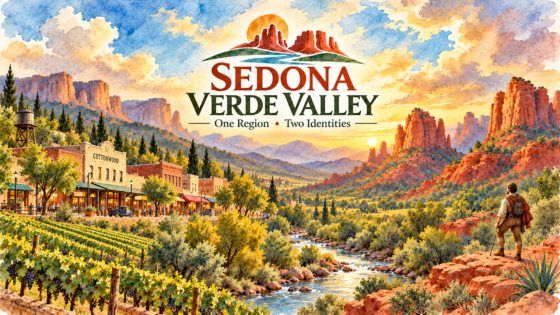
Pride of place gives Sedona and the Verde Valley their character. But protecting local identity should not keep the region from recognizing the long-term economic, tourism and cultural value of a shared Sedona Verde Valley brand.
By Bear Howard and Associates
Sedona, AZ –There is nothing wrong with pride of place. It is one of the strengths of this part of Arizona. People in Jerome want to be from Jerome. Cottonwood has developed a strong identity of its own. Clarkdale values its history. Camp Verde has roots reaching deep into Arizona’s territorial era. Cornville and Page Springs retain a rural character increasingly associated with vineyards and wine country.
And people who live among the red rocks – from Boynton Canyon through the City of Sedona, the Village of Oak Creek and into Oak Creek Canyon – overwhelmingly think of where they live as Sedona.
Those identities matter and should be preserved. The mistake would be allowing pride of place to prevent us from recognizing another reality: economically, culturally and increasingly as a visitor destination, these communities function as parts of one larger region. A regional identity does not require surrendering a local one.
That is the case for Sedona Verde Valley. It is not an attempt to rename Sedona or make Cottonwood, Jerome, Clarkdale or Camp Verde subdivisions of Sedona. Nor is it an attempt to force the red-rock communities to describe themselves simply as the Verde Valley. It recognizes something already here: two powerful identities occupying one increasingly interconnected region.
Two histories, two identities
The distinction begins with history. The communities traditionally associated with the Verde Valley grew largely from the forces that shaped Arizona in the late nineteenth and early twentieth centuries: mining, agriculture, ranching, military settlement, railroads and commerce. Camp Verde developed around the military presence of the 1860s. Jerome grew from copper. Clarkdale was created as a planned company town. Cottonwood evolved from farming, ranching and regional commerce. These communities had recognizable identities decades before modern Sedona emerged.
Sedona has older roots too, but most of what people recognize as modern Sedona came later. Roads improved. Hollywood discovered the red rocks. Tourism grew. Retirement communities, resorts, galleries, restaurants and visitor businesses followed. Outdoor recreation, wellness and spiritual tourism became part of the destination. Much of that growth occurred after World War II, and the City of Sedona itself did not incorporate until 1988.
So while the traditional Verde Valley grew principally from Arizona’s mining, agricultural and settlement era, modern Sedona grew largely from scenery, tourism, recreation, retirement, art and experience. Those different histories help explain why the people of the larger region do not always describe where they live in the same way.
Sedona is part of the Verde Valley – and also something distinct
Geographically, it is reasonable to include Sedona within the broader Verde Valley. Regional organizations often do exactly that. But geography is only part of identity. Names acquire meaning through history, culture and everyday use.
Someone in Cottonwood, Clarkdale, Jerome or Camp Verde can comfortably say they live in the Verde Valley. Someone living near Coffee Pot Rock, Boynton Canyon, the Village of Oak Creek or Oak Creek Canyon is much more likely to say Sedona. Neither is wrong. The larger region has developed two legitimate identities.
Verde Valley is the older regional identity. Sedona is the stronger destination identity. Neither name, by itself, fully describes the whole. That is why Sedona Verde Valley works as an umbrella: it connects the two without asking either to disappear.
Wine country makes the relationship obvious
The emergence of Arizona wine country makes the case especially clear. The federally recognized Verde Valley American Viticultural Area gives the Verde Valley name formal standing in the national wine industry, and much of the vineyard, winery and tasting-room economy is concentrated around Cottonwood, Clarkdale, Cornville and Page Springs.
At the same time, Sedona remains the region’s most internationally recognized visitor brand. That creates a complementary relationship rather than a competition. Sedona brings destination recognition. The Verde Valley brings wine country, history, agriculture and a different landscape and experience.
A visitor can wake up among Sedona’s red rocks, spend the afternoon in Page Springs vineyards, dine in Old Town Cottonwood, visit Jerome the next day, ride the Verde Canyon Railroad from Clarkdale and explore Camp Verde. From the visitor’s point of view, this is not a collection of unrelated places. It is one trip. Sedona Verde Valley gives that trip a name.
From a Sedona vacation to a regional experience
For decades the tourism proposition was simple: come to Sedona. That proposition worked extraordinarily well. The next evolution can be broader: experience the Sedona Verde Valley.
This does not weaken the Sedona brand; it extends its reach. Sedona can remain the doorway while the larger region becomes the destination. Instead of focusing only on attracting more people to already crowded places, the region can give existing visitors more reasons to stay longer, explore farther and spend across a wider area.
A two-night Sedona trip can become four or five nights built around red-rock scenery, wine, historic downtowns, archaeology, state parks, rail travel, river recreation, galleries, food, music, hiking, wellness and cultural experiences. That spreads economic benefit, gives smaller communities greater participation in tourism and reduces the pressure to place every new visitor experience inside Sedona itself.
The objective then changes from simply attracting more visitors to attracting visitors who stay longer, spend more, explore more and understand more of the place they have come to see. That is a stronger long-term tourism strategy.
The economy already ignores the boundaries
The regional economy is already behaving this way. People live in Cottonwood and work in Sedona. Sedona businesses employ workers from throughout the Verde Valley. Restaurants serve Verde Valley wines. Visitors staying in Sedona eat in Cottonwood, shop in Jerome and travel through Clarkdale and Camp Verde. Housing costs in one community affect employers in another.
Transportation, healthcare, education, recreation, workforce development and retail increasingly cross municipal lines. The political boundaries remain important, but the economic boundaries are becoming less distinct.
The same is true of many public issues. Wildfire does not stop at a city limit. Neither does water, traffic, housing pressure, tourism or workforce scarcity. Sedona Verde Valley does not require a new government. It requires stronger regional thinking among the governments and communities that already exist.
Pride of place should not become a wall
Every community in this region has reasons to be proud of itself. People should defend the character of Jerome, care deeply about Cottonwood, celebrate Clarkdale, protect what is distinctive about Camp Verde and proudly say they live in Sedona.
But pride of place should not become provincialism – the belief that acknowledging a larger regional identity somehow diminishes the local one. The strongest regions understand that both identities can exist at the same time.
A person can be proud to live in Jerome and also say they live in the Sedona Verde Valley. A Cottonwood business can retain its local identity while benefiting from a regional visitor brand. A winery can proudly carry the Verde Valley AVA designation while benefiting from proximity to Sedona. A Sedona resort can promote Verde Valley wine country without weakening the Sedona name.
The choice, therefore, is not whether Sedona should become part of the Verde Valley or whether the Verde Valley should place itself beneath Sedona. That is the wrong argument. The opportunity is to recognize the value of both names and use them together.
The larger region does not need to be invented. It is already visible in where people work, where visitors travel, how the wine industry has developed, how housing and transportation interact, and how businesses depend upon customers and employees from neighboring communities. What has been missing is simply a name broad enough to describe it.
Sedona is Sedona. The Verde Valley is the Verde Valley. Neither needs to surrender its identity. Together, however, they have the opportunity to become something larger and more valuable: the Sedona Verde Valley.






3 Comments
Funny how people cling to a town most of them are not even from originally? I get the Jerome, Clarkdale and Camp Verde loud and proud as they are all small communities with limited housing and businesses. Sedona and Cottonwood have practically morphed into one between their ever expanding communities, business exchanges and duality of shops like Sedonuts or Top of the Hill Deli. Each has it’s own historic district, tourist shops and variety of ethnic and fast food restaurants. Cottonwood’s restaurants in my opinion provide more variety and value for family style meals. Each has their high end/upscale restaurants and are nearly all owned by the same person/persons. I’m a big fan of Maynard Keenan’s attempts to build community while providing a lot of local employment and teaching others about what he does, how and why. He’s a benefactor of the Verde Valley and River in that he has vineyards (which also employ many locals) and Farm to Table produce served in his restaurants that all depend upon the water from the river, the volcanic soil and great growing climate. I find his prices reasonable for what you get. I’ve seen more and more locals having brunch in his Queen B Vinyl Cafe. Just saying, that I applaud this type of philanthropy vs monopolistic empires who do what they do for the $ rather than their customers and community.
Yeah, Jill. I regularly hear from people who want to preserve a Sedona that has not existed in decades. Many have lived here for 2 or 3 years, tops. I get it when long-term residents pine for the ways of old, but things always change. That’s the way of the world. I do get particularly annoyed with newcomers who don’t do their homework before moving here and then getting outraged that Sedona no longer looks like those old black-and-white postcards.
I’ve never eaten at Keenan’s restaurants but do like what he does for his community. Sedona has a number of people like that, too, although they’re generally not as high-profile as Keenan.
Derek you’re dead on with your analogies. However, it is more common that I hear the small (very very small) handful of Sedona lifers complaining about how and why Sedona isn’t a horse and buggy Wild West show town more than anyone new here complaining about it. No place I have ever lived looks the same as when I lived there. As you said that is just part of life. As for Keenan, I’m sure there are a few small scale entrepreneurs in Sedona who do things to help their community on a daily basis. The large monopoly restaurateurs here are not anything like Keenan is. They only do things for tax breaks, ego and popularity with occasional extremely rare acts of kindness for a price. That’s my observation and experience of the present situation with Sedona. Traffic, parking, price, attitude and less populated restaurants make a drive down to Cottonwood for a nice evening meal worth the extra time and drive worthwhile. If you prefer traffic, limited parking, outrageous prices, snobby attitudes and crowded spaces then by all means stay right here for your dining experience.