

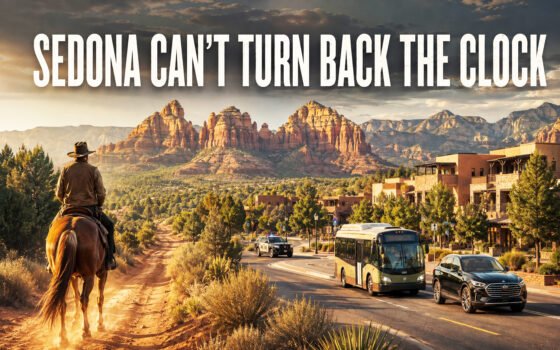
The red rocks may be timeless, but the community is not. Sedona’s future must be governed by what it has become—not by nostalgia for what it once was.
By Bear Howard and Associates,
Sedona looks permanent. The red rocks appear eternal, its neighborhoods are tucked into the landscape, and the community carries the relaxed look of a Midwestern town that has sat undisturbed for 200 years. But modern Sedona is remarkably young.
In 1955, 155 phone numbers were in the phonebook; about 200 to 300 families, fewer than 500-800 people, lived here. Early Sedona was not an affluent resort community. It was rural, remote, difficult to reach, and a hard place to make a living.
People worked with their hands and backs. Electricity, dependable wells, improved roads, and reliable public services arrived gradually. For much of the outside world, Sedona was more legend than destination.
Then access improved. Photographs in publications such as Arizona Highways introduced the red rocks to the world. Cowboy movies brought Hollywood. Tourism expanded, entrepreneurs opened businesses, and retirees began arriving. Most were middle-class people, not wealthy aristocrats descending from private jets. Housing remained relatively inexpensive, building standards evolved slowly, and Sedona retained more than a little of the Wild West—just with prettier rocks.
That history exposes the 800-pound gorilla in the room: gentrification. Sedona has been reinventing itself for decades. Each generation of arrivals helped change the place and then became tempted to treat the Sedona they discovered as the authentic version that should be preserved forever.
Today, Sedona has fewer than 10,000 residents within approximately 20 square miles, nearly half of which is National Forest. Most of the remaining developable land has already been built upon. Sedona is not an endlessly expandable rural town. It is a nearly built-out international resort destination attracting millions of visitors annually.
Eventually, Sedona’s physical development will involve rebuilding older areas, where the land underneath the building is worth more than the building itself. It’ll be Sedona’s own version of urban renewal. The property referred to as the Dell’s will factor in at some point for development, probably with a residential component, because we need buildable real estate for residential use. Expansion into adjacent forest land seems unlikely for the foreseeable future.
And with the high cost of building and resale housing being increasingly out of reach for middle- to maybe even upper-middle-class retirees, Sedona will continue to become more gentrified, with higher-income, substantially well-funded retirees and business entrepreneurs taking advantage of the Tourism economy. Sedona will probably evolve into the Beverly Hills of northern Arizona. And most of the workers who support this population will live elsewhere.
But in real time, Sedona must live with the reality of who it is and what it is, functioning as a “successful” community committed to a future the majority can embrace. That will not be easy.
We must accept that Sedona is a city—not merely a small community or quiet Western town. It has a budget nearing $100 million, public transportation, a wastewater treatment plant, a professional police department, and more than 150 city employees. It faces traffic, housing, tourism, infrastructure, environmental, and public-safety demands normally associated with much larger municipalities.
Yet Sedona’s political leadership is frequently temporary. A relative newcomer, who has called Sedona home for just a few years, may run for City Council and quickly become one of seven officials with the authority to hire or fire the city manager, redirect public policy, and reverse years of planning. Over the past few decades, most new candidates have been new residents.
New residents bring energy and useful experience. The danger arises when enthusiasm is mistaken for institutional knowledge. Someone who has lived here for two or three years may understand what irritates them today without knowing why earlier councils made certain decisions, which alternatives already failed, or how many battles produced the services Sedona now takes for granted.
Our elected officials must plan for the Sedona that exists—not govern according to an idealized version of its past. When reality and expectations do not align, dissatisfaction becomes political conflict. Hence contentious elections like the one we just had.
Sedona can preserve its natural beauty and distinctive character, but it cannot remain frozen in time. Residents who demand that government recreate the Sedona they imagined may eventually have to decide whether present-day Sedona is still right for them. Everyone has choices. Turning back the clock is not one of them.
5 Comments
Bear your words are on the mark. Anyone who has lived anyplace for any length of time and then returned there years later are generally shocked by how much things have changed since they lived there. If a city/town doesn’t stay current, which requires constant change it dies. Especially a small city/town.
Unfortunately, this article only says “it’s bad as it is” and doesn’t present any ideas about what direction Sedona could or should move in. Additionally, the author remains anonymous, as usual. This publication could have started something valuable for Sedona for once.
T. Wirth, the opinion piece says it was written by By Bear Howard and Associates and is not anonymous as you claim. It is a good for thought piece not a “here’s what I would do or wouldn’t” piece. You didn’t have any suggestions of your own to add and just criticize to criticize which is quite hypocritical of you. Try again, this time show us how it should’ve been done rather than complaining about how it was done.
That would help this App be more valuable than it already is. Thanks
Jill Dougherty, you are a real person who can be found in Sedona. The same is true for other authors on this website. However, a search for “Bear Howard and Associates” yields no results other than a few links to articles here, and “Bear Howard” is a historical figure who has long since passed away.
Perhaps you know who is behind “Bear Howard and Associates” (maybe it’s even you yourself); I – who have lived in Sedona for 17 years – do not know. That is why I have said, and will say again: The author of this article remains anonymous.
Sedona operates under a Council-Manager form of government. The overall “government” consists of the elected City Council, a professionally trained City Manager whom the council hires to run day-to-day operations, and various municipal departments (like police, public works, and parks).
I have in general no problems with this form of government – but the anonymous Bear Howard and Associates apparently has. It would be interesting if someone – why not the anonymous Bear Howard and Associates? – would come up with a different idea how to govern Sedona. That could be “good for thought.”
To call me quite hypocritical is quite stupid. I just said that the article UNFORTUNATELY (that word is important here) would not say anything about the direction Sedona could or should go in the opinion of the anonymous Bear Howard and Associates. That’s “how it should’ve been done,” and that could give this website value.
Who is Tom W.????? Can’t find you on local search???? I stand by my words-“hypocritical”! Who cares who is who? Why not focus on the message?