

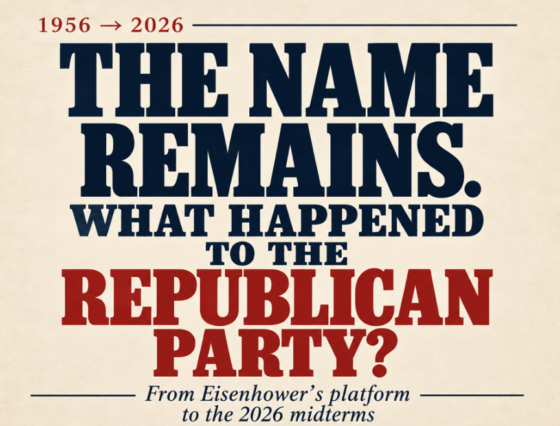
From Eisenhower’s 1956 platform to the 2026 midterms
By Bear Howard and Associates
Imagine handing a voter a political platform that supports expanding Social Security, extending minimum-wage protections, improving unemployment insurance, welcoming refugees, and protecting workers’ rights to organize and bargain collectively.
Then tell that voter it is the Republican platform.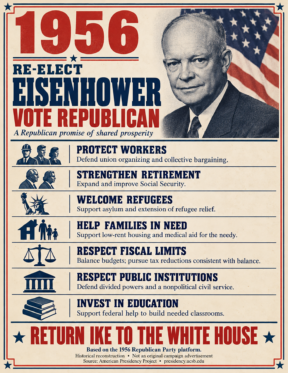
It was. In 1956, Republicans made those commitments while asking Americans to reelect Dwight D. Eisenhower. They also supported private enterprise, balanced budgets, and lower taxes. Their platform treated economic security and fiscal responsibility as compatible obligations.
Seventy years later, as Americans approach the November 2026 midterms, that document provides an unusually revealing test. Today’s Republican leadership need not be measured exclusively against Democratic priorities. It can be measured against its own party’s declared principles.
The distance is considerable.
Start with workers. The 1956 platform explicitly supported union organizing and collective bargaining. In March 2025, President Donald Trump issued an executive order excluding an extensive list of federal agencies and subdivisions from statutory collective-bargaining protections, invoking national security. The list reached beyond defense and intelligence to agencies including the Environmental Protection Agency and National Science Foundation.
Federal employment is a distinct legal setting, but the governing choice remains revealing: an administration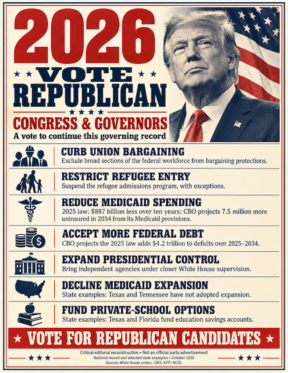 claiming to champion working people used presidential power to diminish its own employees’ bargaining rights. The practical test of support for workers is whether they retain power when their interests conflict with those of management—including management in the White House.
Consider refugees. Eisenhower’s platform celebrated providing asylum and supported extending the Refugee Relief Act. Trump began his second term by suspending refugee entry through the U.S. Refugee Admissions Program, subject to exceptions.
Both administrations could invoke national interest. Their starting assumptions nevertheless point in opposite directions: offering refuge as a national responsibility, or suspending admission as a protective measure. That difference concerns the kind of country America intends to be.
The contrast becomes equally concrete in the federal budget.
In 1956, Republicans pledged further Social Security expansion and emphasized assistance for medical care of the needy. Medicaid did not yet exist, so the comparison is about governing priorities rather than identical programs.
The Republican reconciliation law enacted in July 2025 moved in a different direction. The Congressional Budget Office estimated that its Medicaid chapter would reduce federal spending by approximately $887 billion over ten years and increase the uninsured population by 7.5 million in 2034. Those are projections, not people already stripped of coverage—but they describe the anticipated consequences of legislation Republicans chose to enact.
Nor can the entire package be defended as a straightforward return to fiscal discipline. CBO’s February 2026 outlook estimated that the law would increase cumulative deficits by approximately $4.2 trillion over 2025–2034, including interest and macroeconomic effects, relative to its January 2025 baseline. Reducing health coverage while adding substantially to projected borrowing is a choice about priorities.
Accuracy strengthens this argument. The 2024 Republican platform expressly promised to protect Social Security and Medicare without benefit cuts or an increase in the retirement age. It would therefore be wrong to claim that the party formally campaigns to abolish either program. The more persuasive criticism compares its promises with its actual choices across the broader safety net.
The deepest break, however, concerns power.
The 1956 platform defended divided governmental authority and a nonpolitical career civil service. (presidency.ucsb.edu) Trump’s February 2025 order on agency accountability sought greater presidential control over independent regulatory agencies and made the president’s and attorney general’s legal interpretations controlling within the executive branch. The order did not eliminate judicial review, but it plainly asserted a more centralized model of presidential supervision.
Conservatives can debate the proper boundaries of executive authority. They cannot reasonably treat every expansion of that authority as harmless merely because their own president exercises it. A principle that restrains only the opposing party is a partisan convenience.
Trump’s January 6 clemency proclamation presents an even starker test. On returning to office, he commuted fourteen named defendants’ sentences, pardoned all other people convicted of offenses related to the Capitol events, and directed the Justice Department to seek dismissal of pending cases. His proclamation characterized the prosecutions as a national injustice.
The presidential pardon power is constitutional. The political judgment it expresses is still subject to scrutiny. Sweeping relief for people prosecuted over an assault on the electoral transfer of power sends a message about whose conduct deserves accountability—and whose deserves forgiveness.
These choices belong to a president, but the midterms make them a party question. Congressional candidates cannot claim the inheritance of constitutional restraint while treating oversight of their own administration as disloyalty. Congress exists to exercise independent judgment, including when doing so inconveniences a president of the same party.
The claim that the old Republican Party has disappeared therefore needs a precise meaning. Its voters have not vanished. Its organization remains. Individual Republicans may still practice the principles their party once advertised.
But an institution’s identity cannot rest indefinitely on commitments it no longer honors.
A party that weakens worker protections, narrows humanitarian commitments, accepts enormous additional borrowing, and concentrates authority around its president has changed more than its campaign language. It has changed what it is willing to defend.
In November 2026, voters are entitled to judge that transformation. They owe no permanent allegiance to a name.
If Republicans continue to excuse these choices while invoking Eisenhower’s legacy, the historical objection is straightforward: they are claiming an inheritance while abandoning its obligations.
The elephant remains. The governing principles are what must be accounted for.