
An electoral rebuke of Trump offers renewed hope abroad—but rebuilding trust will take more than one election.
By Bear Howard and Associates
EARTH, November 8, 2026. The news traveled faster than the reassurance.
Democrats had won control of Congress. Donald Trump’s party had suffered a punishing defeat. Across international headlines, America appeared capable of changing direction. Becoming dependable would take longer.
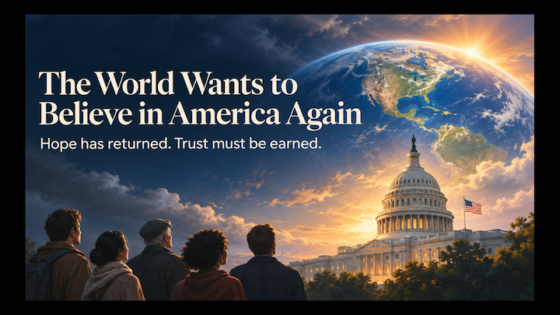
For people beyond America’s borders who welcomed the result, the election offered something precious: a reason to hope that Washington might become a little less alarming.
Their reactions had a human warmth missing from the diplomatic statements. London reader Jayjay Epega expressed joy; Canadian reader David Roy hoped for a more constructive relationship. These individual responses, published by the Guardian, cannot speak for entire countries. But they reveal something worth hearing beneath the election-night arithmetic.
People outside America have a considerable stake in American decisions. Washington’s choices reach into their businesses, household budgets, security, and plans for their children. They cannot cast an American ballot, but they can find themselves paying part of the bill.
The world gets no electoral votes. It gets consequences.
Official responses were usually more restrained. China emphasized cooperation. Japan reaffirmed the importance of its alliance with the United States. Some European leaders were openly welcoming: Spain’s Pedro Sánchez celebrated the rebuke, while Norway’s prime minister saw prospects for greater agreement on international issues.
Others had good reason to choose their words carefully. They still have to negotiate with the president who remains in office. Diplomacy rarely improves when the opening remark is, “We certainly enjoyed watching you lose.”
Ordinary people have more freedom to express relief. They also have reasons to hesitate.
Associated Press interviews captured both feelings. Joe Reeve, a London startup founder, initially welcomed the result but remained troubled by America’s political reversals. In South Korea, office worker Kim So-jung wanted evidence of changed behavior before restoring confidence. Indonesian business development manager Aditya Surya likewise looked for consistent respect for institutions and international partners.
Their hesitation does not invalidate their hope. It explains how much has to happen before hope becomes trust.
How confidently can anyone plan around American commitments if those commitments might be discarded after the next election? A handshake becomes less reassuring when everyone must calculate its expiration date.
This is the deeper problem behind the headlines. America’s credibility depends on whether other people can reasonably rely on its conduct. An ally considering its defenses, a company contemplating expansion, and a family trying to build a secure future all need some measure of predictability.
In Nigeria’s ThisDay, columnist Waziri Adio connected relief over the election to hopes for easing energy and living costs. He also cautioned that expectations of a beneficial policy shift could prove mistaken. His perspective placed American power where people often experience it most directly: in the cost of getting through the day.
That gives the United States an opportunity larger than either party’s victory speech.
America could help reduce uncertainty through patient diplomacy, reliable commitments, and serious attention to the human consequences of its economic decisions. It could use its influence to help people recover from disruption and plan beyond the next crisis.
That requires accepting responsibility for the effects of American power, including effects Americans do not immediately see.
Democrats will share responsibility for what follows. Their incoming congressional majorities will have tools for oversight, spending decisions, and negotiation. They will not control every presidential action or command the world economy. Their challenge is to use the authority they do have with discipline and practical purpose.
A press conference announcing that decency has returned will not be sufficient. The world has heard speeches before. Some of them came with excellent lighting.
The hopeful reading of this election is that Americans have opened a path toward more responsible leadership. The caution expressed abroad asks whether the country will stay on it.
America cannot heal every wound or settle every conflict. It can become a more reliable partner in the work. That would improve lives far beyond its borders—and strengthen its own future.
For those who welcomed the result, there is room to smile. There is reason to hope.
Trust will return when America gives them reasons to keep doing both.