

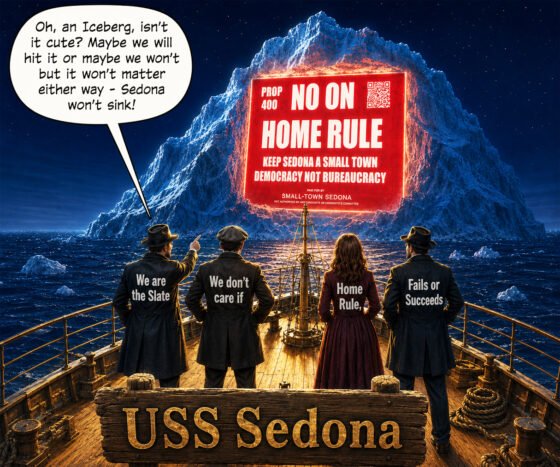
Four candidates say Home Rule may pass or fail. Their “whatever happens, happens” approach could put city services, local nonprofits, and Sedona’s ability to govern itself at risk.
Opinion by Bear Howard
Sedona, AZ — For nearly four decades, Sedona has operated under a simple reality: the city is largely funded by visitors, not residents.
Every year, millions of dollars flow into Sedona through sales taxes and bed tax paid by tourists, restaurant patrons, shoppers, and overnight guests. Those dollars support police protection, parks, road maintenance, transit services, tourism management, community programs, and dozens of quality-of-life improvements that residents enjoy every day.
The system is not perfect. No government ever is.
But it has worked.
Sedona has no city property tax. It maintains substantial financial reserves. It provides a level of service that many communities of our size can only dream about. Most importantly, it allows local elected officials to make decisions based on local needs rather than being constrained by a spending formula created by the State of Arizona nearly fifty years ago.
That is what Home Rule protects.
Yet a small but vocal group of residents seems willing to use Home Rule as a weapon.
Their argument is not really about fiscal responsibility. Residents contribute relatively little to city revenues compared with the enormous contribution made by visitors. Most residents pay only the city’s 3.5 percent sales tax on purchases made within Sedona. Nevertheless, some advocate withholding Home Rule as a way to punish the city for decisions they personally dislike.
That is not budgeting.
That is not governance.
That is political retaliation.
Underlying much of this movement is a growing belief that representative government itself cannot be trusted. Every issue becomes a referendum. Every disagreement becomes a demand for direct voter control. Every elected official becomes a suspect. The result is a form of government paralysis where long-term planning is replaced by constant political combat.
Sedona was never designed to operate that way.
We elect council members and a mayor to study issues, make difficult decisions, balance competing interests, and govern on behalf of the community. That is representative democracy. It is how cities function.
Voting “No” on Home Rule will not fix disagreements about housing, tourism, traffic, development, or any other issue. It will simply reduce the city’s ability to respond to those challenges.
This election presents voters with a remarkably clear choice.
Seven candidates are seeking seats on the Sedona City Council dais—one for Mayor and six for Council.
Three candidates have publicly and unequivocally stated their support for Home Rule in this election. They have also expressed support for pursuing a long-term solution that would eliminate the need for Sedona voters to revisit Home Rule every four years: a Permanent Base Adjustment, or PBA, which could be placed before voters in 2028.
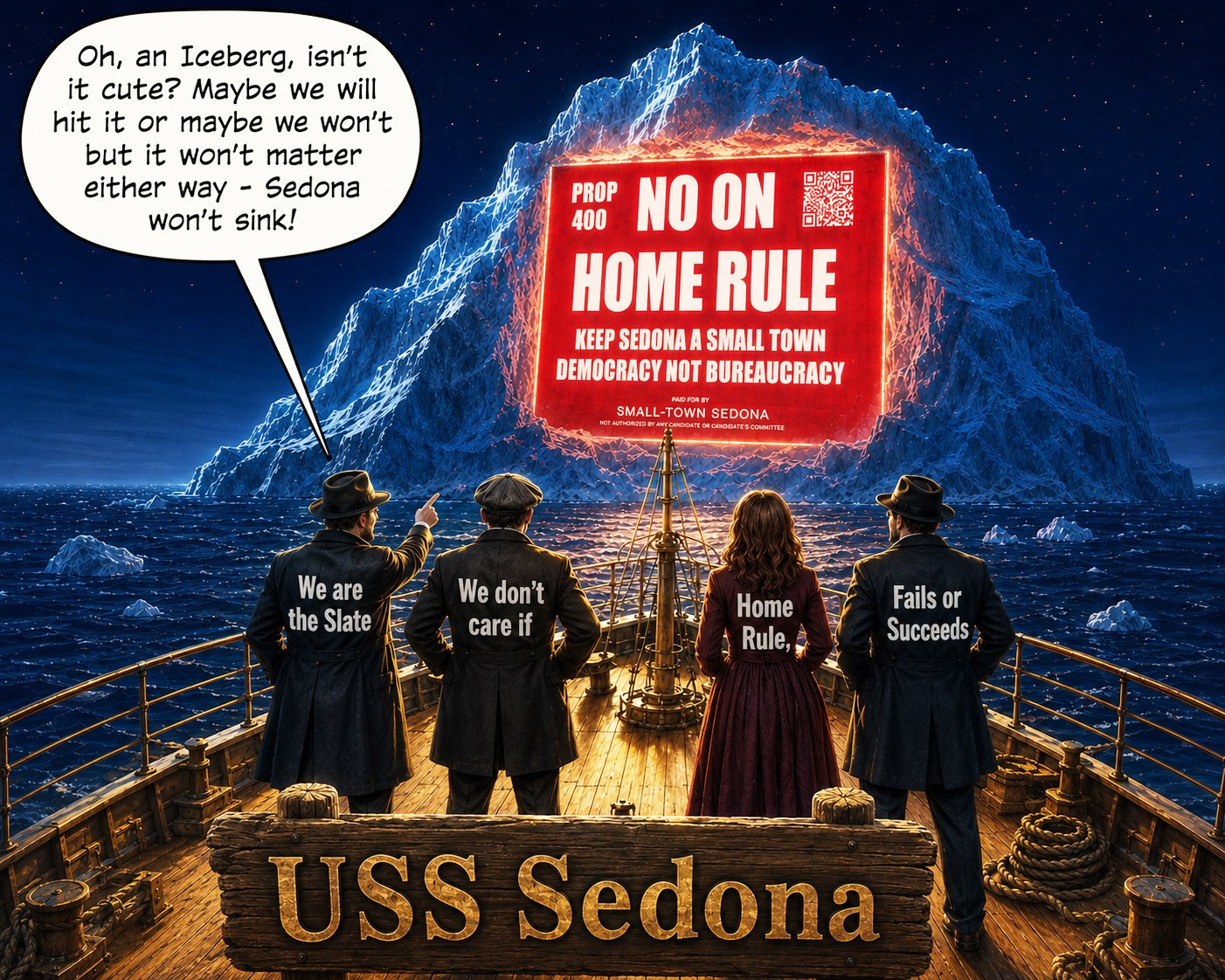
The remaining four candidates—one running for Mayor and three running for City Council and running as a “slate”—have chosen a different position. Rather than publicly supporting Home Rule, they have repeatedly stated that they will simply “accept the will of the people” whether Home Rule succeeds or fails. At first glance, that may sound reasonable.
But leadership is not merely accepting outcomes after they occur. Leadership requires evaluating consequences before they occur and helping voters understand what is at stake.
If a candidate cannot determine whether preserving the city’s ability to fund police, parks, road maintenance, nonprofit partnerships, and essential municipal services is in Sedona’s best interest, voters are entitled to ask a simple question:
What exactly are they prepared to lead?
Public office requires judgment. Home Rule is not a theoretical issue. It is the financial foundation upon which modern Sedona operates. Candidates who decline to take a position on such a fundamental question raise legitimate concerns about their readiness to govern.
The iceberg ahead is not government spending.
The iceberg is the belief that weakening the city’s ability to govern will somehow make Sedona stronger.
It won’t.
It is unnecessary because Sedona already has the revenue it needs.
It is foolish because it creates risks without solving problems.
It is selfish because it prioritizes political grievances over community needs.
And it is radically unwise because it gambles with a system that has helped make Sedona one of the most successful small cities in Arizona. The USS Sedona does not need to hit the iceberg to prove it exists.
The smarter course is simply to steer around it.
Vote Yes on Home Rule. Support the three candidates who support the Home Rule, Proposition 400: Melissa Dunn, Brian Fultz, and Tony Hauserman.
Then, after the election, let’s work together to pursue a Permanent Base Adjustment in 2028 and make this year’s Home Rule election the last one Sedona ever needs to hold.
16 Comments
It is really unfortunate that Sedona.Biz continues to print these biased ultra liberal opeds by Bear Howard!!!
The pages of Sedona.biz are open to anyone of any political persuasion. I can only publish what I receive: left, right, middle or from outer space. Everyone gets a space in this news and community forum.
You don’t need to publish this, but… I’ve submitted twice for a Letter to Editor. No response. And I mean it when I say: that’s perfectly fine. It’s your site, but let’s keep it real.
Try sending the letter to the editor to tommythereporter@gmail.com
They just want to drain a non existent swamp, just like their fearful orange leader did then stocked it with swamp monsters and self enrichment profiteers. Their only plan is to break what has been working for the majority while their minority will reap the profits by way of construction contracts with the city they will profit from rather than have to pay to use like everyone else. We’ve all witnessed the disastrous implementation of “chainsaw” nonsense when our Federal Government employed trillionaire white Nationalist Afrikaner Elon Musk Inc. We (who have eyes, ears, brains and hearts have witnessed the disastrous ICE crackdowns and murders by their hand, the failed illegal tariffs, the very failed illegal war on Iran and the massive Epstein coverup and other crimes like illegal Bitcoin investing and investors, make deals with foreign governments to build privately owned resorts in their countries by a criminal POTUS who was supposed to put his private businesses and money making ventures on hold and in a trust until leaving office like every other POTUS has for decades. The crimes are too many to list them all. They are up there with the daily lies coming from the same administration.
Do we really want that kind of nonsense going on here as well? Because that is precisely what will happen if the wrong people (the wrecking balls) make it into city government.
You’re just lying. Plain and simple.
And let’s hear you, just once, call out the people who tried to stop a perfectly legal, perfectly normal, 100% democratic process to get signatures for a ballot initiative sponsored by citizens of this community. A city worker got fired because of that. One of the current candidates for Mayor lambasted residents who didn’t support the car park for “sheer ignorance” because of that, losing a lot of trust in the community (any apology on that btw?). And it certainly appears that specific folks in town have special, elevated access to the Council and Staff. Are you going to call that out as inappropriate?
Nope. Instead, you’re going to lecture us about morals and democratic norms? It is unearned.
As I’ve posted previously, voting no on Home Rule isn’t about grievance whatsoever. It is an opportunity to improve how we scope and prioritize objectives together as a community. My guess is that’s what you actually hate.
Letting Home Rule lapse for one cycle forces the City to come back to voters for overrides or a Permanent Base Adjustment. That means they have to justify priorities instead of assuming automatic approval.
This isn’t about punishing the City. It’s about recalibrating the relationship between the City and the people who live here. A one year reset forces transparency, forces prioritization, and forces the City to seek voter approval for big-ticket items. That’s healthy. And a more meaningful democracy.
And if the City’s priorities are truly aligned with residents, overrides will pass easily. If they’re not, then it’s good we have a conversation.
The fact that such a LARGE group of residents feels the need to keep supporting ballot initiatives should tell you that something is off with this city government. It’s exceptionally dim to blame it on a process.
I want to know who it is HardPass thinks to be a liar and for him to present legitimate (not propagandist) evidence that what was said are lies. He wants to post an editorial (I can’t wait for it) while being one of the biggest trolls on here. Calling someone a liar just because you dislike what they have to say doesn’t mean they have lied, just means you dislike what they have to say. If you call someone a liar then provide legitimate proof that they have lied that’s another case all together. For example Donald Trump is a serial liar. Here’s the proof-
https://www.washingtonpost.com/politics/2021/01/24/trumps-false-or-misleading-claims-total-30573-over-four-years/
https://en.wikipedia.org/wiki/False_or_misleading_statements_by_Donald_Trump
I don’t say he’s a serial liar without the facts to back it.
So enlighten us all as to who said what that was a lie(s). And back it with some facts from a legitimate accredited news source. No propaganda channels or Faux News channels please. Thanks for playing!
Bear Howard appears to claim that people like me are voting against home rule as a “weapon” to “punish the city” out of “grievance.” As I explained above, those aren’t my intentions and, incidentally, I’m perfectly happy. He’s just lying to you and continues his unfortunate tribal nonsense. And clearly his math is a little fuzzy, as Mark TB explains below. Btw, I’ve voted for Home Rule in the past. Always. I’m voting against it this time because I think it will give us the best opportunity to improve trust in City government and have better outcomes, better decision-making.
Trust is different from honesty, but let’s inspect Bear’s ideas about leadership and care for Sedona residents.
For all the TDS around here, I find it incredibly ironic that you folks seem not to care whatsoever about the attempt to subvert our democracy here in Sedona. Some powerful people apparently planned to stop citizens from collecting signatures for a ballot initiative. If you can be impartial, think about that. Is that appropriate behavior? Whatever your thoughts about the car park, to me, this was perhaps the slimiest thing I’ve seen around here. One city staffer was fired for it. That really happened. It was real. And people like Bear Howard endorse the enablers while pretending to be a moral authority and lecture us about democratic norms. The cowardice disgusts me.
Several members of Council knew it was happening and did absolutely nothing, not until a FIOA exposed the behavior. To me, that’s not leadership. I think we should have higher standards. I mean, these folks are too afraid to even talk about it now. Never even an apology. Never a note that they learned something and plan to be better.
It’s so funny to see dudes like Pfaff flex on here (dif thread) while hiding from any commentary on this matter. More importantly, Fultz and Dunn won’t address it either. What does that tell you about their character? Seriously.
So yeah, I question their judgment, ability to lead, and pull a community together. I just see a lot of cowardice and am looking forward to voting for change.
Maybe that’s trolling, or maybe that’s just having values that say you shouldn’t try to undermine our democracy here in Sedona.
Voting NO on Home Rule will not ensure accountability anymore than voting YES for it will. The point of Home Rule is to ensure that crucial non profits can receive the necessary funding they need to survive. Without it they will wither and die. If you think anyone who hears the cries to abolish Home Rule and to purge the “broken” city government (which it is not) think for a second that you and your candidates of choice will do anything but break things that have and do work, you’re sadly badly mistaken.
Pfaff isn’t hiding from anything. I have a full-time law practice, plus my council duties, plus addressing anti-Home Rule arguments on other platforms. I have neither the time nor the interest to jump in whenever someone starts another round of performative outrage in a comment thread on Sedona.biz.
You seem so small when you act like this.
It’s such a low bar to expect leaders to call out bad behavior in real time. It’s even lower to expect them to call it out after-the-fact.
People who post under pseudonyms shouldn’t accuse others of hiding or being “small.”
To continue the myth that residents only pay 3.5% sales tax to support city operations is disingenuous. While sales and bed taxes are a significant revenue source for the city, other sources like State revenue sharing are based on the number of residents, not visitors. Using that approach, residents contribute 34% and visitors 66% of City revenue. In addition residents pay the higher cost of all items purchased locally. In addition all revenue becomes public money that needs to benefit residents and not be focused on business desires.
So let’s pay 100%+ in regular monthly property taxes rather than 34% in occasional bed taxes. Makes perfect sense, to the slow minded people of our town. I’d much rather pay the occasional bed tax that not every local in Sedona does or can charge like Safeway, Whole Foods, Basha’s, CVS, Walgreens etc. Shop or eat in a tourist oriented business and you pay the tax. It’s how Sedona functions and without it, it will not.
Out of state sellers, if they do more then $100k in the state are required to collect, state, county, and city TPT taxes. Marketplace Sellers (think Amazon.com) collect the TPT tax from all sellers on it’s platform (that ship to AZ residents). Other Remote Sellers are supposed to collect and remit TPT taxes, but some do not. So residents are feeling that 3.5% tax bite (9.85% total, including county TPT) on more than local purchases.
https://azdor.gov/business/transaction-privilege-tax/retail-sales-subject-tpt/out-of-state-sellers
https://www.amazon.com/gp/help/customer/display.html?nodeId=202211260
https://azdor.gov/business/transaction-privilege-tax-tpt/retail-sales-subject-tpt/out-state-sellers/frequently-asked-questions
“South Dakota v. Wayfair is a 2018 U.S. Supreme Court ruling that allows states to require out-of-state businesses without a physical presence to collect and remit tax on sales from transactions in their state based on certain economic and transactional thresholds….On May 31, 2019, Arizona Governor Doug Ducey signed H.B. 2757 into law. This legislation requires retailers that are remote sellers and marketplace facilitators with no physical presence in Arizona but make sales into Arizona over certain threshold amounts to begin filing and paying transaction privilege tax (TPT) in Arizona starting with taxable periods from and after October 1, 2019.”
Yes- Both county and city TPT must be collected. You can look up the rates here:
https://www.aztaxes.gov/Home/TaxRateDetails?X=-111.786257779126&Y=34.857550251697
For my house address in Sedona, it gives this for Marketplace Sellers:
“The Suggested Business Codes and Tax Rate(s) for Marketplace Facilitator (Out-of-State ) at this location:
SE – SEDONA: 605 – MARKETPLACE FACILITATED OR REMOTE RETAIL SALES: 3.5 %
YAV – YAVAPAI (YAV): 605 – MARKETPLACE FACILITATED OR REMOTE RETAIL SALES: 6.35 %
Tax Rates are effective as of Monday, June 29, 2026”
Let’s clarify what TDS or Trump Derangement Syndrome truly is:
A) Electing a convicted felon
B) Supporting un ethical and unlawful criminal acts committed by the POTUS, his administration, family and friends
C) Believing foreign propaganda like Fox, RT, NewsMax over facts and truths
D) Claiming elections are somehow rigged just because you lost bigly and even when you win so the lie seems to have legs that it doesn’t
E) Supporting serial liars even after they lie to everyone including their own voters, specifically when lied to about draining the swamp, no more foreign entanglements and releasing the full and un redacted Epstein files where the person telling those lies is implicated nearly 2 million times (and that’s just in the redacted released files not the millions that remain in released
And finally-
F) Supporting an Insurrectionist President who caused hundreds of our Law Enforcement Officers (the ones MAGA claims to be the sole sponsors and protectors of) to be beaten severely by a group of MAGA supporters with true TDS.
Stupid Red Hat wearing idiots and gun toting buffoons only make my argument for me. Intimidation doesn’t work on those of us who truly believe in Democracy! We kicked Fascist cowardly ass before and we’ll do it again this November at the polls!