

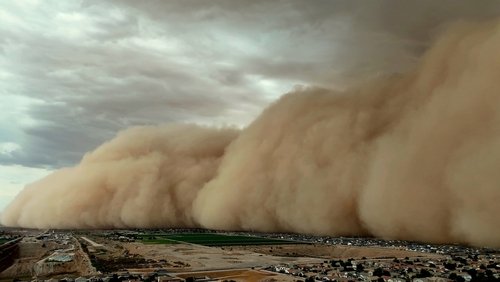
The dust is remaining suspended because the massive initial volume, the microscopic size of the particles, and the local geography prevent it from settling.
The historic Category 5 Haboob that swept through Arizona generated an unprecedented volume of dust, and several mechanical factors explain why it is lingering so long:
1. Terminal Settling Velocity (\(V_{t}\))Very small particles settle at an incredibly slow rate dictated by Stokes’ Law. For fine particulate matter (PM₁₀ and (PM_{2.5}\)), the terminal velocity is minimal:
A tiny dust particle (2.5 μm) settles at a rate of roughly 0.0002 meters per second. In perfectly still air, it takes days for these particles to fall just a few hundred feet to the earth.
2. Microscopic Particle Density
Because the August 3rd storm was so severe (shattering records on the PHX-DUST Scale), the sheer volume of dust injected into the upper boundary layer means the air is saturated. Even as larger grains of sand fall out immediately, millions of microscopic particles remain trapped aloft.
3. Thermal Buoyancy and Mixing
Arizona’s ongoing Extreme Heat Warning creates intense thermal updrafts. The blazing sun heats the desert floor, causing air to rise. This continuous, subtle upward convection easily counters the incredibly weak downward terminal velocity of the fine dust, keeping it perpetually levitated.
4. The “Valley” Topography
The Phoenix metro area acts as a geographic bowl. Without a sustained, sweeping front-line wind or heavy monsoon rainfall to physically “wash” or flush the dirt particles out of the atmosphere, the dust simply stagnates within the valley basin.
5. Multi-Day Re-injection
Compounding the issue, subsequent minor thunderstorm outflows over the following nights have repeatedly pushed smaller, fresh waves of dust back into the air, preventing the atmosphere from fully clearing out.




3 Comments
They’re also great at spreading Valley Fever caused by carcinogenic chemicals used in the massive agricultural industry of Arizona and our neighboring states.
Jill they also spread heavy metals and other toxins from ongoing fires and burn scars. All the days of poor air quality here means dust and soot settling on everything which can become airborne with even gentle winds. Contaminates the water table and has drastic negative effects upon wildlife and plant health.
TJ Hall, correct! What goes up must come down. And what comes down is generally toxic.