


A follow-up to “The President Isn’t on the Ballot. His Freedom Is.” reveals something larger than a debate over the midterms: two political cultures increasingly convinced they are fighting to save the same country from each other.
By Bear Howard and Associates,
A recent Sedona.biz article, “The President Isn’t on the Ballot. His Freedom Is.”, examined what could happen after the 2026 midterm elections if Democrats gain control of the House, or both the House and Senate, during the final two years of Donald Trump’s presidency.
(Link to story: “https://sedona.biz/the-president-isnt-on-the-ballot-his-freedom-is/”
The story was largely about institutions: congressional investigations, appropriations, judicial confirmations, impeachment, divided government and the constitutional checks that determine how much freedom any president has to pursue an agenda when the opposing party controls Congress.
Then came the comments.
And they told a different story.
At the time this follow-up was prepared, twelve comments had been posted beneath the original article. Taken together, they provide an interesting little window into something much larger than the congressional elections of 2026.
They reveal how Americans increasingly see politics not as a disagreement over policy, but as a struggle over what America is, who threatens it and who has the right to claim they are defending it.
Readers may want to first read – or reread – the original article and its comments. Then come back to this analysis and decide whether the characterization is fair. Better yet, add your own comment to the original discussion afterward.
Because the comments may ultimately be as revealing as the article itself.
The Constitutional Question Quickly Disappeared
The original story asks a fairly straightforward political question:
What happens if control of Congress changes?
That could have produced an argument about divided government.
Would congressional investigations provide legitimate oversight or become political retaliation?
Would a Democratic House constrain presidential spending?
Would a Democratic Senate block judicial appointments?
Would divided government produce compromise, paralysis or confrontation?
Would impeachment become a serious possibility?
Those questions barely survived contact with the comment section.
Instead, the conversation quickly turned into a miniature version of America’s larger political conflict.
One commenter dismissed the premise with the familiar accusation of “Trump Derangement Syndrome” and referred derisively to Democrats as “DemocRats.”
Another Trump supporter broadened the indictment, accusing Democrats of failing to secure the border, resisting election reforms, protecting undocumented immigrants and tolerating government fraud.
Another offered something considerably less complicated:
“TRUMP! TRUMP! RED ALL THE WAY DOWN THE BALLOT!”
Those reactions reflect an important cultural attitude.
For many Trump supporters, politics is increasingly viewed through the lenses of sovereignty, loyalty and threat.
The border is no longer merely an immigration-policy question.
Election procedures are no longer administrative details.
And Donald Trump is no longer simply a Republican president whose policies they prefer.
He has become the central figure in a larger struggle over whether the country they recognize as America is being protected or dismantled.
The Other America Answers Back
Trump’s opponents in the comment section respond with equal intensity.
They accuse MAGA Republicans of tolerating or supporting gerrymandering, political violence, corruption, dishonesty, historical revisionism, and authoritarian behavior.
Trump himself is portrayed not simply as a president whose policies they oppose, but as a fundamentally dangerous political figure.
Some comments describe his followers as brainwashed, cowardly or complicit. January 6 appears. Iran appears. War and casualties appear. Questions of hypocrisy, law and order and political morality quickly overwhelm any discussion of congressional procedure.
Here, too, a larger worldview is at work.
For these commenters, the principal danger to the country is not liberal government or immigration.
It is Trump and the political movement surrounding him.
They see threats to democratic institutions, constitutional restraints, truthfulness, political norms and the peaceful exercise of power.
And so an extraordinary thing happens.
Both sides believe they are defending America.
They simply cannot agree about what America needs defending from.
Two Different Threats to the Same Country
To the Trump supporters participating in this discussion, the danger comes from uncontrolled borders, election practices they distrust, government waste or fraud, liberal institutions and a Democratic Party they believe has moved far outside traditional American values.
To Trump’s opponents, the danger is Trump himself and a movement they associate with authoritarianism, dishonesty, political violence, racial resentment and contempt for constitutional restraints.
That is no longer an ordinary argument over whether taxes should be 2 percent higher or lower.
It is no longer principally an argument over the size of government.
The disagreement has become moral.
And once politics becomes moralized, compromise gets much harder.
If your political opponent simply has a bad idea about taxation, you can negotiate.
If you believe your political opponent is destroying America, negotiation can begin to look like surrender.
That psychological shift shows up throughout the comments.
When Civility Becomes Suspicious
One of the more revealing exchanges comes when commenter Michael Johnson refers to Utah Gov. Spencer Cox’s appeals to lower America’s political temperature and asks why political disagreement has become so personally vicious.
But even that attempt at moderation illustrates the problem.
Johnson also argues that Trump himself bears considerable responsibility because the president routinely insults political opponents and even foreign leaders, behavior that supporters may then imitate.
The answer he receives, in essence, is that civility toward people regarded as fascists is not necessarily a virtue.
That exchange gets remarkably close to the center of America’s current political problem.
The traditional democratic assumption is that political opponents are fellow citizens who happen to disagree.
The emerging attitude is different:
If these people represent an existential danger to the country, why should anyone be polite to them?
Once people accept that proposition, political hostility becomes easy to justify.
Each side believes the other started it.
Each side believes its own anger is defensive.
Each insult from the opposition becomes further proof that everything previously believed about that opposition was correct.
The conversation stops functioning as a debate.
It becomes a feedback loop.
Twelve Comments Are Not Sedona
There is an important caution here.
Twelve comments on Sedona.biz are not a public-opinion poll.
They certainly should not be interpreted as representing Sedona, the Verde Valley or even the entire Sedona.biz readership.
Only a handful of participants left comments, and one particularly active anti-Trump commenter wrote several.
So this is not quantitative evidence of what the community believes.
It is something different.
It is a qualitative glimpse at how highly engaged Americans on opposite sides of the political divide now speak about one another.
And in that respect, the comments are remarkably familiar.
They could probably appear beneath political articles in hundreds of communities across America.
The Irony Beneath the Argument
The irony is considerable because the original article was about the very constitutional machinery designed to contain these disagreements.
The House checks the president.
The Senate confirms appointments.
Congress controls appropriations.
The president has veto power.
Courts determine whether executive actions exceed constitutional authority.
The House can impeach.
The Senate can convict – but only with an extraordinarily high threshold.
And elections periodically redistribute all of those powers.
No president gets everything.
No Congress gets everything.
No election is supposed to give one faction permanent control.
That frustration is not necessarily evidence that the system is broken.
It is largely how the system was designed.
Yet almost none of that becomes the focus of the comments.
Instead, within a handful of exchanges we are talking about Trump, MAGA, Democrats, fascists, immigration, election fraud, January 6, Iran, Fox News and brainwashing.
The institutional question disappears beneath the cultural war.
Maybe That Is the Real Story
The original article asks:
What happens if control of Congress changes?
The comments answer another question:
What kind of country are we – and which side is destroying it?
Those are very different conversations.
The first can be analyzed through election results, congressional rules and the Constitution.
The second involves identity, fear, resentment, patriotism, trust and increasingly incompatible interpretations of reality.
And that may be the more consequential problem.
The political center has not necessarily disappeared from America.
But it is often badly underrepresented in public political conversation.
Anger produces comments.
Certainty produces comments.
Insults produce comments.
The person saying, “There are legitimate concerns on both sides, and perhaps divided government could produce responsible congressional oversight while preserving legitimate executive authority,” is considerably less likely to pound the keyboard.
So the loudest participants begin to look like the country.
They aren’t necessarily the country.
But they increasingly determine the language through which the rest of the country experiences politics.
And Then There Is That Word: Freedom
The headline of the original article undoubtedly contributed some fuel:
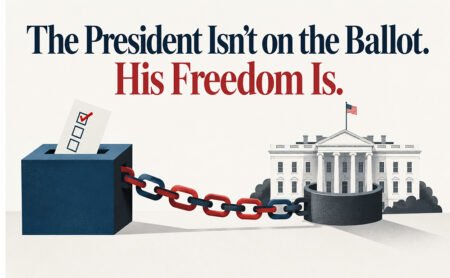
“The President Isn’t on the Ballot. His Freedom Is.”
The body of the article is considerably more institutional than that provocative headline.
But the headline puts Donald Trump personally at the center of the election, and the commenters willingly followed him there.
For Trump’s supporters, his freedom may mean allowing an elected president to govern without Democrats spending two years obstructing him.
For Trump’s opponents, presidential “freedom” may sound dangerously close to freedom from accountability.
That one word therefore captures much of America’s present divide.
Freedom.
Both sides claim it.
Both sides believe they are protecting it.
And both sides increasingly believe the other threatens it.
Perhaps that is the most important lesson in the comments beneath the original story.
The Constitution was designed precisely because Americans were never expected to agree about everything. It divides power, creates obstacles and forces competing political movements to coexist inside the same system.
Today the greater challenge may not be whether Republicans or Democrats control Congress.
It may be whether Americans can continue accepting that people who profoundly disagree with them nevertheless possess an equal claim to citizenship, patriotism and participation in that system.
Now Go Back and Read the Comments
If you have not already done so, read the original Sedona.biz article, “The President Isn’t on the Ballot. His Freedom Is.”
Then read the comments beneath it.
(Link to story: “https://sedona.biz/the-president-isnt-on-the-ballot-his-freedom-is/“)
Don’t just look for the people you agree with.
Look at how people on both sides describe the other side. Look at what they fear. Look at what they believe they are defending. Look at how quickly a discussion about Congress becomes a judgment about character, morality and America itself.
Then add your own comment.
Do you see the same cultural divide described here?
Is one side principally responsible for creating it?
Has political hostility become unavoidable because the stakes really are that high?
Or are Americans being trained – by politicians, political media and perhaps by one another – to regard disagreement as evidence of disloyalty?
The original article asked what voters might do to the balance of power in Washington.
The comments raise the harder question:
Can Americans still disagree about who should govern without concluding that the people on the other side are enemies of the country?



3 Comments
Good point Bear. What Congress under a Democratic majority may or may not do is a good question but I doubt anyone can accurately answer it. Too many variables possible especially with Democrats like John Fetterman effectively defecting to MAGA and supporting their fascist agendas while claiming to be “the only sane Democrat”. Sane people do not support fascist and fascism- Sorry big man!
“Both sides believe they are defending America” you say? Well one side is fascist and full of hate, criminals and corruption while the other supports democracy, constitutionality, rule of law and rights and freedoms for all not just wealthy white criminals. This is relative to what may or may not happen should Democrats take back the house and senate despite Trump and MAGA’s desperate gerrymandering, last second rule changes, public bribes and government interference in this election cycle.
In my opinion it would be dereliction of duty for Democrats (should they return to power) to not impeach Trump and every single Congressionally approved MAGA Judge, General, Attorney, FBI/CIA agent etc. Every single one of them has lied under oath, violated laws and the constitution. We tried being lawful to the last fascist regime(s) to take power and commit crimes against humanity as a whole by only going after leadership. Time to play hardball and go after everyone involved and make life so difficult for them and their families that maybe they’ll think twice before committing crimes of hate and violence against the masses? Probably not as there are always hateful jackasses in every society everywhere.
We are in this mess due to Congress not doing their job, plan and simple.
The checks and balances are gone.
Executive orders rule now.
We have a president who in the oval office admitted insider trading? Is that the norm?
Paying off people for your vote? Pledging ones support or they will go to hell?
You can ask all the questions in the world. Till someone stops the madness it will continue.
Till we follow the rules our founding fathers set up, it will continue.
Only one party to blame for their cowherds and turning their backs!
WS Dave,
don’t forget he (Mr Election Integrity 🤮) told his people to vote even if they’re not registered or able to vote falsely claiming as usual that the Democrats lost in 2020 but somehow cheated to win despite zero evidence ever being presented to the contrary. His minions voted for him despite being a known draft dodger, adulterer, convicted sex offender, liabetic, grifter who likes seeing others perpetrate violence upon others despite being an absolute coward whose only fight/combat record has been his self acclaimed “Vietnam” of avoiding STD’s, filing for bankruptcy and paying attorneys to get him out of self inflicted legal trouble just like his porn Star hush money payments or his sexual assault of Jean Carroll for which he has been formally charged twice for and is all out of appeals which makes him permanently guilty.
Fact check me if you would Whiskers.And I know,,, the commas are back sorry.
As for how this relates to Congress? Well, the current MAGA Majority Congress and Senate both are out covering up the Kings election interference and bribery by making excuses for his lies and crimes as per SOP. They have even crafted ways they plan to pay for it using proceeds from tariffs or cuts to other budgetary items all of which will only increase the rapidly growing MAGA/Trump Federal deficit. Don’t worry though, he’ll get away with this as well because like his fictional COVID payments and non existent DODGE dividend payments. Nobody except his Epstein Class pals have made money off of the economy and got lifetime tax breaks nobody else did or will. And yet despite his many lies and crimes (mostly directed at his MAGA sycophants) and an economy that is bankrupting the nation (except for the Epstein Class who thrive while we struggle) his minions continue to support him. In friggin credible! Had any Democrat POTUS lied and violated law on a daily basis like this administration has and does there would’ve been an insurrection nationwide.