

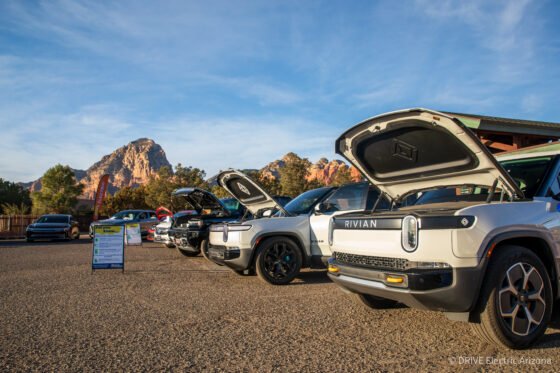
SEDONA, Ariz. – The city of Sedona and Drive Electric Arizona invite all northern Arizona residents to attend the third annual Electric Vehicle Ride and Drive event on Sunday, Oct. 25, 2026 from 1 to 4 p.m. in the parking lot next to the playground at Posse Grounds Park, located at 525 Posse Ground Rd. Participants will learn about electric vehicle (EV) ownership and have the chance to ride in or drive some of the most innovative electric vehicles on the market.
Between 15 and 25 EV’s and their owners will be available at the event to answer questions from the public, offering up their vehicles for display, and allowing their vehicles to be driven along an identified route in Sedona.
To drive an EV, participants must bring a valid driver’s license. Licenses will not be required for those who want to take a ride in an EV as a passenger. Registering for the event is not required but is recommended and can be completed at: www.driveelectricaz.org/
“Our EV owners are eager to answer questions and share their personal stories in a casual environment. We aren’t selling anything; we simply want to share our love of EVs with others,” said Co-Founder and Vice President of Drive Electric Arizona, Peter Culin.
“For those of us who are looking for our next car or are tired of the high cost of gas at the pump, this event is a rare opportunity to test drive a wide range of different EV’s on the market without the pressure often found at dealerships.,” said city of Sedona’s Sustainability Coordinator Zach Schwarz.
Several partners will also have displays, including Valley of the Sun Electric Vehicle Association, Arizona Public Service (APS), Solar United Neighbors, Clean Air Arizona and the city of Sedona’s Sustainability Department.
For more on the event, contact Zach Schwarz at ZSchwarz@Sedonaaz.gov or 928-203-5123.




20 Comments
How EVs destroy the environment
High Manufacturing Footprint: Producing an EV battery is energy-intensive, creating significantly higher carbon emissions during production than building a traditional gas vehicle.
Destructive Resource Extraction: Mining lithium, nickel, and cobalt consumes massive amounts of local water, risks acid mine drainage, and drives deforestation and habitat loss.
Fossil-Fuel Grid Reliance: Operational zero-emissions depend on the power source; charging on coal- or natural-gas-heavy power grids shifts emissions from the tailpipe to the power plant.
Microplastic & Dust Pollution: EVs are substantially heavier due to battery weight, causing faster tire wear that releases more microplastics and particulate matter into air and runoff.
Recycling & Waste Risks: Processing spent lithium-ion batteries requires complex chemical or thermal operations, and improper disposal risks toxic metal leaching into soil and water.
Fossil fuels (coal, oil, and natural gas) harm the environment through global climate change, widespread pollution, and the destruction of natural habitats.
Climate Change and Global Warming
• Greenhouse Gas Emissions: Burning fossil fuels releases massive amounts of carbon dioxide (CO₂) and methane into the atmosphere. These gases trap heat like a blanket, driving global warming.
• Extreme Weather and Sea Levels: A warmer planet accelerates sea-level rise, melts glaciers, and intensifies droughts, heatwaves, wildfires, and severe storms.
• Ocean Acidification: Oceans absorb up to 30 percent of man-made carbon emissions, turning the water more acidic and destroying marine life like corals and shell-forming organisms.
Air Pollution
• Toxic Byproducts: Combustion releases sulfur dioxide, nitrogen oxides, benzene, and heavy metals like mercury.
• Smog and Acid Rain: Nitrogen oxides and sulfur dioxide combine in the air to create low-level smog and acid rain, which damages forests, soils, and freshwater systems.
• Public Health Risks: Airborne soot and particulate matter cause respiratory illnesses, asthma, lung cancer, and thousands of premature deaths annually.
Water Pollution and Habitat Destruction
• Extraction Damage: Strip mining, mountaintop removal, and drilling destroy forests, erode landscapes, and fragment critical wildlife habitats.
• Water Contamination: Coal mining runoff, oil spills, and toxic wastewater from fracking can poison rivers, lakes, and underground drinking water aquifers.
• Plastic Pollution: Over 99 percent of plastics are manufactured from fossil fuels, creating millions of tons of waste that choke marine ecosystems.
I’ll take door #1 over door #2 any day mate
grid still runs mostly on fossil fuels. Roughly 60% of US electricity comes from natural gas and coal. Nuclear supplies about 18%, and wind, solar and hydro make up the rest. In states like West Virginia, Wyoming and Missouri, coal alone supplies most of the power. An EV charging there is effectively coal-powered.
Timing makes it worse. Most people charge overnight, when solar produces nothing. The load at that hour falls on gas plants, coal plants and whatever baseload is available. Add new demand at peak hours, and utilities fire up gas “peaker” plants, the least efficient units they run.
Energy also gets lost along the way. Power plants waste a large share of their fuel’s energy as heat. Transmission lines lose another 5% or so. Charging loses another 10–15% as heat in the charger and battery. Every one of those losses means more fuel burned at the plant to put a mile on the road.
Demand is also growing faster than clean capacity. Utilities are postponing coal plant retirements and building new gas plants to keep up with EVs, data centers and electrification. Adding millions of EVs doesn’t clean up the grid. It gives the grid a reason to burn more.
The tailpipe didn’t disappear. It moved somewhere you don’t see it.
Automakers have already given their verdict. Stellantis wrote off $26.5 billion, Ford $19.5 billion and GM $6 billion, and Volkswagen/Porsche took a $3.5 billion hit on top of that. Honda expects up to $16 billion in charges as it pivots away from EVs. Across Ford, GM, Stellantis and Honda alone, that’s roughly $70 billion written off on EV bets. Meanwhile, Toyota, which stuck with hybrids, largely avoided the damage. Companies don’t walk away from $70 billion investments because of internet arguments. They walk away because customers didn’t show up.
Lucid: Lost $1 billion in Q1 on $282 million in revenue, kept alive by Saudi money.
Rivian: Expects to lose $1.8–2.0 billion on an adjusted basis in 2026.
The scorecard: Tesla and BYD make money, with shrinking profits. Everyone else is losing hundreds of millions to billions a year and depending on investors, foreign governments, or parent companies to stay Open . At this point the market has spoken.
EV’s are still evolving. Ferrari has even made one. Just because the auto industry made it impossible for EV’s to even exist until recently does not make them obsolete. Nor does making them obsolete mean we should forget green energy altogether and make the Earth and its atmosphere far more toxic than we already have. You like sitting in your garage, door shut, engine running while smoking a carton of fags and eating a burger full of microplastics and screw worms- good on ya! I prefer fresh air water food and soil over a muscle car without a catalytic converter anytime.
Tesla is a failing company thanks to Nazi saluting Musk and his trillionaire hate machine
Texas is now a national leader in solar power, having overtaken California as the top generator of electricity from utility-scale solar farms.
Key Comparisons and Rankings
• Utility-Scale Generation: Texas generated 58,634 GWh of utility-scale solar power, moving past California’s 53,713 GWh.
• New Installations: Texas leads the United States in new solar capacity, regularly installing significantly more new utility-scale projects than any other state.
• Overall Capacity: Total solar infrastructure in Texas has grown to roughly 53.5 to 55.5 gigawatts (GW), placing it neck-and-neck with or surpassing California for total capacity depending on small-scale/rooftop inclusions. While California still leads in small-scale and residential rooftop solar, Texas dominates large utility-scale farms.
• Milestones vs. Other Fuels: For the first time in state history, annual solar generation in Texas has surpassed coal generation, and solar has briefly peaked at nearly 19.1 GW of instantaneous grid power.
Why Texas is Growing So Fast
• Fast and Cheap Connections: Operating largely under the independent ERCOT grid allows for streamlined local interconnections compared to multi-state federal grid oversight.
• High Demand: Surging population growth (up over 15% in a decade) combined with heavy electricity loads from industrial expansion and AI data centers drive an urgent need for rapid power additions.
• Economic Cost: Solar has become one of the cheapest and fastest methods to generate power in the state, offering long-term fixed power purchase agreements without fuel costs.
• Land Availability: Abundant open land and high solar irradiance in regions like West Texas and South Texas make large-scale solar farms highly profitable for developers and landowners.
*** Funny how those who scream from the mountain tops about the evils of green energy want it the most, MAGA and China included
Nobody said EVs are obsolete, and nobody said to forget clean energy. I said the numbers don’t support the hype, and they don’t.
Ferrari building a car that costs half a million dollars says nothing about whether the average family can afford one. the auto industry didn’t make EVs “impossible.” It spent more than $70 billion trying to make them work, then wrote it off when buyers didn’t show up.
Toyota, one of the most respected automakers in the world, refused to go all-in on EVs and bet on hybrids like the Prius instead. While other automakers wrote off billions, Toyota largely avoided the losses. That tells you who read the market right.
Lucid builds some of the best EV technology in the world. The Air is among the most efficient, longest-range EVs ever made. It also starts at $72,400 and goes up to about $250,000. Even at those prices, Lucid lost $1 billion in a single quarter, and it stays alive because Saudi Arabia keeps funding it. One of the world’s biggest oil producers is propping up the best EV company. If a $72,000-to-$250,000 car with the best engineering can’t make money, the problem isn’t the technology. It’s the business.
Rivian isn’t any better. It lost $837 million last quarter alone and expects to lose about $2 billion this year. It only stays afloat because Volkswagen keeps writing billion-dollar checks and gas-car makers buy its emissions credits.If the best EV engineering can’t make money, the problem isn’t the technology. It’s the business.Part of Rivian’s revenue comes from selling regulatory credits to automakers that build gas cars, so gas cars are effectively helping pay Rivian’s bills.
Costs for EV’s would drop significantly if the automakers would commit to them rather than experiment with them.
Thanks for agreeing they cost too much. That’s been my point all along.
Seventy billion dollars industry wide spent on EVs is a pretty expensive experiment.
Imagine what they’d lose if they got serious.
OK they currently cost too much? So should we abandon them and just continue using our smog machines?
Today’s gas cars are 98–99% cleaner than cars from the 1960s. Hybrids cut fuel use even further, at a price people can afford, and they don’t need a charger. That’s why one in six new cars sold is now a hybrid. It’s not EVs or smog. There’s a middle ground, and buyers have already picked it.
After five years, EVs have lose 57.2% of their value on average, compared with 35.4% for hybrids. The Nissan Leaf loses 63.1%, the VW ID.4 62.1% and the Mustang Mach-E 60.8%. Meanwhile, Toyota hybrids hold 10 of the top 25 spots for best value retention. The RAV4 Hybrid loses just 25.2% of its value in five years, compared with 57% for EVs avg
Insurance: EVs cost about 42% more to insure than gas cars, mostly because they cost more to repair. The Texas example proves the point: clean energy wins when it’s cheaper, not when it’s forced
Every car depreciates 50% the moment you drive them off of the lot. What’s your point here?
No car loses 50% off the lot. That’s a myth. The average car loses 41.8% over five full years. EVs lose 57.2%, hybrids 35.4%, and a RAV4 Hybrid only 25.2%. That’s the point: buy an average EV and you lose thousands more than you would with a hybrid. Same study, real numbers.
https://www.iseecars.com/cars-that-hold-their-value-study
Want to know what will really finish off American EV production? Canada just cut its tariff on Chinese EVs from 100% to 6.1%. BYD, which grew into the world’s biggest EV maker with years of support from the Chinese government, is opening 20 dealerships next door. It can sell compact EVs well under $35,000, a price no North American plant can match . Now they’d be competing against a state-backed giant across the border. That’s not a fair fight. It’s the end of US EV manufacturing.
I’ve been to China and seen their EV operation firsthand, and people here have no idea what’s coming.
It’s over. The USA had its shot, lost billions, and can’t compete. Oh Canada, indeed.
Boy those Canadians are undisputedly smart!
Cheer all you want, but look at what Canada traded. It cut tariffs on Chinese EVs from 100% to 6.1% to get canola tariffs lowered, while its own rebate program won’t even cover China-built cars. So Canadian taxpayers subsidize EVs built in Canada, then let a state-backed competitor undercut them.