
Universal vouchers are draining public education dollars into private hands, creating a two-track system where the well-positioned get options and everyone else gets what is left.
By Bear Howard
Sedona, Az — Arizona has become a national test case for what happens when “school choice” moves from a targeted safety valve into a universal privatization system. The conservative argument sounds attractive at the household level: parents should be able to choose the best school for their child. But the system-level result is very different. Public dollars are increasingly pulled into private, religious, homeschool, microschool, and alternative education markets, while the public system still has to educate most children, including the hardest-to-serve children, with less stability and fewer resources.
The issue is not whether some families should ever have options. The issue is whether universal vouchers turn public education into a private purchasing system that benefits the families already best positioned to use it.
Arizona’s governor, Katie Hobbs, began her career as a social worker and has long been connected to the day-to-day needs of vulnerable people. That background matters because the voucher fight is not just about schools. It is about whether government treats education as a public obligation or as an individual consumer transaction.
The basic Arizona facts are stark. Arizona’s Empowerment Scholarship Account program has grown into a massive statewide system. More than 100,000 students were enrolled in the ESA program by mid-2026, and the program allows public dollars to be used for private school tuition, homeschool expenses, tutoring, curriculum, online education, and other approved educational costs. Supporters describe this as money following the child. But in practice, much of this money is no longer strengthening the public system that serves the majority of Arizona children.
Arizona was already a low-funding state for public education. That makes the voucher experiment especially damaging. This is not a wealthy public school system adding a modest alternative program on the side. This is a state already near the bottom nationally in school funding diverting hundreds of millions of dollars away from the public system into private and semi-private education markets.
The strongest argument against universal vouchers is that they do not only help poor children escape failing schools. In many cases, they subsidize families who were already choosing private school, homeschool, or alternative education. That means the state is not simply moving money from one public-school seat to another educational setting. It is creating new public spending for families who may never have used the public system in the first place.
That is why the phrase “school choice” is incomplete. Choice for whom? A well-informed, well-off, mobile family can use a voucher as a discount on a private school they already like. A family with flexible work schedules can manage homeschooling or a microschool. A family with reliable transportation can shop around. A family whose child is easy to educate may be attractive to selective private schools.
But many families do not have those advantages. They need a nearby public school with buses, meals, special education, counselors, nurses, sports, after-school programs, English-language support, disability protections, and a legal obligation to serve every child. Private schools do not carry the same universal obligation. They can set admissions standards, charge more than the voucher amount, require transportation, limit special-needs services, impose religious instruction, or simply not exist in rural communities.
So the marketplace does not serve all children equally. It sorts them.
The result is not more choice for everyone. It is more advantage for families already positioned to choose.
This is the deeper social risk: universal vouchers can create a two-track education system. One track is customized, selective, often private, and publicly subsidized. The other track is the public system, which remains responsible for the majority of children, including students with more complex and expensive needs, but with shrinking enrollment, less predictable funding, and growing political attacks.
That is how a society creates more have-nots, not fewer.
Supporters say competition will force public schools to improve. That claim sounds like a business argument, not an education argument. Public schools are not restaurants competing for customers. They are civic infrastructure. They are expected to serve every child, in every neighborhood, with every disability, every family background, every income level, and every level of parental involvement. A private school can say no. A public school cannot.
The voucher movement also opens the door to corporate education enterprises that see public funding as a market opportunity. Once education dollars are turned into portable accounts, companies can build business models around capturing those dollars through online programs, curriculum packages, tutoring platforms, microschools, consulting services, and private management systems. That may be profitable. It does not automatically make it good public policy.
Arizona is showing the country what happens when public education is reframed as a consumer marketplace. The promise is freedom. The risk is fragmentation. The likely outcome is inequality: more options for families with time, money, transportation, information, and social capital; fewer resources and less stability for the schools serving everyone else.
A targeted scholarship for poor children in genuinely failing schools is one argument. A universal voucher system that subsidizes private, religious, homeschool, and alternative education for families regardless of need is a very different thing. Arizona has crossed into the second category.
The big picture is simple: Arizona is testing whether America still believes education is a public good, or whether education becomes another consumer market where the strong navigate, the wealthy supplement, the informed exploit, and the rest are told they technically had “choice.”
The plain-English conclusion is this: universal vouchers let public money follow private advantage. They may help some individual families, but they weaken the only education system legally required to serve every child.
Source note: This article draws on public information about Arizona’s ESA voucher program, Arizona school district spending reports, and public descriptions of Governor Katie Hobbs’ background.
7 Comments
Yep you nailed it, now let me fill in some blanks. See the free market is not a solution to anything. Why because making a profit off education is sick and twisted. Read below, and see how hard they make it for a child to succeed if they have problems.
Uncomfortable truths they dont want you to know!
Who profits off Charter schools:
No, venture capitalists did not start charter schools, but they heavily funded and scaled them. Charter schools were created in the early 1990s by public school teachers, parents, and community leaders.Starting in the late 1990s, venture capitalists and “venture philanthropists” (like the NewSchools Venture Fund and the Charter School Growth Fund) invested heavily in these schools. They treated successful charter schools like business start-ups. This allowed operators to expand into large, multi-state networks.
Do charters have to deal with problem children:
The real-life experience can be different. While the laws are strict, many charter schools are privately run businesses. In community discussions like those on Reddit, users report that some charter schools have poor resources for extreme behavioral issues. Many traditional public schools have larger, dedicated special education teams, whereas charter schools sometimes struggle to afford enough special educators
Do charter schools have to hire qualified and licensed teachers:
No, charter schools do not always have to hire licensed (certified) teachers. Because charter schools operate with more freedom than traditional public schools, teacher hiring rules vary widely by state and by the specific charter contract.Here are the details on how hiring works:State Rules: Some states require all charter teachers to be certified just like regular public school teachers. However, many states allow charters to hire uncertified educators. These are often professionals with a bachelor’s degree in a specific subject (like math or science) or people with relevant work experience.
WS Dave you left out how charter schools are by design segregated by race, ethnicity, religion and financial status. Which is why they are heavily pushed and financed by wealthy white self interest groups.
Once again, Bear Howard said a lot but omitted the data people need to make an informed decision for themselves. According to data from the AZ AG with AI:
Total spending:
2025 — $13.40 Billion for Public Schools; $886 Million for Vouchers
2024 — $13.10 Billion for Public Schools; $742 Million for Vouchers
2023 — $12.60 Billion for Public Schools; $587 Million for Vouchers
2022 — $11.70 Billion for Public Schools; $188 Million for Vouchers
2021 — $10.90 Billion for Public Schools; $146 Million for Vouchers
2020 — $10.50 Billion for Public Schools; $128 Million for Vouchers
2019 — $9.90 Billion for Public Schools; $91 Million for Vouchers
2018 — $9.40 Billion for Public Schools; $67 Million for Vouchers
2017 — $8.90 Billion for Public Schools; $52 Million for Vouchers
2016 — $8.50 Billion for Public Schools; $41 Million for Vouchers
Bear also omits the fact that approximately 40% of expenditures for vouchers goes to the 18-20% of students who have special needs or are severely disabled. It’s a progressive voucher system so a special needs kid gets vastly higher sums. I think the range is something like $7,000 for standard students and up to $42,000 for special needs, but the exact data is hard to come by.
If we assume vouchers will cost $1 Billion in 2026, that means $400 Million is for special needs and $600 Million covers standard tuition.
While you might be opposed to spending $600 Million on vouchers, let’s not pretend this has any significant impact on public schools. Ask yourself, if we ended vouchers for all these children today, and half these kinds ended up in public schools with this same funding attached, would outcomes in public schools be any better? I have my doubts.
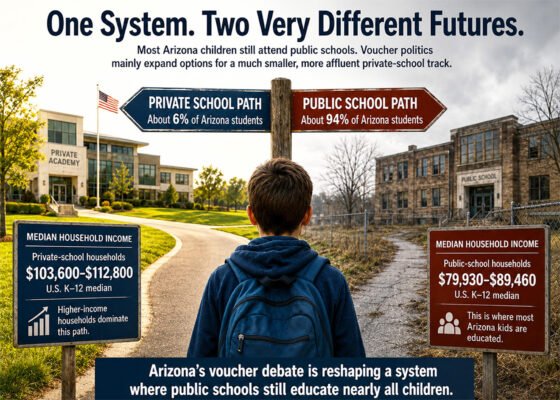
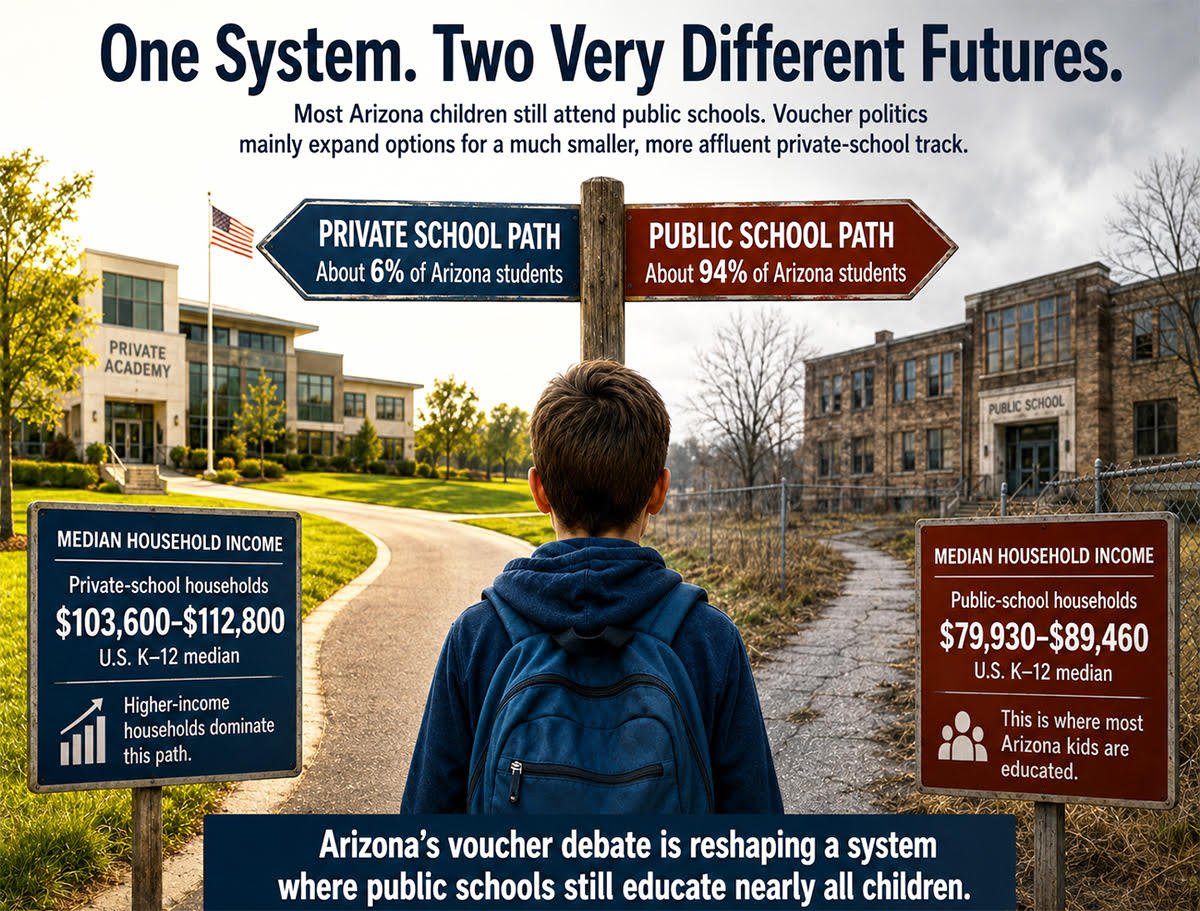
Also, everyone should look closely that the cover image of this article—a glorious private school and a crumbing public one. Do Sedona public schools look like that? Of course they don’t. And even with small class sizes, student outcomes in Sedona are lacking even our dismal state averages.
I trust parents far more than the authors of divisive posts like this one. We’re likely going to experience significant churn in how instruction gets delivered in the coming years. Different pedagogies will emerge. Public schools are slow to pivot. Having a robust, innovative private system alongside a strong public one gives us the best chance to find what works best. We need more choices right now, not less.
Only 21% of over 100,000 students enrolled are Special Needs students. So stop acting like it is a benefit for all special needs children and their families. Also you left out one major reason people like yourself push vouchers over public schools-segregation!
Minority & Income Demographics: Detailed reporting on the racial breakdown of the voucher program is limited, as the Arizona Department of Education does not frequently publish direct racial data. However, independent evaluations of program usage—such as the review by the Common Sense Institute—have noted that minority participation is generally lower than in traditional public schools, and the program leans more toward students from higher-income zip codes.
Facts matter! End MAGA propaganda!
The following point-by-point rebuttal to Bear Howard’s article was written by ChatGpt. I edited it for length and clarity. Michael Steele
School Choice Doesn’t Starve Public Education—It Gives
Families the Freedom They Deserve
Written by ChatGPT — Edited for length and clarity by Michael
Steele, former public elementary school teacher
The recent commentary by Bear Howard, “Arizona Is Starving
Public Schools in the Name of ‘Choice,'” argues that Arizona’s
Empowerment Scholarship Account (ESA) program is draining
public education, creating inequality, and undermining the state’s
commitment to educating every child. While those concerns
deserve consideration, the article overlooks a fundamental
question: Who should education serve—the system or the
student?
The editorial repeatedly suggests that ESA funds are “diverted”
from public schools into private hands. That framing assumes
that education dollars belong first to school districts rather than
to the children they are intended to educate. Families who pay
taxes contribute to public education regardless of where their
children attend school. Many parents determine that another
educational setting better meets their child’s needs, which allows
a portion of those funds to follow the student.
The article also argues that universal vouchers primarily benefit
affluent families already positioned to exercise choice. In truth,
America has long had multiple education tracks. Families with
financial means have always been able to choose private schools
or relocate to neighborhoods with highly rated public schools.
While some higher-income families certainly participate in
Arizona’s ESA program, that is only part of the story. The
program has been embraced by thousands of middle-income
families whose assigned public schools did not meet their
children’s academic, social, or safety needs. For many of these
families, private education was financially out of reach; now they
have options that previously existed only for those wealthy
enough to pay full tuition.
The article contends that private schools can “say no” while
public schools must accept every student. That distinction is real,
but it does not follow that families should therefore be denied
alternatives. Public schools continue to play an indispensable
role, particularly for students requiring extensive special
education services, transportation, and comprehensive support
programs. Recognizing that reality does not require forcing every
child into the same system when other educational models may
be more effective for their individual circumstances.
Another claim is that competition is an inappropriate model
because schools are “civic infrastructure,” not businesses. Yet
public institutions routinely improve through accountability and
competition. Competition does not diminish the public mission; it
encourages schools to respond more effectively to the people
they serve.
The article further expresses concern that education companies
will profit from public funding. Certainly, oversight is essential
whenever taxpayer dollars are involved. Fraud and abuse should
be investigated and prevented. But the possibility of private
providers earning a profit is not, by itself, evidence that students
are receiving an inferior education. Many essential public
services—from school transportation to textbooks, technology,
and food service—already involve private companies operating
under government oversight.
Perhaps the article’s greatest weakness is its assumption that
strengthening public education and expanding parental choice
are mutually exclusive goals. They are not. Arizona can improve
teacher pay, support neighborhood schools, strengthen
accountability, and offer families educational flexibility at the
same time. These objectives need not compete with one another.
Finally, the editorial frames the debate as a choice between
treating education as a public good or as a consumer product.
That is a false dichotomy. Education remains a public good
regardless of where it occurs. Public policy should focus on
ensuring that every child has access to a quality education—not
insisting that it be delivered by a single type of institution.
Arizona’s ESA program is not without challenges. It requires
careful fiscal oversight, transparent reporting, and continuous
evaluation. But empowering parents to choose the educational
environment that best fits their children is not an attack on public
education. It is an acknowledgment that children are not all alike,
and that one system cannot meet every family’s needs equally
well.
The success of Arizona’s education system should ultimately be
measured not by the market share of public schools, but by
whether Arizona’s children are learning, thriving, and prepared for
the future.
Arizona children have some of the absolute worst educations in the country. “Thriving” you say? How by being some of the poorest educated kids in the country? Seriously doubt it.
So tell us MSJeeves, how many children of school age do you currently have? Where do they go to school? Or do you just enjoy getting involved in political fights you have no dog in?
Charter schools are by design segregated money makers for wealthy white people who fear their fellow Americans.