
By Bear Howard and Associates
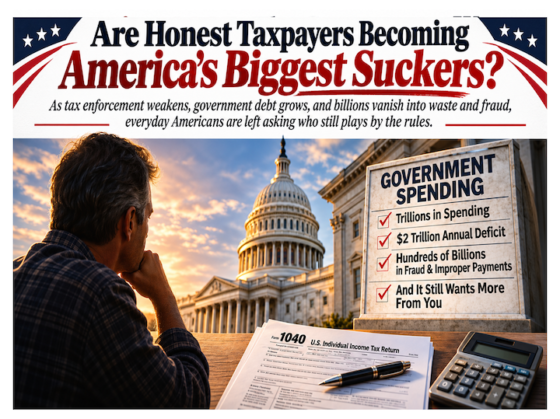
In 2027, America faces a financial and moral contradiction that few politicians are willing to acknowledge. The government demands financial responsibility from its citizens while routinely spending beyond its means, losing hundreds of billions of dollars to fraud and improper payments, and weakening the very institution that collects taxes.
Meanwhile, an increasingly entrepreneurial economy has created enormous disparities in how income is reported, monitored and taxed. Salaried employees have little discretion, while financially sophisticated individuals enjoy opportunities to minimize their obligations. Others may question whether compliance is worth the financial and administrative burden, particularly as enforcement resources diminish.
What happens when honesty becomes a financial disadvantage? When government waste undermines the moral incentive to comply? When the fear of enforcement begins to lose its credibility?
This essay examines the uncomfortable intersection of human nature, economic self-interest, government accountability and the financial obligations of American citizenship. It challenges readers to consider whether America is inadvertently creating a culture in which compliance is increasingly perceived as optional rather than obligatory.
Before you file your next tax return, consider what this evolving financial reality means for you, your fellow citizens and the future of America.
And at the end of this article, you tell me, “Are honest taxpayers becoming America’s biggest suckers?”
Sedona, AZ – Imagine three Americans sitting in a neighborhood coffee shop. One is a salaried employee, another is an independent entrepreneur, and the third is a successful investor. They enjoy approximately the same privileges of American citizenship, yet their financial relationships with their government are remarkably different.
The first has already surrendered a portion of his income before his paycheck reaches his bank account. The second is responsible for reporting his earnings, calculating expenses and determining what he owes. The third operates in a sophisticated financial environment where accumulating substantial wealth does not necessarily generate an immediate income tax obligation.
All three live under the same federal tax laws. But their ability to manage, minimize or potentially escape taxation is anything but equal.
Welcome to America in 2027.
The American economy has evolved considerably beyond the traditional employer-employee relationship. Millions of Americans now generate income through independent businesses, consulting, digital commerce, freelance services and entrepreneurial activities that do not involve conventional payroll systems.
A person can operate a substantial business from a kitchen table without employees, commercial property or a storefront. Some revenue is independently reported to the government through documents such as 1099s. Some is not. The legal obligation to report taxable income remains, but the government’s ability to independently verify that income varies considerably.
The IRS’s own historical research illustrates this reality. During the 2014–2016 tax years, approximately 1 percent of wage income subject to substantial reporting and withholding was misreported, compared with 55 percent of income subject to little or no independent reporting.
Apparently, human honesty is influenced considerably by the presence of an observer.
Meanwhile, the American tax code has evolved into an extraordinarily complicated collection of deductions, exemptions, preferential rates and specialized provisions. Those who can afford sophisticated accountants and attorneys possess advantages unavailable to most working Americans.
The federal income tax remains progressive overall, but taxable income is not the same thing as accumulated wealth. Someone whose investments appreciate by millions of dollars may experience an enormous improvement in financial circumstances without immediately owing income taxes on those gains. Meanwhile, working Americans surrender income through payroll taxes, sales taxes and other government charges.
The inequality extends beyond how much people pay. It includes how much control they possess over the process of paying.
Then there is the psychology of taxation.
For generations, Americans have been conditioned to fear the Internal Revenue Service. Receiving an envelope bearing its return address can ruin an otherwise perfectly pleasant afternoon.
For a household struggling financially, an unexpected tax assessment can be devastating. For a wealthy individual, it may be another administrative matter delegated to professional advisers.
Wealth purchases more than material possessions. It purchases expertise, representation, financial resilience and the confidence to challenge government decisions.
Yet the institution responsible for maintaining tax compliance is entering 2027 substantially diminished.
Under President Biden, Congress authorized approximately $80 billion to modernize and rebuild the IRS. Subsequent congressional actions, beginning in 2023 and continuing under the second Trump administration, reduced that allocation to approximately $26 billion. Between January 2025 and January 2026, the IRS workforce declined from approximately 103,000 employees to 74,000.
Consider the economic logic of that decision. America has an increasingly complicated economy, increasingly sophisticated financial transactions and an enormous tax code, but considerably fewer people responsible for investigating compliance.
Even before these reductions, the IRS estimated that $696 billion in federal taxes legally owed for 2022 had not been paid on time. Approximately $606 billion was projected to remain uncollected after subsequent payments and enforcement efforts.
Every enforcement institution has limited resources. Investigating financial activity costs money, and the government must weigh potential recovery against investigative costs and the broader importance of deterrence.
The resulting perception that certain violations may never be discovered is itself a danger to voluntary compliance. That does not make ignoring tax obligations a sound financial strategy. Automated enforcement remains powerful, unpaid liabilities can accumulate, and deliberate evasion carries serious civil and criminal consequences.
Nevertheless, the credibility of enforcement matters as much to public behavior as the existence of penalties.
But enforcement is only half the story.
What happens when the American citizen begins questioning whether the government deserves his financial contribution in the first place?
Every dollar an individual earns represents something personal: time, physical effort, intellectual energy, creativity or investment. A thousand dollars may represent groceries, medical care, automobile repairs or the opportunity to work a little less and enjoy life a little more.
To Washington, a thousand dollars is practically a rounding error.
In fiscal year 2026, the federal government spent approximately $2 trillion more than it collected. Federal debt held by the public reached the equivalent of the country’s annual economic output.
The government continues operating despite this enormous financial imbalance. To an individual taxpayer, the machinery of government can appear almost indifferent to whether his particular contribution ever arrives.
Compounding that perception is the government’s own record of financial management.
The Government Accountability Office estimates annual federal fraud losses of between $233 billion and $521 billion, based on data from 2018 through 2022. Federal agencies separately reported approximately $186 billion in improper payments during fiscal year 2025. These categories overlap and are not entirely attributable to deliberate dishonesty, but their magnitude is extraordinary.
Some taxpayer money ends up with dishonest contractors, fraudulent applicants and organizations receiving payments they have not legitimately earned. Other money is lost through administrative errors, inadequate oversight and inefficient purchasing.
Citizens are expected to meticulously document their expenses while the government struggles to adequately account for its own.
It is not difficult to understand how resentment develops.
Eventually, an American may begin asking why he should surrender a portion of his limited financial resources to an institution that appears capable of spending almost without restraint and whose financial discipline frequently seems inferior to his own.
The weakness in that reasoning, of course, is that what appears inconsequential when one person does it becomes enormously consequential when millions do it. Government borrowing is not free money. Its costs accumulate through interest payments and financial obligations passed to future generations.
Nor does government waste cancel an individual’s legal obligations.
But those facts do not resolve the underlying crisis of confidence.
America depends upon a financial social contract: citizens contribute resources, and government uses those resources responsibly to provide collective benefits.
That contract cannot remain healthy when taxpayers believe others are escaping their obligations, when compliance is unnecessarily burdensome, when financial sophistication purchases unequal advantages, and when government itself appears insufficiently accountable for the money it spends.
The challenge confronting America in 2027 is therefore much larger than collecting taxes. It is restoring the credibility of taxation itself.
That requires simpler laws, equitable treatment of different sources of income, effective enforcement, responsible government spending and meaningful consequences for dishonesty on both sides of the transaction.
Otherwise, America risks becoming a society divided among those who pay because they have little choice, those who pay because they possess a conscience, and those who regard their financial obligations as negotiable.
Perhaps the most disturbing question Americans should contemplate in 2027 is not how many people are cheating their government, but how many otherwise responsible citizens are beginning to question the wisdom of being financially honest within the system their government has created.
A nation cannot indefinitely demand financial responsibility from its citizens without demonstrating financial responsibility itself.