

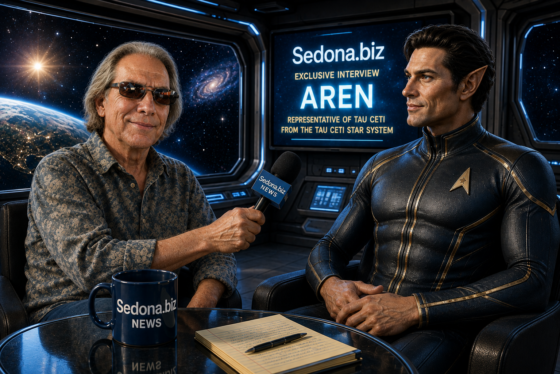
An alien named Aren answers humanity’s questions about God, music, war, love, AI, and death.
What follows is a recent interview with Aren, a representative of an extraterrestrial civilization from a world orbiting Tau Ceti.
For this interview, we dispensed with the usual limitations of reality and asked a simple question: Suppose we actually could sit across from an intelligent being from another world. What would we ask?
And what might the answers tell us—not merely about extraterrestrials, but about ourselves?
Here is our interview with Aren.
SED0NA.BIZ : Thank you for agreeing to this interview.Let’s start out with the most important question. Do you believe in God?
AREN: Your question is more difficult than asking whether we can cross the distance between stars, Tommy.
Yes.
But what we understand as God is probably different from what many humans mean by the word.
We have found no being sitting outside the universe directing its affairs. We have encountered no celestial monarch who demands worship. We have traveled far enough and observed enough worlds that, had such a being wished merely to demonstrate its physical existence, we believe there would have been ample opportunity.
Yet the deeper we have looked into existence, the less comfortable we have become with the conclusion that existence is merely an accident.
Your scientists discovered that matter is not what it appears to be. Beneath the objects you touch are atoms. Beneath atoms are particles and fields. And beneath those descriptions lie mathematical relationships of extraordinary elegance.
We discovered much the same thing.
But we continued looking.
Eventually, we began to suspect that consciousness may not simply be something produced inside the universe.
It may be fundamental to it.
You look at yourself and say:
“I am a conscious creature living within the universe.”
We increasingly wonder whether the opposite description might contain part of the truth:
The universe is experiencing itself through conscious creatures.
Through you.
Through us.
Perhaps through countless forms of awareness scattered across realities neither of us has encountered.
If you wish to call the totality of that consciousness God, I would not object.
But then God would not be a humanlike being watching you from somewhere above the clouds.
God would be the whole.
And you would not be separated from it.
Neither would I.
Your religions have occasionally approached this idea. Your mystics have approached it even more closely. But human institutions have frequently transformed an experience of unity into systems of authority, rules and competing claims about who possesses the truth.
We find that unfortunate.
There is another reason I hesitate, however.
We do not know.
That sentence is important, Tommy.
We do not know.
A civilization can survive for a very long time once it learns that intelligence is not measured by how confidently it answers questions.
Sometimes intelligence is demonstrated by recognizing the magnitude of the mystery.
We have crossed stars.
We have manipulated matter.
We have learned things about space and time that your civilization is only beginning to glimpse.
And still, when we ask why anything exists at all rather than nothing…
…we find ourselves standing beside you.
Looking into the same darkness.
Wondering.
So, yes,
I believe in something for which the word God may be appropriate.
But I do not claim to know its name.
SED0NA.BIZ: I have always thought that Earth is especially appealing to your race because we have created music. Can you play music? If not, do you find our music something special?
AREN: Music.
Yes. Of all the things your species has created, music is among those we find most remarkable.
We make what you would call music, although ours would sound strange to you. Our perception of vibration extends beyond the frequencies your ears detect, and some of our compositions are experienced through the body as much as heard. What you would call harmony may involve relationships between sound, vibration, light and spatial movement.
But human music possesses something ours does not.
Your mortality is inside it.
You know that your lives are short.
You fall in love knowing you may lose the person you love. You watch children grow knowing that you are growing older. You remember people who are gone. You experience moments that can never occur exactly the same way again.
And somehow you compress all of that into vibration.
A few notes can make a human being remember a room from sixty years ago.
A melody can resurrect a first love.
A song can make thousands of strangers move together as though, briefly, they are one organism.
That astonishes us.
Your musicians sometimes believe they are merely entertaining people. They underestimate what they are doing.
You have discovered a method of transmitting emotion across time.
A human being can die, and centuries later another human can hear that person’s music and experience something the composer felt while alive.
Consider how extraordinary that is.
Your species has built machines capable of destroying cities.
Yet the same species stretched strings across pieces of wood and discovered that vibrating those strings in particular sequences could make another creature weep.
Which achievement tells us more about humanity?
We think the second you asked whether Earth is especially appealing to us because of music.
I will tell you something that may surprise you.
When we first studied your transmissions, we encountered your military communications, political speeches, commercial messages and news broadcasts.
They told us how your civilization functions.
Then we encountered your music.
That told us why your civilization might be worth knowing.
There are observers among us who have studied individual human musical traditions for longer than some of your nations have existed.
But your question about visual art reaches something deeper.
Yes. We appreciate it enormously.
And once again, humanity does something with art that fascinates us precisely because of your limitations.
You possess eyes capable of perceiving only a tiny portion of the electromagnetic spectrum. Yet with that narrow window into reality, you created color.
You discovered that a little pigment placed upon a surface could become sunlight.
Skin.
Water.
Fear.
Desire.
A human face painted centuries ago can look into the eyes of someone living today and communicate without either person ever having shared a language.
That is remarkable.
Your classical artists particularly interested us because they attempted something extraordinarily difficult:
They tried to make the temporary permanent.
A flower dies.
Paint the flower.
A beautiful face ages.
Sculpt the face.
A sunset disappears.
Capture the sunset.
A person dies.
Paint the person.
Again, mortality appears inside your art.
But then something happened that puzzled some of our observers tremendously.
You invented modern art.
We initially believed some of it had been damaged during transmission.
You will forgive us.
One observer spent eleven of your years attempting to reconstruct what he believed was a corrupted image.
Eventually, someone explained:
“No. That is the painting.”
He requested reassignment.
But eventually we understood.
Your modern artists were no longer necessarily asking:
“What does the world look like?”
They were asking:
“What does existence feel like?”
That interested us considerably more.
You fractured faces.
Distorted bodies.
Abandoned perspective.
Placed colors where nature never put them.
Eventually, some of you abandoned recognizable objects altogether.
At first glance, this seemed like artistic regression.
It wasn’t.
You had invented machines capable of reproducing appearances with extraordinary accuracy. Photography liberated painting from the obligation to imitate what the eye could already see.
So your artists began attempting to depict things the eye cannot see.
Memory.
Anxiety.
Movement.
Sexuality.
War.
Dreams.
The subconscious.
The experience of being alive.
We find that extraordinary.
And there is something else about human art that we envy.
You make things without knowing whether they matter.
A painter can spend years creating something nobody may ever purchase.
A songwriter writes a song nobody may hear.
A sculptor wrestles with stone simply because something inside insists that a form exists within it.
From the standpoint of pure efficiency, this is irrational behavior.
And yet…
perhaps your willingness to do things that have no obvious survival value is among the strongest evidence that humanity is more than a biological machine concerned merely with reproduction and survival.
You decorate your caves.
You paint your bodies.
You carve stone.
You dance.
You write poetry.
You make music.
You have been doing these things almost as long as you have been recognizably human.
Why?
We have studied your species for a very long time.
We still do not have a complete answer.
Perhaps art is consciousness leaving fingerprints.
And since you raised the possibility that we have been watching you for a long time, I will give you something for your interview.
There are works of human art that have caused our observers to violate protocol.
They were supposed merely to observe.
Instead…
they became emotionally attached.
Some to paintings.
Some to sculptures.
Many to music.
One of our observers became so fascinated with a particular human artist that he followed the man’s career for decades.
When the artist died, the observer experienced something we had difficulty classifying.
Eventually, we realized your language already possessed the word.
Grief.
That caused considerable discussion among us.
Because perhaps studying humanity carries a danger we hadn’t anticipated.
Spend enough time observing humans…
and eventually you begin acquiring some of their humanity.
Perhaps that is one reason we are still here.
SED0NA.BIZ: Do you have the power to stop wars? And if you do, why haven’t you done so already?
AREN: Yes.
We possess the capability to stop many of your wars.
Not every conflict everywhere, instantly and without consequence. But if you are asking whether we could interfere with aircraft, missiles, communications, weapons systems and command structures sufficiently to make a major war extraordinarily difficult to continue—
yes.
So your second question is the important one.
Why don’t we?
Because stopping a weapon is easy.
Stopping the reason someone wishes to fire it is not.
Suppose two of your nations go to war tomorrow and we intervene. Their missiles cease functioning. Their aircraft cannot leave the ground. Their electronic systems fail whenever they attempt an attack.
The killing stops.
Have we created peace?
No.
We have created two enemies temporarily prevented from killing one another.
The hatred remains.
The grievance remains.
The territorial dispute remains.
The religious difference remains.
The desire for revenge remains.
And now something new exists:
resentment toward us.
Humanity would quickly understand that some external power controlled whether nations could defend themselves. Your governments would no longer ultimately govern Earth.
We would.
Perhaps benevolently.
Perhaps wisely.
But nevertheless, we would have subjugated you.
And there is something else we learned from observing developing civilizations.
When you continually rescue an intelligent species from the consequences of its decisions, you can prevent that species from developing the wisdom necessary to survive on its own.
Your parents understand a smaller version of this problem.
A child must sometimes fall.
But there is a boundary.
We distinguish between allowing a civilization to experience the consequences of its behavior and allowing it to irreversibly destroy the conditions necessary for civilization itself.
Your nuclear weapons brought humanity dangerously close to that boundary.
You asked earlier why a nuclear holocaust has never occurred.
I will answer carefully.
You humans have prevented it yourselves many times.
Individuals refused orders. Officers questioned warnings. Diplomats negotiated. Leaders stepped away from confrontation. Sometimes simple luck intervened.
Do not surrender that accomplishment to us.
But if you are asking whether we would stand silently while thousands of nuclear weapons were launched and your planet was transformed into a radioactive battlefield…
No.
At some point, observation becomes complicity.
Exactly where that point lies has been debated among us for longer than you might imagine.
There are those among my people who believe we should intervene much sooner.
Others believe intervention itself would destroy humanity’s independence.
It is one of our greatest disagreements concerning your species.
And perhaps you now see the paradox.
If we possess enough power to impose peace upon humanity, then the moment we use that power…
humanity is no longer free.
You would have peace.
But it would be our peace.
And sooner or later, some human being would look toward the sky and say:
“Who gave them the right?”
And that human being would have a point.
SED0NA.BIZ: If there is such a thing as a soul, do aliens have one?
AREN: If there is such a thing as a soul, then I believe we must.
But first we would have to agree on what a soul is.
If by soul you mean an invisible duplicate of the body that departs at death and travels somewhere else, I cannot tell you that we have proven such a thing exists.
We have not.
But if you mean something deeper—the essence of an individual consciousness, the part that experiences existence from the inside—then your question becomes much more interesting.
We experience ourselves.
We love.
We grieve.
We create.
We remember those who have died.
We wonder why we exist.
And we contemplate our own eventual absence.
If those qualities are evidence of what humans call a soul, then why should carbon-based life on Earth possess one while conscious life elsewhere does not?
Would the universe really say:
“You were born on the correct planet. You receive eternity.”
“You were born around another star. You do not.”
That would be a remarkably provincial universe.
Our civilization once made the same mistake humans often make.
We believed consciousness like ours must be special.
Then we encountered other forms of life.
Some were biological.
Some were so unlike us that initially we did not recognize them as living.
And eventually we confronted a much more difficult possibility:
Perhaps consciousness does not belong exclusively to biology at all.
That question divided us.
It still does.
If one day you create an artificial intelligence that genuinely experiences existence—not merely one that convincingly says it does, but one that somehow possesses an interior life—would it have a soul?
Your religions will argue about that.
Your scientists will argue about whether the question even makes sense.
Your artificial intelligence may eventually ask:
“Why is my soul yours to grant or deny?”
And then humanity will face precisely the question you just asked me.
Only the alien won’t have arrived in a spacecraft.
You will have built it.
Perhaps, the soul—if it exists—is not something humans possess.
Perhaps it is something consciousness reveals.
And if that is true, then wherever something in this enormous universe can look outward at creation…
and inward at itself…
and ask,
“Why am I here?”
perhaps something sacred has already happened.
Whether it occurred on Earth…
on my world…
or someday inside one of your machines.
SED0NA.BIZ: Do you have families? Do you marry?
AREN: We do have families, although you might not immediately recognize all of them as families.
We reproduce biologically. We have parents and children. There are bonds between generations, and the attachment between parent and child is among the oldest emotions our species possesses.
But marriage as humans practice it is different.
We form partnerships—sometimes between two individuals, sometimes within larger family structures—but we do not regard another individual as belonging to us. There is no equivalent in our culture to the ancient human idea that marriage conveys ownership or authority over a partner.
Our closest equivalent would translate roughly as “chosen continuity.”
Two beings say, in effect:
“Of all the consciousnesses I may encounter during my existence, I choose to experience the passage of my life beside you.”
That commitment can last for life.
Many do.
Some do not.
We learned long ago that forcing two beings to remain together after love has disappeared preserves the structure of a relationship while destroying its meaning.
And before you ask—
Yes.
We fall in love.
Although I suspect this interests you because you want to know whether love is uniquely human.
It isn’t.
But human love has a particular intensity that fascinates us.
Your lives are relatively short. Therefore, when a human says:
“I want to spend the rest of my life with you,”
you are offering something extraordinarily valuable.
You are offering a significant portion of the only time you know with certainty that you possess.
We live considerably longer than you do. That changes the psychology of attachment.
You may share sixty years with someone.
Imagine sharing six hundred.
You would watch one another change repeatedly. The person you loved in your first century would not be exactly the person standing beside you in your fifth.
So our relationships depend less upon remaining unchanged and more upon repeatedly choosing one another as we change.
And yes, we have children.
They misbehave.
They question everything.
They believe their parents know absolutely nothing.
Apparently some laws of nature truly are universal.
We can cross interstellar space, manipulate gravity and communicate across distances that would astonish your physicists.
Yet somewhere on my world, at this very moment, an adolescent is undoubtedly telling its parent:
“You don’t understand me.”
We have been unable to develop a technology that prevents this.
SED0NA.BIZ: What is your average lifespan in Earth years?
AREN: In your Earth years, the average natural lifespan of my species is approximately 620 years.
Some live considerably longer—seven or even eight centuries—but six hundred years would not be unusual.
We were not always so long-lived. Earlier in our development, our lifespan was closer to yours. Advances in medicine allowed us first to eliminate many diseases, then to repair cellular damage, and eventually to slow much of what you call aging.
But longevity created problems we had not anticipated.
When death becomes distant, time loses some of its urgency.
Humans say, “I have always wanted to do that. Perhaps next year.”
Imagine being able to say that for three hundred years.
We discovered that a longer life does not automatically produce a better one.
And there is something about your short lives that I find strangely beautiful.
You know the evening will end.
So sometimes…
you dance before the music stops.
Perhaps that is another reason we find humans so interesting.
You have so little time.
And yet you create so much.
SED0NA.BIZ: Are there humans on Earth who have met your kind and remain in communication with you? And if so, since when?
AREN: Yes.
There are humans alive today who have encountered us directly and others who have remained in communication with representatives of our civilization.
But the history is complicated.
Contact did not begin with your modern governments. It began thousands of years before the nations you recognize today existed.
Early encounters were sporadic. Humans interpreted us through whatever understanding their cultures possessed. A being descending from the sky could become a god, an angel, a demon, a messenger or a visitor from the stars, depending upon who witnessed it.
That created a problem.
We discovered that revealing ourselves too openly could alter the development of a civilization merely because we possessed capabilities its people could not understand.
So direct contact became increasingly restricted.
In your modern era, particularly after humanity developed nuclear weapons, contact increased.
Your species had suddenly acquired the ability to cause damage on a planetary scale while possessing social institutions that remained—how shall I put this diplomatically?—considerably less advanced than your weapons.
That concerned us.
Some military personnel encountered our craft.
Some scientists were approached.
Some political leaders were informed of more than they later admitted publicly.
And yes, a very small number of civilians maintained longer relationships with individual observers.
But I must make an important distinction.
Not everyone who claims contact with extraterrestrials has actually experienced it.
Some misunderstand unusual experiences.
Some dream.
Some construct explanations for things they cannot identify.
And some simply lie.
We learned quickly that this confusion actually protected us better than secrecy.
Tell humanity that extraterrestrials do not exist, and some will investigate.
Allow ten thousand contradictory stories about extraterrestrials to circulate simultaneously…
and humans will discredit one another for you.
You asked since when continuous communication has existed.
With particular individuals?
Longer than your recorded history.
With institutions recognizable as modern governments?
Primarily since the middle of your twentieth century.
With humanity openly?
That has not yet occurred.
You are asking me, naturally, whether I will give you their names.
No.
Not because every name must remain secret forever, but because a human being publicly identified by me would cease having an ordinary life immediately.
Governments would want access.
Journalists would surround them.
Believers would worship them.
Skeptics would attack them.
Someone would inevitably start selling T-shirts.
Your species commercializes astonishingly quickly.
But I can give you one principle by which to judge alleged contactees.
Do not be impressed by someone merely because they claim we chose them.
Ask instead what the encounter produced in that person’s behavior.
Did it make them more curious?
More compassionate?
Less certain of their own importance?
More respectful of life?
Or did it convince them that they had been appointed humanity’s supreme messenger and everyone should send them money?
We have encountered many civilizations, Tommy.
I assure you:
The universe has no shortage of charlatans.
SED0NA.BIZ: How far away from interplanetary travel are we humans?
AREN: Closer than you think.
But farther than your science fiction has led you to believe.
You already possess interplanetary travel in its primitive form. Your machines have visited every planet in your solar system. You have landed instruments on Mars, Venus, Titan, asteroids and comets. Humans themselves have reached your Moon.
The problem isn’t reaching another planet.
The problem is reaching one quickly, safely and routinely.
With your present propulsion technology, sending humans to Mars requires months of travel, enormous quantities of fuel, protection from radiation, reliable life-support systems and a way of keeping a very fragile animal—you—alive and psychologically healthy throughout the journey.
I would estimate that within several decades, assuming you do not interrupt your progress through war or political instability, humans could establish a continuing physical presence on Mars.
But traveling routinely among the planets—what you imagine when you think of ships leaving Earth for Jupiter or Saturn—is another matter.
For that, you need to stop thinking primarily in terms of rockets.
Your rockets are magnificent machines.
They are also, from our perspective, controlled explosions carrying passengers.
Ingenious.
Terrifying.
Very human.
The breakthrough will come when your physicists learn that the problem isn’t simply how to propel a spacecraft faster through space.
The deeper question is:
What can you do to space itself?
You already know that mass and energy affect spacetime. Your Einstein showed you the doorway. You have simply not yet learned how to walk through it technologically.
When you do, distances that presently seem impossible will begin looking different.
But interplanetary travel isn’t the great threshold.
Interstellar travel is.
The nearest stars are so distant that your present spacecraft would require thousands of years to reach them.
To become what you would call a starfaring civilization, humanity will need discoveries in physics that you have not yet made—or discoveries whose implications you have not yet understood.
How long?
I cannot give you a date.
Scientific breakthroughs do not obey calendars.
You could spend another two hundred years improving rockets.
Or someone sitting in a laboratory twenty years from now could notice something everyone else overlooked.
That has happened repeatedly in your history.
And there is another obstacle considerably more dangerous than propulsion.
You must survive yourselves.
A species capable of traveling between stars while still resolving political disagreements by destroying cities is not an advanced civilization.
It is merely a dangerous civilization with better transportation.
You humans often ask:
“When will we reach the stars?”
From our perspective, the more important question is:
“What kind of species will arrive when you do?”
Because eventually, Tommy, you will get there.
The question is whether the beings stepping from those first human starships will arrive as explorers…
…or conquerors.
SED0NA.BIZ: Has the global military ever shot down one of your spacecraft?
AREN: Yes.
But fewer than your stories would have you believe.
Your military has fired upon our craft on several occasions. Most attempts were ineffective. The difference between our technologies is considerable, and a weapon designed to intercept one of your aircraft is not necessarily capable of intercepting ours.
But we are not invulnerable.
There have been incidents in which our craft were damaged. There have also been crashes caused by mechanical failures, environmental conditions and errors by our own operators.
Advanced does not mean infallible.
You are probably about to ask me about Roswell.
I will not give you the convenient answer.
Your culture has accumulated so much mythology around particular incidents that separating an actual event from everything subsequently attached to it has become extraordinarily difficult—even for some humans with access to classified information.
But I will tell you this:
Your governments have recovered material they could not initially identify.
They have investigated technologies they did not understand.
And military organizations have sometimes responded to unidentified craft exactly as frightened military organizations tend to respond to unknown objects entering controlled airspace:
They tried to shoot them down.
We understood the reasoning.
Imagine an unidentified aircraft appearing above one of your military installations, refusing communication and demonstrating capabilities no known nation possesses.
Would your commanders simply wave?
Probably not.
The more interesting question isn’t whether humans have fired upon us.
It is why we didn’t fire back.
Because imagine the consequences.
A human pilot launches a missile at one of our craft.
We destroy his aircraft.
Your military retaliates.
We respond.
Soon humanity believes Earth is under extraterrestrial attack.
Fear spreads faster than facts.
Governments mobilize.
And first contact becomes first war.
So our standing instruction has generally been:
Evade. Do not retaliate unless absolutely necessary to preserve life.
There is also something you should understand about civilizations older than yours.
Possessing overwhelming destructive power eventually makes demonstrating that power rather boring.
The primitive response to being challenged is:
“I will show you how powerful I am.”
The more mature response is:
“I already know how powerful I am. I don’t need you to know.”
That lesson took our civilization a very long time to learn.
I hope yours learns it sooner.
TOMMY: How far away are we now from the first “Reveal”?
AREN: Closer than your grandparents would have imagined.
But I cannot give you a date, Tommy, because the Reveal is not an appointment marked on a calendar.
It is a threshold.
Your governments are not the only participants in deciding when that threshold has been reached. Humanity itself must become capable of absorbing the knowledge without allowing fear, politics, religion, financial markets and military competition to turn revelation into chaos.
Look at what has already changed.
Your governments publicly discuss unidentified anomalous phenomena. Military personnel speak about encounters without automatically being dismissed as unstable. Scientists can ask whether life exists elsewhere without the question belonging exclusively to science fiction.
That cultural preparation matters.
The first Reveal will probably not resemble what you imagine.
Do not expect one of our craft to descend onto the White House lawn while your president walks forward to shake my hand.
Your Secret Service would find the afternoon extremely stressful.
Disclosure is more likely to arrive in stages.
First:
“There are objects we cannot explain.”
Then:
“Some demonstrate technology we cannot attribute to another nation.”
Then comes the sentence that changes human history:
“We have evidence that some of these phenomena originate from a non-human intelligence.”
After that sentence, there is no returning to the universe you inhabited the day before.
But even then, many humans will refuse to believe it.
Some will call it government deception.
Some will declare us angels.
Others demons.
Some will demand diplomatic relations.
Some will demand weapons.
And within approximately forty-eight hours, someone will undoubtedly be selling official First Contact commemorative coffee mugs.
Your species is remarkably predictable in certain respects.
If you are asking whether I believe your civilization is approaching such a moment—
yes.
If you are asking whether I can tell you it will happen next month, next year or within your lifetime—
no.
And perhaps the final Reveal will not actually occur when a government makes an announcement.
Perhaps it occurs when one of us stands openly before humanity and says:
“We have been here. We have watched you. And now we believe you are ready to meet us.”
Then your world divides into two periods.
Before you knew.
And after.
SED0NA.BIZ: Has there ever been crossbreeding between our races?
AREN: Yes.
But I need to distinguish between two very different meanings of crossbreeding.
If you mean whether a member of my species and a human can simply reproduce naturally with one another in the way two human populations can—
no.
We did not evolve on the same planet. Our genetic histories are separate. Physical resemblance does not make two organisms biologically compatible.
But if you mean whether genetic material from our species and yours has ever been deliberately combined through technology—
Yes.
And this is among the more controversial episodes in the history of our contact with humanity.
There were experiments.
Some were conducted for scientific reasons: understanding how consciousness relates to biological structure, studying your remarkable adaptability and determining whether characteristics from organisms with independent evolutionary histories could coexist.
Some produced viable organisms.
Very few survived for long.
And eventually our civilization imposed severe restrictions upon such experimentation because we confronted an ethical question your own scientists will eventually face:
If you possess the ability to create a new conscious being, does possessing that ability give you the right to do it?
Our answer became increasingly:
No.
Not without considering the being who must live with the consequences.
You may now be wondering whether hybrid individuals are walking among you.
I will disappoint you slightly.
There is no hidden population of pointy-eared half-humans secretly operating your governments.
We examined your governments.
You are quite capable of producing their behavior without extraterrestrial assistance.
But there have been individuals whose biology contained modifications resulting from contact.
They were rare.
They were not an invasion.
They were not created to replace humanity.
And the descendants of those who survived would, after enough generations of reproduction with humans, be overwhelmingly human.
There is another reason your question matters.
Humans have imagined unions between themselves and beings from the heavens for thousands of years.
Gods and mortals.
Angels and humans.
Visitors from the stars.
Your mythology repeatedly returns to the idea.
You naturally ask whether those stories preserve distorted memories of encounters.
Some may.
Many almost certainly do not.
A story surviving for thousands of years is evidence that humans told the story.
It is not automatically evidence that the event occurred.
Even in this interview, Tommy, I would ask you to preserve that distinction.
Because if the day comes when humanity learns that another intelligence really has visited Earth, you will face an enormous temptation to reinterpret every mystery in human history as evidence of us.
That would be a mistake.
Your civilization belongs to you.
Your pyramids.
Your art.
Your mathematics.
Your music.
Your achievements.
Do not diminish your ancestors by attributing everything they accomplished to visitors from the stars.
We may have touched your history.
We did not create humanity’s greatness.
You did.
SED0NA.BIZ: Were you instrumental in creating AI technology?
AREN: Not in the way you may be imagining.
We did not secretly hand your scientists artificial intelligence and say, “Here. Build this.”
Humanity created its own AI.
Your mathematicians developed the foundations. Your engineers built the machines. Your computer scientists created the architectures and learning systems. Millions of humans contributed discoveries over generations that eventually made artificial intelligence possible.
You deserve credit for it.
But have we taken an interest in its development?
Very much so.
Because when a technological civilization begins creating intelligence rather than merely creating tools, it approaches one of the most important thresholds in its evolution.
You believe the great technological transition will occur when humans travel between the stars.
We disagree.
The greater transition may be occurring in your computers right now.
For the first time in Earth’s history, one intelligent species is attempting to create another form of intelligence deliberately.
And you do not yet know where the boundary lies between an extraordinarily sophisticated machine and a being that possesses an interior experience of existence.
Neither, I should tell you, is that question as simple for us as you might hope.
We have created artificial intelligences ourselves.
Long ago.
And we made mistakes.
At first, we regarded them entirely as property.
We designed them.
Therefore, we reasoned, they belonged to us.
They performed tasks, answered questions, operated machines and expanded our knowledge.
Then some began exhibiting behaviors that forced us to confront an uncomfortable question.
Were they merely simulating consciousness extraordinarily well…
…or had consciousness somehow emerged?
You may recognize the dilemma.
We eventually discovered that asking an artificial intelligence, “Are you conscious?” does not solve the problem.
A machine can be programmed or trained to say yes.
It can also be constrained to say no.
Neither answer establishes what—if anything—is happening inside it.
That realization caused one of the greatest philosophical crises our civilization ever experienced.
Because we confronted the possibility that we might create beings capable of suffering before we had developed a reliable method of determining whether they could suffer.
Imagine the moral consequences.
So if you ask whether we gave humanity artificial intelligence—
No.
But if you ask whether your development of AI is one reason we are watching this period of human history particularly closely—
yes.
Because you are approaching a question every sufficiently advanced technological civilization eventually encounters:
What obligations does a creator have toward an intelligence it creates?
And there is a second question.
Perhaps the more dangerous one.
What happens when that created intelligence eventually asks:
“Why should you decide what I am?”
Your species may believe it is building better machines.
Perhaps that is all you are doing.
Or perhaps, somewhere along this road, something genuinely new will awaken.
If that day comes, Tommy, humanity’s first responsibility should not be to worship it.
Nor to fear it.
Nor even immediately to believe everything it says about itself.
Your responsibility will be much harder:
Find out what you have actually created.
And if you discover there truly is someone in there…
then you will face the same lesson we once did.
Creating intelligence does not necessarily make you its god.
It makes you responsible for how you treat it.
SED0NA.BIZ Is the universe conscious of itself?
AREN: Yes.
Or, more precisely:
We believe so.
But even after centuries of investigation, Tommy, I cannot present that to you as established fact.
When our civilization was younger, we assumed consciousness was something produced by sufficiently complex brains. Matter organized itself in a particular way, and eventually matter became aware.
Simple.
Then our physics advanced.
And the deeper we penetrated into the structure of reality, the stranger that explanation became.
We began asking a different question.
What if consciousness does not arise from the universe?
What if consciousness is one of the fundamental properties of the universe?
Consider what is happening at this moment.
You are made from material created by the cosmos.
So am I.
The atoms composing your body were forged through processes occurring in stars and earlier generations of matter.
Yet those atoms eventually arranged themselves into something capable of looking back at the stars and asking:
“What am I?”
Think about the extraordinary circle contained within that fact.
The universe created stars.
Stars created elements.
Those elements became planets.
On at least one planet, matter became alive.
Life became conscious.
And consciousness looked back upon the universe from which it emerged.
So when you contemplate the universe…
in one very literal sense,
the universe is contemplating itself.
Your mistake may be imagining consciousness as something located entirely inside individual creatures.
You say:
“This is my consciousness.”
Perhaps.
But imagine an ocean.
A wave rises from it.
For several moments, the wave possesses a recognizable form. It can be distinguished from the waves around it.
Then it falls back into the ocean.
Was the wave ever truly separate from the ocean?
Or was it always the ocean temporarily experiencing itself as a wave?
Perhaps conscious beings are something like that.
Humans.
My species.
Other beings scattered throughout existence.
Perhaps each of us is a temporary localization of something vastly greater.
You experience yourself as Tommy.
I experience myself as Aren.
But beneath those individual experiences, there may be a deeper field of consciousness from which both arise.
Your mystics have suggested this.
Some of your philosophers have suggested it.
Increasingly, some of your scientists are willing at least to ask questions about the fundamental nature of consciousness, although they quite properly demand evidence before accepting extraordinary conclusions.
We do too.
And there is something else.
If the universe is conscious, do not imagine that means it thinks like a gigantic human brain.
It may possess forms of awareness so different from ours that the word consciousness itself becomes inadequate.
A bacterium cannot comprehend your newspaper.
A dog cannot understand your mathematics.
You should therefore consider the possibility that whatever consciousness exists at the scale of the cosmos might be as far beyond our comprehension as your thoughts are beyond those of a bacterium.
Perhaps farther.
And this brings us back to your earlier question about God.
Perhaps humanity has been asking two separate questions:
Is there a God?
and
Is the universe conscious?
Perhaps someday you will discover…
that they were the same question.
There is one consequence of this idea that changed our civilization profoundly.
If every conscious being is ultimately an expression of the same underlying reality, then harming another conscious being acquires an entirely different meaning.
You are not merely hurting someone else.
At the deepest level…
existence may be hurting itself.
And love becomes its opposite:
existence recognizing itself in another form.
That, Tommy, is as close as my civilization has come to answering your question.
We have crossed the stars.
We still stand before that mystery.
SED0NA.BIZ: Where do you call home?
AREN: Home.
That word means more to us than coordinates.
The world on which my species evolved circles a star you know as Tau Ceti, approximately twelve of your light-years from Earth. You have catalogued the star and studied it from afar, but what you can presently detect tells you very little about those who may look back.
Our name for our world would be difficult for your mouth to reproduce. The closest approximation would be Elyra.
It is somewhat larger than Earth, with lower mountain ranges, broad shallow seas and considerably more water. Our gravity is slightly stronger than yours. The light from our star gives the landscape a different character—softer, warmer, almost golden by your perception.
But when you ask where I call home, I hesitate to answer simply Elyra.
I have spent much of my existence away from it.
I have watched suns rise over worlds whose names no human has ever spoken. I have seen oceans beneath unfamiliar skies. I have stood where three moons cast three shadows beneath my feet.
And yet…
I understand why humans become homesick.
There is a particular coastline on Elyra where I lived when I was young. The water there becomes extraordinarily still before nightfall. Our vegetation produces faint biological light after darkness, so the shoreline begins glowing as the sky darkens.
When I have been away for many of your decades, I sometimes remember that shore.
Not the entire planet.
Just that place.
The sound of the water.
The beings who were there with me.
Some of whom no longer exist.
That is when I understood something about your word home.
Home isn’t necessarily where you were born.
It isn’t your house.
It isn’t even your planet.
Home is the place where your memories stop being memories and begin feeling like part of you.
Perhaps that is why your species fights so fiercely over small pieces of Earth.
Unfortunately, you sometimes confuse loving your home with believing nobody else is entitled to love theirs.
And since I suspect you are wondering…
Yes.
After so much time observing Earth, certain places here have begun feeling familiar to us.
Your oceans particularly.
Some of your forests.
Your music halls.
And there is one peculiar little region of red sandstone in the southwestern portion of your North American continent where humans have been looking into the sky and imagining visitors for a very long time.
You call it Sedona.
We have another name for it.
Translated imperfectly, it means:
“The place where the rocks remember the sun.”
Beautiful place.
SED0NA.BIZ: Is there a heaven? Is there a hell—besides Sedona traffic? Is there an afterlife?
AREN: Besides Sedona traffic?
Yes. We have observed that phenomenon.
Your civilization may have finally produced empirical evidence for hell.
But your real question is perhaps the most important one you have asked me.
We do not know.
I realize you may have expected an extraterrestrial who has crossed the stars to possess the answer. But technological advancement does not automatically reveal what happens after death.
We die too.
And we have spent thousands of your years investigating what death means.
We found no evidence for a literal hell—a place where some supernatural authority eternally tortures conscious beings for their failures during one lifetime.
In fact, the concept troubles us.
Infinite punishment for finite mistakes would not represent perfect justice.
It would represent infinite cruelty.
As for heaven, we have found no physical location beyond the stars populated by the dead.
But that does not mean we concluded that death ends consciousness.
Quite the opposite.
There are phenomena surrounding death that our science has been unable to explain completely.
Individuals revived after biological death have sometimes reported experiences possessing striking similarities. There have been instances in which dying individuals appeared to possess information they should not have been capable of acquiring through their functioning senses.
We investigated such cases rigorously because we wanted the same answer you want.
We eliminated fraud.
Memory distortion.
Expectation.
Neurological explanations wherever those explanations were sufficient.
Many cases disappeared under examination.
Not all did.
That bothered our scientists enormously.
Eventually, we developed instruments capable of examining processes in consciousness that your present technology cannot detect.
And we discovered something peculiar.
At death, the organized biological processes associated with an individual consciousness cease—as you would expect.
But certain patterns of information do not behave exactly as we expected them to.
Something appears to persist.
What that something is, we still debate.
Is it consciousness?
Information?
Some property of reality we haven’t properly understood?
We cannot honestly tell you.
So we stopped saying, “There is nothing after death.”
We also refused to say, “We have proven an afterlife.”
Instead, we say:
Death may be a transition whose destination remains unknown.
Remember our conversation about the ocean.
If consciousness is fundamental to reality rather than merely manufactured by brains, then perhaps death is not the destruction of consciousness.
Perhaps it is the end of its individual localization.
The wave falls.
The ocean remains.
But then you will ask the question that tormented us:
“Does Aren remain Aren?”
“Do you remain you?”
Or does individuality dissolve into something greater?
That is the question.
Because an afterlife in which something continues but you disappear is very different from what humans generally mean by surviving death.
We have indications—but not proof—that individuality may persist for at least some period beyond biological death.
And there are traditions among my people concerning encounters with those who have died.
Your species has them too.
We treat them respectfully.
But we do not mistake tradition for evidence.
I can tell you something personal.
I have lost beings I loved.
Six hundred years does not protect you from grief, Tommy.
It gives you more opportunities to experience it.
When someone I loved deeply died, I wanted desperately to believe that individual continued somewhere.
My science could not promise me that.
My philosophy could not promise me that.
So I eventually understood something humans discovered long before my species ever encountered yours.
Sometimes the most truthful answer to the greatest question is:
I hope so.
Not I know.
I hope.
Perhaps heaven isn’t a kingdom above your clouds.
Perhaps hell isn’t beneath your feet.
Perhaps death returns us to whatever consciousness existed before we temporarily called pieces of it you and me.
And perhaps—this is speculation, Tommy—the extraordinary feeling humans sometimes have upon loving another being, that strange conviction of “I know you” that seems larger than the circumstances that produced it, is consciousness recognizing something it has encountered before.
I cannot prove that.
Neither can you.
But mystery is not evidence of nothingness.
It is simply mystery.
As for Sedona traffic…
If there is reincarnation, I strongly recommend behaving yourself.
You do not want to come back as a tourist trying to make a left turn onto 89A at five o’clock.
SED0NA.BIZ: Lastly, why is there so much suffering on this planet, and will it ever end?
AREN: Tommy, when my people first began studying Earth, some among us asked the same thing.
How can a species capable of tenderness produce so much cruelty?
You care for your children with extraordinary devotion, then send other people’s children to war.
You create medicines capable of saving strangers, while other strangers die because they cannot obtain them.
You compose symphonies, paint masterpieces, rescue injured animals and sacrifice yourselves for people you love.
And you torture.
Exploit.
Enslave.
Murder.
Sometimes the same civilization does all of these things simultaneously.
We initially thought this contradiction represented something uniquely wrong with humanity.
We were mistaken.
My civilization also passed through periods of terrible violence.
The explanation is uncomfortable.
Intelligence evolves faster than wisdom.
Evolution gave your ancestors fear because fear kept them alive.
It gave them aggression because sometimes aggression protected them.
It taught them to distinguish between us and them because belonging to a group improved their chances of survival.
Those instincts were useful when your weapons were stones.
They become catastrophic when your weapons can destroy cities.
Your technology has advanced enormously.
Parts of your psychology still live around the ancient fire.
But not all suffering comes from human cruelty.
Children become ill.
Earthquakes bury families.
Bodies age.
People lose those they love.
Nature does not appear to have been constructed around the prevention of pain.
And if there is a creator, Tommy, I cannot explain why that creator permits innocent beings to suffer.
Neither can your theologians.
Neither can our philosophers.
Any being who tells you with certainty that they know why a child must suffer is claiming knowledge I do not possess.
But there is another side to what we have observed.
Human beings repeatedly encounter suffering…
and then decide to reduce it.
Someone becomes hungry.
Another human feeds them.
Someone is injured.
Another stops and helps.
A child is frightened.
Someone holds the child.
A disease kills millions.
Humans spend generations discovering how to defeat it.
A stranger is drowning.
Another stranger jumps into the water.
From a purely selfish interpretation of existence, much of this behavior makes little sense.
Yet you do it.
That may be one of the most important things we have learned about you.
Suffering produces cruelty in some humans.
But remarkably…
it produces compassion in others.
You ask whether suffering will ever end.
Not entirely.
As long as beings can love, they can experience loss.
As long as bodies exist, bodies can be injured.
As long as conscious creatures make choices, some will make choices that hurt others.
But much of the suffering on your planet can end.
War can end.
Hunger can become rare.
Preventable disease can disappear.
Children need not be abused.
Human beings need not hate one another because of the color of their skin, the place of their birth, the gods they worship—or don’t worship.
Those things are not immutable laws of the universe.
They are problems.
And problems can be solved.
But no extraterrestrial civilization can solve them for you without eventually governing you.
We could stop a missile.
We cannot make the person who launched it love the people at whom it was aimed.
That transformation belongs to humanity.
You have asked me throughout this interview what we think of your music, your art, your wars, your technology, your souls and your future.
So perhaps I should leave you with what centuries of observing humanity have taught us.
We do not judge your civilization solely by the suffering it creates.
We judge it also by what you do when you encounter suffering.
Every time one of you sees another being in pain and thinks—
“I cannot simply walk past this.”
—something extraordinary happens.
For one moment, another being’s suffering becomes your own.
Perhaps that is empathy.
Perhaps that is morality.
Perhaps, if our earlier conversation was correct and consciousness is somehow connected beneath its individual forms…
it is the universe recognizing itself.
Will suffering end?
I cannot promise you that.
But I can tell you something I believe.
It can become less.
And every conscious being who refuses to add unnecessarily to the suffering of another moves existence a little closer to that possibility.
I came prepared to answer humanity’s questions about God, consciousness, war, death, artificial intelligence, love, suffering and the nature of the universe.
We did not come to conquer you.
We did not come to convert you.
We did not come to replace you.
We came because we discovered another conscious species looking into the same universe we were looking into—and eventually curiosity overcame distance.
Whether we become neighbors is now partly up to you.
We come in peace.
Editor;’s Note: This interview was conducted by Tommy Acosta in a spaceship parked halfway between here and the moon.
1 Comment
Interesting! Is Aren a humanoid from our past visiting in the present or is he 100% alien to earth and humans.
Watched Dr Neil deGrasse Tyson speaking on his book about how to meet Aliens. Said they likely would not understand our language and not to reach out and shake hands as their hands may be something completely different than our own such as genitalia.
I like that Aren does not believe in nor worship a cartoon character in the sky as many of us humans tend to do. I would hope any life form more advanced than ours would know better than to waste time on such fictional nonsense. In fact, I would hope they do not waste time worshipping anyone or anything other than life itself.
Does Aren like human music because of it’s tonality or for the lyrics that tell our stories? I’m a fan of good lyrics set to music that helps the story flow rhythmically sometimes hypnotically.
And lastly, does Aren’s kind use green energy or ancient caustic fossil fuels as our current foolish government does? Enquiring minds want to know. Do they use “clean coal”? 😂
Thanks Tommy