

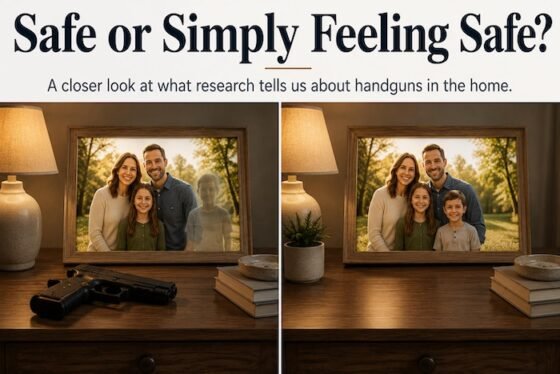
A closer look at what research tells us about handguns in the home.
By Bear Howard and Associates
Sedona, AZ — There is a curious contradiction at the heart of American life. More firearms are owned in the United States than in any other nation, and millions of those are handguns purchased for one simple reason: protection. For their owners, a handgun often represents peace of mind. It is a tangible answer to an uncertain world. It sits in a bedside drawer, a closet, a safe, or beneath a car seat as reassurance that, should the unthinkable happen, they will not be defenseless.
That feeling is real. Whether or not a gun is ever drawn, simply believing it is there can reduce anxiety. The owner may sleep better, travel with greater confidence, or simply feel more in control of life’s uncertainties. It would be a mistake to dismiss that emotional benefit. People do not buy handguns because they hope to use them. They buy them because they hope they never have to.
But statistics have an uncomfortable habit of asking questions that our emotions often avoid.
When researchers have looked beyond individual stories and instead examined millions of households over many years, they have consistently found a paradox. The very object that provides reassurance is also associated with a higher likelihood of tragedy occurring inside the home itself. The increased risk is not primarily from a stranger breaking through the front door. It is far more often the result of suicide, domestic violence, accidental shootings, or moments of intense emotion that last only minutes but have irreversible consequences.
This is where the conversation usually becomes polarized. One side insists that a gun is protection. The other insists that a gun is dangerous. Reality is more complicated than either slogan.
A handgun can absolutely save a life. There are documented cases in which an armed citizen stopped an assault or prevented a violent crime. Those events are real and deserve acknowledgment.
Yet they exist alongside another reality. Public health researchers repeatedly find that households containing handguns experience significantly higher rates of firearm suicide and higher rates of homicide involving family members or intimate partners. These are not political opinions. They are statistical observations collected across large populations over decades.
The difficult question, then, is not whether defensive gun use exists. It clearly does.
The more important question is whether, over the course of an ordinary lifetime, the presence of a handgun increases or decreases the overall safety of the people who live with it.
The best available evidence suggests that the risks outweigh the benefits for the average household.
Perhaps the least appreciated part of this discussion has nothing to do with bullets at all. It has to do with psychology.
A person who owns a handgun often enjoys the comfort of believing they are prepared for danger. That confidence has value. It can reduce fear and increase a sense of personal control.
But another form of peace of mind receives far less attention.
For people who choose not to own firearms, especially handguns, there is often a different kind of security. They do not worry about children discovering a weapon. They do not think about whether it is locked, loaded, or accessible. They do not wonder whether a family argument could escalate because a firearm is within reach. They do not bear the responsibility of safeguarding a lethal instrument day in and day out for years, perhaps decades.
In other words, they experience peace not because they possess a weapon, but because they have deliberately removed one source of risk from their environment.
Neither form of reassurance should be casually dismissed. Both are genuine emotional experiences.
The difference is that only one of them aligns with the long-term statistical evidence on injury and mortality.
This is not an argument that responsible gun owners are irresponsible people. Nor is it an argument that every household should make the same decision. Millions of Americans own firearms responsibly throughout their lives and never experience a tragedy.
Rather, it is an invitation to look beyond the immediate emotional appeal of protection and consider the broader reality that unfolds over decades and across millions of households.
Humans are remarkably good at imagining dramatic threats. We picture the home invasion, the violent criminal, or the terrifying stranger in the night because those events command our attention.
1 Comment
There is a place for the firearms most people feel the need and right to carry- the US Military. Nobody with the exception of well trained specialized law enforcement and military personnel needs anything more than a handgun for self defense and possibly a shotgun for hunting and home defense. Everything else is over the top for what people claim they need them for. Nobody needs an AR, SKS, .308, tech9, uzi, MP5, M60, M2 as many anti government but pro distorted 2nd Amendment sycophants claim and demand.
Everyone who posses a firearm whether legal or not possesses death at the squeeze of a trigger. Most people only think about the self defense aspect while completely ignoring the legal repercussions of making a mistake that costs an innocent person (usually a family member or family friend) their lives while at the very same instance ending their own lives as they knew it prior to pulling the trigger.
Gun ownership should be a privilege (not a right) available to law abiding background check passing citizens who have passed a legal firearms safety course.
The Constitution specifies musket rifle ownership as a requirement and right of “standing militias” which we no longer have since they were replaced by a Federal Military. The so called militias we do have are nothing more and nothing less than anti government extremist hate groups just like the Aryan Nation and KKK. Granting them the right to bear arms was never part of the founders equation for 2nd Amendment rights.