

By Shairi Richards
Sedona, AZ –It’s election time again in Sedona, and I find myself taking time away from my usual creative pursuits to more deeply explore the issues facing my beloved town.
One thing I can tell you for sure: some people are feeling angry, and they’re letting it be known.

Some people are upset about the parking garage in Uptown and the issues that remain unresolved there. Some are unhappy about the adobe-colored sidewalks (known as shared use paths, or SUPs) being built in their neighborhoods; others love them. Some object to affordable housing projects being developed in the city, while others are clamoring for the opportunity to rent a unit. The future of the Cultural Park and a proposed amphitheater has become another flashpoint. And, of course, there’s ALWAYS the traffic.
In fact, there is so much disagreement over so many issues that it can be difficult to separate one concern from another. Which brings me to this year’s Home Rule election.
What the Heck is Home Rule?
This is my third time writing about home rule. I was first inspired to write about this complicated subject back in 2018 when I posted on my personal Facebook page in favor of home rule and received some very aggressive push back with a lot of facts and figures. At the time I had no way of knowing what was true and what wasn’t. I worked as a radio and TV journalist in my early career, so I decided to find out.
My research resulted in two articles: A Crash Course in Sedona Civics Parts 1 and 2 written in 2018 and 2022. If you’d like the full background, click the highlighted dates. Now it’s 2026 and here we are again. The issues have changed some, but the mechanics of Home Rule have not. Let me explain.
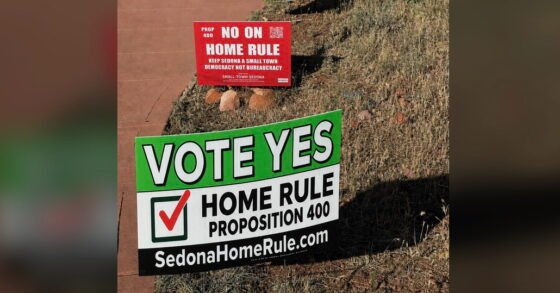
Home Rule is on the ballot this year as Proposition 400. A yes vote gives the city the authority to spend the money it has. Arizona law requires all cities to have a balanced budget, so it doesn’t allow Sedona to spend more than it has. It simply allows the city to spend the money it brings in each year, plus the savings it has tucked away over the years to pay for big projects.
Home Rule is officially called the Alternative Expenditure Limitation, which begs the question, alternative to what? Back in the late 1970s, the state created a spending formula for cities called the State Imposed Expenditure Limitation. It’s based on population and inflation, and it’s a relatively small number compared to the city’s actual budget. When you hear people refer to the “base,” that’s what they mean.
If voters turn down Home Rule, it launches a sequence of events that could force the city into difficult times. Not because the city loses its money. The money would still be there. Sedona just wouldn’t be allowed to spend it. The money would sit in a bank account and all kinds of problems could ensue. If things don’t play out in a very specific way, services will have to be cut. Grants to nonprofits like the library, the Sedona International Film Festival, the Humane Society, and the recycling center would likely be among the first to go.
Arizona cities operating under Home Rule must go to voters every four years for approval. That’s where we are now.
And Then There’s the PBA
You may be hearing about something called a Permanent Base Adjustment, or PBA. When the state formula was created back in the late 1970s, lawmakers recognized that not every city’s needs could be handled under that original formula. So, the PBA gives cities a way to permanently raise their spending limitation by presenting voters with a new, higher number. Once voters approve it, the city doesn’t have to come back for approval unless it needs to raise the limitation or cap even further. Sedona has never raised its base. Instead, voters have approved Home Rule every four years since 1996.
What About a Budget Override?
There’s one more piece of this puzzle worth knowing about: a special budget override. If Home Rule fails on July 21st, the city’s current budget is actually funded through June 30th, 2027, so nothing changes immediately. After that, the city could hold a special budget override election in May 2027 where voters could approve a new budget for one additional year.
If Home Rule is voted down, it cannot return to the ballot for two years. And a Permanent Base Adjustment can only go before voters in a regularly scheduled municipal election year, the next one being July 2028. As you can see, the timing gets complicated quickly. I’ll come back to all of this later, because it’s central to understanding what those who want Home Rule voted down are proposing.
The main group opposing Home Rule this year is a political action committee called Small-Town Sedona. Their spokesperson has said publicly, “All the non-profits will be funded. The city is just using scare tactics. There is nothing to be afraid of.” They describe their alternative plan as a more stable option for funding the city. That’s not really true. Their plan has some serious flaws that I’ll get into later. But first, let’s explore what the city has actually been doing with its money and if they should have the right to spend it.
Should the City Have the Power to Spend the Money it Brings in?
I think this is the question at the root of the Home Rule debate. It’s a question of whether we trust our city government.
First, some civics: we have a city manager style of government. Voters elect a mayor and council. The council hires a city manager, and the day-to-day operations of the city are handled by the city manager and staff. The mayor is the presiding officer, but when it comes to voting, each council member and the mayor have only one vote. So how do they decide what to focus on? That comes from us, the voters, through something called a community plan.
Every ten years, all Arizona cities are required to create a community plan that reflects the will of the people. Completed in 2024, Sedona’s latest plan is designed to guide the city for the next 10 years. The drafting of this plan was no small thing. It was the product of a massive two-year public campaign, a citywide survey, and a 12-person citizen work group. Everyone was invited to participate and many did. Most impressively, the city uploaded the draft onto an interactive platform, allowing residents to edit the text line by line. Nearly 700 locals stepped up to help shape it.
With Sedona’s population falling just under 10,000 in the last census, it meant the city wasn’t legally permitted to put the Community plan up to a vote of the people. Laws are complicated, but it’s my understanding that it’s a state restriction. The city did try to get the legislature to pass a bill that would allow our community plan to come to a vote, it passed the House, but unfortunately died in a Senate committee. Even so it was a very public and community driven process.
What’s in the Community Plan?
The Community Plan is full of great information about where the city is headed. If you want to explore it in detail, you can find it here.
https://www.sedonaaz.gov/home/showpublisheddocument/51968/638562902536270000
Here’s a quick look at what our residents came up with as issues for the city to address:
- Traffic: Alleviating chronic backups and getting cars off our roads.
- Housing: Building affordable units on the 18% of buildable land we have left, while dealing with state laws designed to protect short-term rentals and limit local control.
- Tourism: Shifting from marketing to visitors to actively managing them.
- Recreation: Managing overwhelmed trailheads and the explosion of off-road ATV traffic.
- Sustainability: Protecting Oak Creek, reducing wildfire risks, and conserving our desert environment.
- Regional Planning and Community: Governing a town that straddles two counties, two state highways, and federal forest land, while supporting a shrinking resident population priced out by high housing costs.
- Arts and Culture: Nurturing gathering places so the arts remain a living part of our local identity, not just a tourist draw.
Of course, the devil is always in the details, but I personally am in agreement with much of what the Community Plan lays out. So, we have a set of priorities as laid out by the plan, but how do we pay for them?
Let’s Talk About the Money
Where does Sedona’s money come from? Mostly from people who don’t live here: our wonderful and often problematic tourists.
Sedona has no city property tax. None. When you pay your property tax bill, that money goes to the county, the school district, and the fire district. Not one penny goes to the City of Sedona. That’s unusual, and it’s worth knowing.
The city runs primarily on two taxes. A 3.5% sales tax paid by everyone who spends money in Sedona, residents and visitors alike. And a 3.5% bed tax on top of that, meaning visitors pay a total of 7% in city taxes on every overnight stay, hotels, short-term rentals, all of it. The city also receives other monies from fees, state funding, and interest on its savings. But sales and bed taxes, mostly paid by our visitors, account for a majority of the money coming in.
Within the city’s 3.5% sales tax is a dedicated half-cent tax. That tax amounts to just half a penny on every dollar you spend and was added in 2018 specifically for traffic mitigation. It funds roads, roundabouts, shared use paths, and the shuttle system. It was originally meant to be temporary, but in 2021 the council made it permanent. It now generates about $4.8 million a year for transportation projects, and in a town where traffic is the number one complaint, half a cent on the dollar seems like a reasonable trade.
So that’s the picture: a city funded primarily by its visitors, with no property tax burden on residents, and a dedicated transportation fund for the traffic problems we all complain about. Plus, since 2022, the city has maintained a strong financial position, paying off debts early, fully funding it’s reserves and building a healthy cushion for tough times. Sedona has plenty of money. Home Rule answers the question: should the city be allowed to spend it?
Is the City Spending Well?
Deciding what to do and implementing solutions are two different animals. And solutions can be expensive. When I wrote my first article in 2018, the city employed 142 people and the budget was about 47.5 million dollars. Today there are 206 employees and the budget has nearly doubled to 97.9 million dollars. There are 64 more employees now than there were 8 years ago.
What are they all doing? Some of the new staff members were assigned to departments that already existed. More police officers were hired to handle the public safety demands of our town. On a busy spring weekend our population of just under 10,000 can bloom to upwards of 35,000 people, making us comparable to a much larger city. More public works staff was needed to maintain all our roads and 11.9 miles of new shared-use paths. Plus, more planners were added to manage the short-term rental permit program and the new community plan.
But the bigger story is departments that didn’t exist in 2018 at all. The Sustainability Department was created in 2019. The Housing Department is new. The city’s transit system which now logs over 350,000 rider boardings and removes more than 129,000 car trips from our roads every year, didn’t exist. And the Parking Garage Fund is brand new for this coming fiscal year.
Most of those 64 new employees are working on things residents said they wanted addressed: traffic, housing, sustainability, and the impacts of too many visitors on too small a town. You can debate whether the solutions are working. But the staff growth largely tracks the problems we asked to have solved.
It’s also worth noting that for the newly adopted 2026/27 budget City Manager Anette Spickard introduced zero-based budgeting, a new approach that requires every department to justify its spending from scratch rather than simply adding to last year’s numbers. Staff growth has slowed to a minimum as a result, and this year’s budget actually came in lower than the year before by several million dollars. The city is making a conscious effort to tighten spending.
Based on my research, the city maintains an exceptionally strong track record of fiscal accountability. For thirteen years running, Sedona’s budget transparency has earned the top presentation award from the Government Finance Officers Association. But you don’t have to rely on a presentation award to judge the city’s fiscal health; the hard data is independently verified. Every year, an outside accounting firm thoroughly audits the city’s books. In the independent audit delivered in this year, the city received a completely clean, ‘unmodified’ opinion. The auditors confirmed there are zero material misstatements in the city’s records. That’s a level of financial health and transparency worth knowing about.
What About the Traffic?
Traffic wasn’t always Sedona’s defining problem. When I moved here 34 years ago, it wasn’t much of an issue at all. These days, it can be our most frustrating daily reality, especially on holiday weekends and during peak tourist seasons.
So, what is the city actually doing about it? More than many people might realize. When critics point to the growth in the city’s budget over the last several years, this is exactly where a significant portion of that money has gone. Major traffic mitigation and transit projects aren’t cheap, but traffic solutions are among the top priorities identified by residents during the community plan process. And the city has come up with many solutions designed to improve traffic flow under their program called Sedona in Motion.
Here’s what they have accomplished so far:
An Extra Southbound Lane in Uptown
A few years ago, if you spent a weekend in Flagstaff and returned to Sedona via the 89A switchbacks, you could easily find yourself sitting in a backup at the edge of Uptown for an hour or more. Through Sedona in Motion, the city funded an additional southbound lane on 89A, and we rarely sit in traffic coming home from Flagstaff these days.
The New Forest Road Extension and the Pedestrian Underpass
The city has also completed the Forest Road Extension, creating an alternative route that allows drivers headed to Uptown or on to Flagstaff to bypass the Y. I have been using it often. It may not be pretty yet, but it works. It did come with a steep price tag, though, unexpected construction hurdles and delays practically doubled the final cost to over $17 million. But that is a prime example of why a city needs the budgetary flexibility that Home Rule provides. When unpredictable infrastructure realities strike, a city has to be able to navigate those shifting costs without having its hands completely tied legally.
The pedestrian underpass at Tlaquepaque is also proving to be an important tool. When the crosswalk is closed and people are directed to use the underpass, traffic flows noticeably better. The city is now working on automating that closure so it can be used more effectively during busy periods.
More Improvements are on the Way
Additional roundabout improvements and roadway connections are also in the works as part of the next phase of Sedona in Motion. I recently came across a city-produced video that does an excellent job of explaining how these projects are intended to work together, and I found it very helpful in visualizing the overall plan. You can watch it here.
https://www.youtube.com/watch?v=aVFE8-Ida9Y
New Technology is Here to Help
The city is also turning to technology to help keep traffic moving. Seven smart traffic cameras have recently been installed along SR 89A in West Sedona. These systems monitor traffic in real time and automatically adjust signal timing based on actual conditions. I have noticed in recent days that I am hitting fewer red lights. So far it seems to be working. New technology is also planned for the Y roundabout where we will soon get a traffic metering system. Drivers will no longer be allowed to drive into the circle and just sit there waiting as they block others from moving through. The meters will determine when a car will be allowed in, helping to alleviate the gridlock.
The Sedona Shuttle is Doing its Job
The Sedona Shuttle is another major component of the city’s strategy. Its purpose is simple: remove visitor vehicles from our roads before they ever reach crowded trailheads and congested intersections. Since launching in 2022, the shuttle has carried more than a million riders, reducing traffic and parking pressure throughout the community.
Then There’s the Parking Garage
The parking garage is probably the most controversial project of this election cycle, and I want to address it honestly. The idea of an Uptown parking garage is not new. The city has been studying parking challenges in Uptown for roughly two decades, conducting multiple studies and public discussions along the way. By the time the final construction contract was approved unanimously by the City Council in May 2024, the issue had been examined for years from a variety of angles. Whether you agree with the decision or not, (and city council members themselves wrestled over the soaring price tag before their final votes) the process itself was not a rushed one.
The contract was procured through a Construction Manager at Risk (CMAR) process, a recognized competitive procurement method commonly used by Arizona municipalities. The way it works is that instead of just picking the lowest bidder on a finished blueprint, the city puts out a public call and construction firms openly compete to be selected based on their experience, track record, and fee percentages. The chosen builder is then legally locked into a guaranteed maximum price to protect city funds from runaway costs. Anyone can look up the state rules on it if they want to know more, but the bottom line is that characterizing the project as a ‘no-bid contract’ is just not accurate.
Is it expensive? Yes, about $26 million for 270 parking spaces. Has construction taken longer than expected? Yes. And questions remain about where Uptown employees will park. Those are legitimate concerns, and the city has convened an Uptown Parking Work Group specifically to tackle them. Residents can certainly disagree with the decision, but after years of studies, public meetings, and council deliberations, it is difficult to argue that the process was rushed or lacking in public discussion.
There are many other projects in the city budget addressing housing, wildfire protection, and arts and culture. I can’t do justice to all of them here, but the newly approved fiscal year 2026/27 budget will soon be available for download at the city’s website if you’d like to explore it.
Is every project perfect? No. Governing a world-class tourist destination surrounded by national forest is genuinely hard work, and not everything goes according to plan. But I see a city that is trying methodically, with public input, to address the issues that we as citizens have identified.
The question isn’t whether the city has made every right call. The question is whether you want a city government with the resources to keep working on our problems. No matter who you vote for on July 21st, the council will need resources to do its work and plan a city worthy of the beauty Sedona comes by naturally.
Planning Makes the Difference
I think Sedona is a beautiful city. We can argue about the art sculptures in the roundabouts, or debate whether certain new buildings fit the aesthetic we love. But on the whole, it’s really lovely to drive down the streets of Sedona. That doesn’t happen by accident.
In this country, people have a right to develop their land, and that’s not going to change. What a city government can manage is how that development looks and what goes where. Sedona has some of the strictest design and zoning standards in Arizona. We have the only McDonald’s in the world with turquoise arches, because our sign and color codes wouldn’t permit the standard yellow ones. Without those standards, Sedona could easily look like any other unplanned rural town, generic commercial sprawl with no sense of place. I’m sure you know what I mean.
Good planning doesn’t get much credit, but it’s one of the things that keeps Sedona beautiful. Planning costs money. Which brings me to the main opposition to Home Rule this year, and their very different vision for Sedona’s future.
The Opposition: Small-Town Sedona
The main group opposing Home Rule this year calls itself Small-Town Sedona, a local political action committee whose tagline is “Democracy over Bureaucracy.” They aren’t new to this fight. The same voices have been opposing Home Rule since my first article in 2018, though the organization has gone through a couple of name changes along the way. The arguments have evolved some, but the core position hasn’t.
Their website states plainly that “quality of life in Sedona was far better back when there was no city of Sedona,” meaning before 1988 when the city was incorporated. And if Home Rule fails, their preferred outcome is, in their own words, “returning to a reliance on community organizations and nonprofits staffed by volunteers, as historically was the case in Sedona prior to its incorporation in 1988.” Their vision seems clear. The plan for how it would actually work is not. Who would the volunteers be? What would they do? How would a city of nearly 10,000 people, visited by millions each year, keep functioning?
Even so, I understand that longing for the Sedona of old. As a long-time resident, I remember it well. But nostalgia isn’t a governing plan. And the Sedona of 1987 isn’t coming back, no matter how we vote on July 21st.
I attended Small-Town Sedona’s presentation at the library on June 13th, and if you’d like to see it for yourself, you can watch it here:
https://www.youtube.com/watch?v=43hrODTKQdg
Their Plan and Its Problems
So, what exactly is Small-Town Sedona proposing if Home Rule fails? Their plan has three steps. The city continues operating under the current Home Rule authorization through June 30, 2027. Then a special override election is held in May 2027 to fund the city for one additional year. Then a Permanent Base Adjustment goes on the ballot to permanently reset the spending baseline going forward.
It sounds manageable. But there are some significant problems with it, starting with a factual error in their own timeline.
Under Arizona law, a Permanent Base Adjustment can only go before voters at a regularly scheduled municipal election for governing board members. Sedona holds those elections every two years in the summer. The next one after the July 2026 vote is in July 2028, not 2027. That’s not a minor detail. It changes everything.
As mapped out in the chart below, this scheduling mismatch creates a serious funding gap. Because a Permanent Base Adjustment cannot legally go before voters until July 2028, and doesn’t take effect until July 2029, a single temporary override leaves the city unprotected for an entire fiscal year in between. To avoid falling back under the state expenditure limit during that gap year, the city would be legally forced to hold two separate emergency override elections, not one.
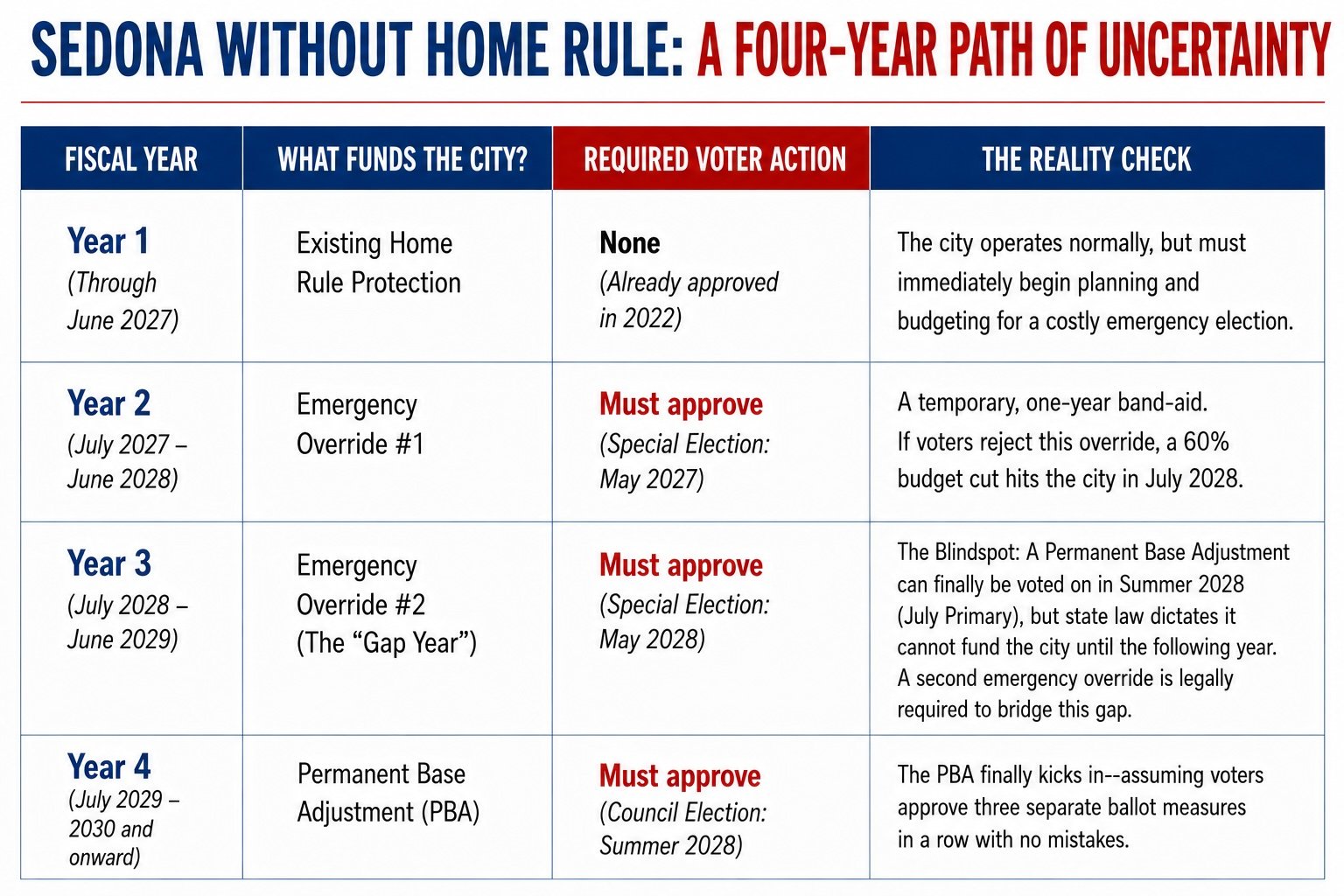
As for the PBA, there’s also the question of the number itself. A Permanent Base Adjustment requires the city to present voters with a specific new spending baseline. Sedona has never done this before. The number has never been set. Getting it right the first time, in a politically divided community, with no precedent to guide it, is a genuine challenge.
Here’s perhaps the most important thing to understand about this plan: even if everything goes right, both override votes pass, and the Permanent Base Adjustment is set correctly and approved in 2028, what do you actually end up with? A city spending roughly what it’s spending now, after years of financial uncertainty and up to $80,000 in election costs. You’ve gone through all of that just to arrive back at approximately where you started.
Two extra elections. Thousands of dollars in extra election costs. Years of budget uncertainty. A number that has to be invented from scratch. And no fallback if anything goes wrong. That’s a significant amount of risk and disruption to take on, especially when we can choose to vote yes on Proposition 400 on July 21.
One Thing Both Sides Agree On
Here’s something that might surprise you: there’s actually a point of agreement in this debate. Almost everyone acknowledges that Sedona’s state expenditure base is badly outdated and needs to be raised. The number was set before Sedona even existed as a city, based on neighboring communities’ 1979-80 spending. That number has never been adequate.
I know this issue from the inside. After my 2018 article, I served on a city-convened citizen work group involving residents from both sides of the Home Rule debate. We were tasked with studying whether Sedona should pursue a Permanent Base Adjustment. We met through late 2019 and presented our findings to council in January 2020. Our recommendation was to stay with Home Rule, not because we couldn’t agree, but because the timing wasn’t right. Sedona was launching its largest capital infrastructure push in history, and you can’t responsibly set a permanent spending ceiling when you don’t yet know what you’re going to need to spend.
That moment may be getting closer. And here’s the good news: voting yes on July 21st doesn’t close that door. A city can pursue a Permanent Base Adjustment while still operating under Home Rule. The PBA conversation should happen, but it doesn’t require defeating Home Rule to start it. If we drop Home Rule before a new base is locked in, we could face serious funding shortages for the city, the non-profits, and many projects we love. Remember, the funding issues are not because Sedona doesn’t have the money. The city has money. But without Home Rule or an adjusted base, the city simply isn’t allowed to spend it.
The Budget Math
Let’s talk money for a minute, because this is where the rubber really meets the road. Small-Town Sedona says the city’s warnings about budget cuts are scare tactics. The city says they’re simply the reality. So, who’s right?
Small-Town Sedona showed a slide at their presentation claiming that under the state expenditure limit, the city could still fund parks, the community pool, special events, recreation programs, and the small grants program that supports our nonprofits. It’s a reassuring picture. But it leaves out the legally required functions: police, streets, wastewater, courts, planning, and the clerk’s office. Those aren’t optional. They’re mandates under state law, and they have to be funded first. Once they are, there is little to nothing left for the things on Small-Town Sedona’s list. The math simply doesn’t work, and you don’t have to take my word for it — the city’s own budget documents back that up.
The reality is that running a city isn’t optional, it’s a legal obligation. Those aren’t political choices. They’re mandates. And the math doesn’t change based on who gets elected on July 21st. A new council, no matter how motivated to cut spending, faces the same legal obligations and the same fixed costs. You can’t wish away a wastewater treatment plant or a police department. There are floors below which you simply cannot go without violating state law or leaving the city unable to function.
So, the question isn’t whether you trust this particular council. The question is whether any council, new or old, can govern a city of Sedona’s complexity within the current state expenditure limit. To me, the answer is no.
And when cuts are forced, it’s the things residents love most that go first, because they’re the only ones that aren’t legally required. Parks, the community pool, special events, nonprofit grants, the library funding, the recycling center — none of those are mandates. They’re choices. And under the state expenditure limit, they’re choices the city simply couldn’t afford to make.
What We’d Be Giving Up
It’s not just about protecting what we have. It’s about what we could build.
Sedona residents have been asking for a recreation center for years. It comes up in community meetings, in the community plan, in conversations all over town. People want more amenities for the people who actually live here, not just the visitors. More affordable housing. Better parks. The next phase of Sedona in Motion. These aren’t frivolous wishes. They’re the kinds of investments that make a town livable for the people who call it home.
Every one of those things requires multi-year financial planning and capital commitment. They require a city that can look ahead, make promises, apply for grants, and follow through. A city operating under annual override elections, going back to voters repeatedly just to keep the lights on, has no capacity to plan anything new. Grant applications require stable funding. Long-term contracts and capital projects require years of confident planning.
A yes vote on Home Rule on July 21st doesn’t mean you’re happy with every decision the city has made. It means you want a city government with the stability and resources to keep working on the problems we all care about, and to build the things we’ve been waiting for.
Here’s Where I Land
Am I happy with every decision the city has made? No. Do I think there are legitimate questions worth asking about specific projects and spending decisions? Yes. But after eight years of writing about this, attending meetings, serving on a citizen work group, and a lot of very thorough research, I keep landing in the same place.
Voting no on Home Rule doesn’t fix the parking garage, doesn’t resolve the Cultural Park question, and doesn’t bring back the Sedona of 1987. What it does do is make it harder for any city government to function, regardless of who’s running it. And whatever direction you want this city to go, it’s going to take money to get there.
The city has money. Home Rule determines whether it’s allowed to spend it. On July 21st, I’m voting yes on Proposition 400. I hope you will too.
Shaeri Richards is a local musician, filmmaker, author, improv artist, and an all-around lover of Sedona.
Author’s Note: This article was first published on the morning of 6/28/2026. It was updated on the morning of 6/29/2026 to refine a few factual details for accuracy. Thanks to Jean Buillet for pointing out the spots that needed correcting.
22 Comments
Very well written and informative. Her detailing the timeline if HR fails is clear, as are the risks and consequences.
All great points of fact. Unfortunately you’re still going to be attacked by the “liar liar” club who want to hold more financial sway with city government so they can personally profit off of building contracts and large events rather than the city garnering the profits and using them to everyone’s advantage. They’ll ignore every fact you have listed and claim you are lying without presenting any actual proof or facts to back their personal money making agendas.
Unfortunately, it appears you have taken the route of selective reasoning to complicate an issue that is not complicated.
Pro home rule or not, either you get it or you don’t. I will vote for NO on prop 400.
Good-bye home rule. In my opinion, the time has come for change to happen in our less than worthy current city government:
Too much disregard for us citizens of Sedona
Excessive over spending on budget,
Costing residence, high water, bills, to their FUBAR on the fake house, covering a damn water tank.
Mixing project budgets under one umbrella, and not being able to decipher how much money was spent on each project
We still don’t know if there was missing money. Can somebody provide factual information on that?
Over-Spending on that car garage you spoke about. Do you know how much each parking space actually cost in the end?
We don’t need housing. Nobody wants to live in those apartments on Shelby and they can’t even get anyone to buy the Navaho loft condos. And you wanna build more high density, housing at the cultural Park. You all know that is a bad idea.
The unfortunate Truth is that those who are hell bent on maintaining prop 400 have no wherewithal to find a way to work with the rest of the Sedona community, rather than to keep us divided. I feel that the community who wants to hold on for dear life to or die on this hill of prop 400, have no interest in fact checking this article.
High water bills are due to supply and demand not city government incompetence. What a weak argument full of holes you present.
Actually Jill Dougherty, the city did not do their due diligence in having quote or estimate in hand before agreeing to a a faux house build. And the assumed az water was going to absorb the cost. Noooo. We are absorbing the cost of an approximate 6 million dollar fake house.
You can fact check me. 🙂 have a great day.
BS! Water rates went up due to over use and abuse of the Colorado River by ever expanding communities who have no water source of their own just as will happen if Sedona does ignorant things like re building an absolute waste of money amphitheater that will draw 3,500+ people who will require water access. The city didn’t jack up rates the Federal government and State did.
What’s a fake house other than the current Federal and State houses?
Oh my looks like your water rates will likely increase even more and the city has zilch to do with it! Be thankful you’re not paying the astronomical Phoenix, Dallas, San Diego or Macon GA water rates or have toilet water for drinking water like Vegas has had to resort to. You pay next to nothing for our precious resource known as H20 compared to most Arizonan’s or Americans from many other states. Having cheap water only encourages wasteful unnecessary usage anyway. We live in the desert not the Andes.
How will Colorado River water cuts impact Arizona? Depends on where you live https://www.azfamily.com/2026/06/30/how-will-colorado-river-water-cuts-impact-arizona-depends-where-you-live/
@Lina Let me take your opinion one at a time.
You will vote to not have home rule: Well what do you think of major cuts to police? Do you know we still are not up to the numbers we had before the crash of 2008. Do you think its easy to get police offerers? You think after having $1,000,000 in reserves is bad, and we will double that sitting in a bank because we cant spend it on citizens if Home Rul fails?
To much disregard to residents? Have you attended any meetings? Filled out surveys in the mail? How about online ones that they send out? I do, keeps me busy. We are lucky to get 25% returned on topics.
To much over spending of budget? Were the hell do you get that? We have a surplus! If you have a surplus that means the opposite…It that just a lie, or uninformed?
High water bills? Well I will agree with that……………………But it wasnt the city that mandated the underground water tank. In fact you should be pissed at the people who live in that area then. Blame the city for neighborhood who even complained about it even being underground?!
Missing money? Who told you that? You do know by law all monies must be audited? And passed? Let me spoon feed you then…………(you know everything is on website dont you?)
https://www.sedonaaz.gov/your-government/departments-and-programs/financial-services/budget-and-finance-reports-and-policies
We dont need housing? Dont tell me you have a roof over your head but screw the people who serve you?
Please ask people at the grocery store, dine out, anyplace in town. How much do you make a year? Where do you live? How much is your rent? You are either afraid of the truth, or just dont care!
The only people I see the division from are the ones who want the city not to run. Why do you not care about our elderly getting meals? Cuts to police sept is a good thing? Traffic can get fixed without spending money? Hell it would be fixed by now if it didnt cost a dime!
Face it you want to blow it all up. Then you can complain that nothing gets done right? Why else do you want to strangle the city you live in, knowing we have many problems that need to be addressed?
Oh dear… pound your chest some more, West Sedona Dave.
You obviously can’t handle the reality that Home Rule has been misused for far too long. No sense in discussing anything with you. You seem to think know what i meant by how I responded…. But, You don’t know me. Don’t assume that i want to blow anything up. So laughable. LoL No need to be so verbally aggressive.
What I would like to see is a balance in our city council; Non- partisan and to allow Sedona City Government to get back on track. With current city council that is NEVER going to happen. And based on the aggressive nature of your response… you seem very upset that i don’t agree with Sherry. Anyway…Have a great say West Sedona Dave!
Prove him wrong then Lina. Crying that he hurt your feelings doesn’t make you right in any sense of the word. Present some actual facts and figures to support your argument rather than whining that WS Dave isn’t playing fairly because he proved you wrong.
JB, You obviously do not know me. or anything about me, because you have made the mistake of underestimating me.Everything you have said, in your response to mine is laughable. I don’t need to prove anything. It’s out there. Don’t be lazy. Go and research it on your own. I already know the answers. I’ve already done the work. If you choose to be lazy and feel loke being a keyboard warrior and verbally knocking women down and in my opinion being boorish about it then I guess that’s just who you are. And yes, this is my opinion of you and how you spoke to me and your response. Don’t mistake The lack of aggressive and vulgar display of emotions in my response for weakness. Seriously, just take a breath and relax. It’s not the end of the world here. Try to enjoy your afternoon.
Lazy people don’t serve their country for 15 years mostly overseas and in combat zones. They don’t sign onto Federal Counterterrorism Teams and combat violent armed foreign and domestic terror.
No lazy people attack people like me without a single fact to back their nonsense. Lazy people want to take rights, food, medicine and opportunity from others less fortunate while scheming to manipulate a city government into a personal money machine.
And lastly, I know female Army Rangers, Green Berets, Marine Infantry, Air Force PJ’s, Federal State and Local SWAT officers and not a single one of them ever said I was being sexist because I asked them the hard questions. Instead they either stood their ground and presented a logical fact based counter argument or point or realized they maybe didn’t have the best answers to key questions and rather than cry sexism they picked their asses up and did their jobs.
Lies and scare tactics. We have way more police than we need. The number keeps going up and up just like the city staff which has doubled in the last 10 years. All the while the population is going down and down. Tell me Dave who is going to pay all these people’s retirement? Cottonwood, Camp Verde, and Clarkdale all on Permanent base. No problems servicing nonprofits and way more municipal services than Sedona. As a matter of fact, 54% of AZ. cities are not on home rule. Home Rule invites corruption and corporate welfare. And as for Sheiri Richards so called article, what a bunch of hogwash. Whitewashing all the wasteful projects trying to make them sound like a good thing is hilarious. Projects like the parking garage that started out at 13 million to 26 million and still going up and Shairi is trying to make that a good thing. Same thing happened with the Forest Road project still going up. But what the hell it’s only money. Very easy to spend when it’s someone else’s money.
Another excellent and informative article on this topic, Shaeri. Thank you!
Shaeri, well done! Thank you!!
Hey Lina! What’s a faux multimillion dollar house and where is it exactly? Surely you’re referring to one of the hundreds of McMansions and estates owned by wealthy monopolist that live here part time? Otherwise you’re gonna have to present some proof of your accusation.
Also, the parking garage looks nearly identical to every recently VA parking garage built over the past 10-15 years. So if the one in Sedona is as ugly as you claim why aren’t you up in arms over our veterans (who have kept you and this country safe) having to use ones just as if not more ugly if seen through your tainted lenses? Guessing if it had faux gold embossment and was owned by a serial liar and criminal you’d be all in on it?
Here’s just one of many VA parking structures I can reference. Now don’t forget to write your Congressional Representatives about how fugly it is and how our veterans deserve better!
https://healthcaresnapshots.com/wp-content/uploads/sites/5/2022/05/va-outpatient-clinic-san-diego-4-1200×802-compact.jpg
Way too complicated explanation:
If you want Big Government ruling Sedona vote No!
If you want local officials ruling Sedona vote Yes.
Some of my reasons to vote NO on Home Rule
Sedona city government is not nonpartisan. It is under Democratic Party control.
The Sedona City government spends millions of dollars in government waste.
Home rule is a money grab.
There are no controls on the city.
Health, welfare, and safety don’t matter to the city.
City lies, no trust in the government.
People have no say in government spending.
Discrimination on residents and other party affiliations that are not democrats.
City makes huge financial mistakes without accountability.
City calls residents nimby cows as well as other names.
Rampant corporate welfare, Chamber, Library, and other groups.
City uses a grant program to control voting.
Corruption.
Can’t follow all the money, slush fund.
City shows disdain for the people.
Years and years of Home Rule. How’s it working for you?
City does everything in a panic, crisis mode.
Made up housing crisis.
City rams’ projects down the people’s throat. Parking garage travesty. Ugly uptown.
Roundabouts. Traffic flowed better with traffic lights at the Y.
Schnebly hill should be paved.
Traffic, Traffic, Traffic.
Population decreasing. Chasing the people out.
Over taxation. City could decrease taxes without the Home Rule.
Paving over Sedona. Too much concrete.
City polls are manipulated to get the answers the city wants.
Change crossing guards to traffic lights.
Big Government small town.
City picks and chooses who they let be involved in city work groups.
City picks and chooses who to go after based on whether you support their agendas.
Overblown budget. Greed.
City has doubled the number of employees. 45 city employees make over $100,000 While working people struggle to make a living. Police department is growing and growing.
Two city council members sit on the board of the Democrats of the Red Rocks. Huge conflict of interest.
City sued the residents over the cultural park.
City chooses who to give service contracts to without getting competitive bids.
City had all the residents’ water bills go up significantly through their ineptness.
The City Council has important votes when most people leave town.
A NO on Home Rule would force a city reboot.
Even though the residents that think they do better because of Home Rule would do much better with a well-run city with residents’ involvement. The people need to take back their power.
“Lies and scare tactics. We have way more police than we need”
Oh really now, how many officers are employed by the Sedona PD. How many are patrol qualified? How many have advanced investigative training? How many are SWAT qualified? how many are traffic accident investigator trained?
How many officers are on shift at any given time? last I checked it was 2-3? That’s hardly enough to respond to two or more critical incidents happening at the same time especially if they are miles apart. 2-3 Officers cannot handle the traffic, parking and security of your mega music venue while also patrolling the rest of the city as required. Hell 2-3 officers could barely handle the parking nightmare from one of your events. They barely patrol our neighborhoods because they’re so preoccupied responding to accidents, medical emergencies and speeders. Yes speeders which traffic circles are designed to slow down and prevent stupid careless accidents by people who want to get everywhere fast fast fast!
So who is it that lies and uses scare tactics? Certainly not I!
Schnebly Hill is prone to rockslides and excessive flooding and it is not City owned. So that’s a non starter.
Overblown budget? I really don’t think the state allows for that so that’s bullshit.
Somebody has been shovel feeding you a whole lot of nonsense and lies!
And as for the ugly parking garage. Once again it is as nice or nicer than any the VA has built in the last 10-15 years for our veterans. So if you take issue with appearance over functionality you should start by writing your Congressional reps and demand better for our veterans. Then maybe your petty little argument would hold some weight rather than sounding like a baby having a temper tantrum for not getting their way on everything?
Wow you just confirmed my definition of TDS for me! Thanks TDS Dana!
Nice article Shaeri!