

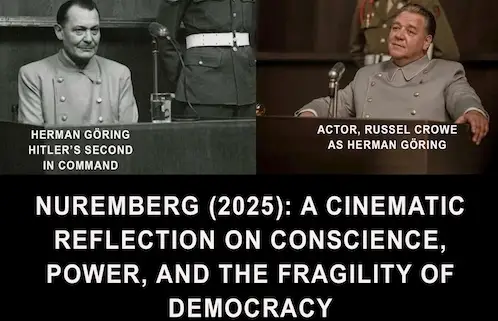
By Bear Howard
I just saw Nuremberg at the Harkins Theatre in Sedona. It powerfully retells the postwar trials of Nazi leaders, but it’s more than history. This film is a mirror—reflecting the moral and political cracks in our own democracy. Director James Vanderbilt’s story warns how truth fades, institutions weaken, and ordinary people look away until it’s too late. Watching is not easy, but it’s necessary. Our citizenship depends on seeing what’s happening and learning from it. This is not about Nazi Germany returning—it’s about preventing the same blindness here. So, see the film. Let its discomfort do its work. Let the images of reckoning challenge the myth of our invulnerability. – Bear Howard
A deep dive into Nürnberg, the movie.
The 2025 release of Nuremberg arrives not merely as another historical film but as a cinematic event steeped in moral urgency. Directed by James Vanderbilt and adapted from Jack El-Hai’s The Nazi and the Psychiatrist, the film dramatizes the Nuremberg Trials—the Allied effort to prosecute Nazi leaders for crimes against humanity after World War II.

Yet, beneath the courtroom scenes and historical precision lies something more provocative: a moral meditation on the ease with which civilization can decay, the malleability of truth, and the slow surrender of moral courage in the name of normalcy.
As American and global politics face increasing stress—polarization, populism, mistrust of institutions, and democratic backsliding—Nuremberg feels less like a retrospective and more like a mirror. Its timing seems less coincidental than providential.
The original Nuremberg Trials (1945–46) were unprecedented. For the first time in human history, victors convened a legal proceeding to hold state leaders personally accountable for crimes against peace, war crimes, and crimes against humanity. The trials exposed the bureaucratic structure of evil—the clerks, lawyers, and officers who transformed ideology into machinery.
The defendants—Göring, Ribbentrop, Speer, and others—were not monsters by birth. They were bureaucrats, professionals, and patriots who rationalized their actions as obedience, necessity, or duty. It was precisely their normalcy that shocked the world.
Vanderbilt’s adaptation captures that psychological paradox through the character of U.S. Army psychiatrist Douglas Kelley, whose interviews with the defendants probe the nature of conscience. The film’s central question—“How could intelligent men believe they were right?”—is not confined to 1945. It is universal and timeless.
Nuremberg resists the impulse to dramatize war spectacle. Instead, it dwells in quiet dread—the sterile courtroom, the endless testimony, the bureaucratic tone of moral collapse. Its visual palette is subdued, its dialogue disciplined, its tone forensic. The effect is chilling: evil becomes procedural, not passionate.
By avoiding cinematic excess, Vanderbilt directs the viewer’s focus inward. The horror is not only what is seen, but what is understood—the recognition that atrocity is often executed not by fanatics alone, but by ordinary men convinced of their own necessity.
This restraint makes Nuremberg profoundly unsettling. It does not invite pity or outrage; it demands introspection.
The decision to release Nuremberg in 2025 gives the film resonance beyond its script. The United States stands at a moment of deep civic anxiety. Faith in government, media, and justice has eroded. Political violence—once unthinkable—is no longer unimaginable. Public discourse has fractured into echo chambers, and truth itself has become a contested territory.
In such an atmosphere, Nuremberg functions as both history and prophecy. Its portrayal of moral blindness under authority evokes the question: Could it happen again?
The answer is not a matter of prediction, but of vigilance. The mechanisms of democratic decay—disinformation, scapegoating, moral relativism—do not announce themselves with fanfare. They accumulate quietly, normalized by repetition and fatigue. Vanderbilt’s film appears to be a cinematic antidote to that fatigue—a moral stimulant reminding viewers that decency without courage is merely politeness.
Hannah Arendt’s phrase “the banality of evil” remains the conceptual cornerstone of understanding totalitarian behavior. Nuremberg echoes Arendt’s insight: evil does not require demons; it requires administrators.
The film’s portrayal of Göring, Speer, and others illustrates how self-justification becomes the most dangerous human instinct. They were, as Arendt wrote of Eichmann, “terrifyingly normal.”
In a democratic context, the lesson is not that America risks Nazism—it is that every democracy risks decay when its citizens surrender their moral autonomy to partisanship, ideology, or despair. The most insidious authoritarianism is not imposed; it is invited.
Across the Western world, truth is being contested with the same tools that once protected it. Information technology, political propaganda, and performative outrage have eroded the distinction between reality and rhetoric.
Nuremberg thus becomes a lens through which to examine the fragility of shared moral language. The trials once reaffirmed that certain acts—genocide, aggression, systemic cruelty—stood beyond the limits of justification. In the present, that moral clarity feels endangered.
The film’s courtroom scenes—each line of questioning, each evasive answer—reflect the contemporary public sphere: argument as theater, accountability as performance.
The lesson Nuremberg offers the modern viewer is simple but severe: democracy is not self-sustaining. It requires active moral labor.
To watch this film is to confront a civic test: Are we willing to endure discomfort to preserve the truth? Are we capable of recognizing the embers before they ignite?
The answer cannot come from governments or leaders alone. It comes from citizens—their vigilance, their courage to speak, their refusal to normalize decay. The power of Nuremberg lies in making that recognition visceral.
Nuremberg is not a museum piece. It is a mirror. It reflects the perennial struggle between conscience and conformity, between truth and convenience.
In the film’s final moments, justice is rendered, but it is not triumphant. It feels fragile—like democracy itself. Watching it today, we understand that the courtroom at Nuremberg was not merely a reckoning for Germany. It was a warning to every generation that follows.
The message is clear, if uncomfortable: civilization is a choice we must keep making. Each act of silence, cynicism, or moral laziness chips away at its foundation.
The real test of Nuremberg is not whether audiences can endure its difficult scenes—it is whether they can leave the theater resolved to defend what those trials once defined: that humanity, dignity, and truth are worth standing up for, again and again, before the embers become flames.
Here is a thorough analysis of the film, and its historic perspective: https://www.smithsonianmag.com/history/the-true-story-behind-nuremberg-a-wwii-drama-about-hermann-gorings-cat-and-mouse-game-with-an-american-psychiatrist-180987621/
References
- El-Hai, Jack. The Nazi and the Psychiatrist. PublicAffairs, 2013.
- Arendt, Hannah. Eichmann in Jerusalem: A Report on the Banality of Evil. Viking Press, 1963.
- International Military Tribunal. Judgment and Sentences of the International Military Tribunal. Nuremberg, 1946.
- Vanderbilt, James. Nuremberg (film), Paramount Pictures, 2025.
- Snyder, Timothy. On Tyranny: Twenty Lessons from the Twentieth Century. Tim Duggan Books, 2017.
1 Comment
Great review of a great movie. I also recommend Son of the Century-Mussolini which is also a mirror of what is happening in our country under MAGA and it is based on the birth of the fascist ideologies MAGA is using as propaganda and power grabbing today. Not only in M’erica but the UK, France, Italy, Germany, Serbia, Hungary and even Japan thanks to Insurrectionist Steve Bannon, Steven Miller and all of their White Supremacist Proud Boy black shirt Nazi thugs spreading Nazi fascist ideology in those countries during King Nothing’s first KOTUS crime spree through present day. Which is precisely why MAGA had VOA shut down, so that the words of Democracy Freedom and Liberty that was their message did not conflict with the fascist messaging of MAGA and the Orange idiot. Oh and the blackshirts also collaborated with Rusher to spread their hate filled messaging which Fascist Putin absolutely loves!