

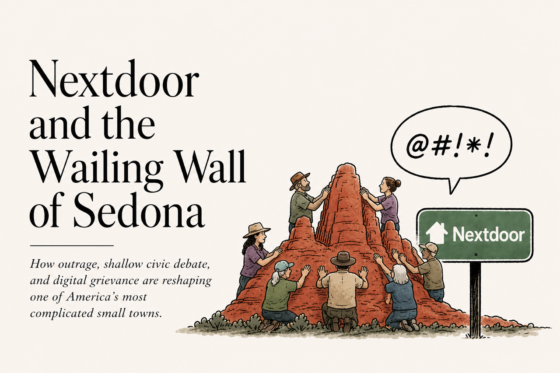
How a neighborhood app became a megaphone for outrage, shallow civic debate, and the growing divide between grievance and governing in one of America’s most complicated small towns.
By Bear Howard and Associated
Sedona, AZ — In communities like Sedona, platforms like Nextdoor often evolve into something far removed from a true civic forum. Instead of becoming a place where informed citizens exchange ideas rooted in history, economics, infrastructure realities, and the long-term challenges of governing a tourism-driven community, it frequently becomes what many quietly refer to as Sedona’s “Wailing Wall” — a digital gathering place where frustration is amplified, context disappears, and negativity becomes its own form of entertainment.
Many of the loudest voices are people who may have lived in Sedona only a handful of years, yet speak with sweeping certainty about issues that are deeply complicated and decades in the making. Discussions about Home Rule, the future of the Cultural Park and Western Gateway, whether an amphitheater should be rebuilt, the anti-housing Initiative Proposition 400, workforce housing, or city employee salaries often unfold without even the most basic understanding of how Sedona is funded, how tourism sustains city services, what state law requires, or how land-use regulations actually function.
There is little recognition that Sedona operates under the same legal, environmental, and administrative burdens as much larger cities while relying heavily on visitor-generated revenue to survive. Instead, complex civic questions are reduced to emotional declarations, suspicion, and reactionary slogans.
One day it is outrage that some city employees earn more than $100,000 a year, without understanding the realities of today’s labor market or the complexity of running a city flooded with millions of visitors annually. The next day, it demands that no housing of any kind ever be built at the Western Gateway, with little discussion of workforce realities, regional economics, or the unintended consequences of forcing workers farther and farther away from the community they serve.
And now, layered into all of this, is an election season where several candidates for mayor and city council appear to have emerged almost overnight, recruited less out of a long-standing commitment to civic service and more out of generalized frustration with the city itself. To outside observers, it can sometimes feel less like a thoughtful movement with coherent policy solutions and more like a coalition built around grievance — a persistent belief that government is inherently suspect unless it bends entirely to one’s personal worldview.
That perception becomes difficult to ignore when the tone mirrors the same style of populist outrage politics that has exhausted much of the country over the past decade: suspicion replacing expertise, slogans replacing policy, anger replacing problem-solving.
No one is saying Sedona is a miniature national political battlefield, but the resemblance can feel familiar at times. The irony is that while this style of politics promises to “take back” communities, it often produces more heat than light, creating an atmosphere in which cynicism becomes a substitute for knowledge.
Meanwhile, the actual work of governing a complicated town — balancing tourism, environmental protection, housing pressures, infrastructure, public safety, transportation, and economic survival — remains stubbornly difficult and deeply nuanced. Healthy communities require disagreement, debate, and accountability.
But they also require informed citizens who understand that governing is not performance art, and that endlessly venting discontent into the digital ether is not the same thing as building a functional future.
Yes, Nextdoor has increasingly become Sedona’s digital ‘Wailing Wall’ — a place where frustration echoes endlessly, facts often arrive late, and discontent is mistaken for civic engagement.
21 Comments
Good analysis but there’s far more to the highly censored, biased App known as Nextdoor. It’s also loaded with paranoia about cars stopping in a driveway or turning around in front of a neighbors house. It’s loaded with hateful comments about the homeless. There’s conspiracy theorists who don’t comprehend that commercial aircraft leaving con trails do so because at their normal flight altitude of 30,000+ ft the average temperature is -40• thus causing exhausted fuel mixed with heated oxygen that freezes and become ice particles that are small and light enough to hang in the atmosphere for various periods of time based upon UV radiation, winds and other atmospheric conditions. Nextdoor is a tragic reflection of how and why we are where we are today and it’s sheer madness to say the very least.
Great post and great comment. I love the metaphor of a wailing wall.
There is nothing culturally or religiously significant about Nextdoor. It is more like an asylum where the insane, the ignorant, the angry and the insecure gnash their teeth and beat their chests. Otherwise I agree with your analysis Bear.
More like the wall of pissing, moaning, conspiracy and paranoia as TJ has stated.
I was repeatedly banned from NextDoor by its “local site management” propaganda arm simply for responding in kind using the same type of language as the posters I posted against. They claimed I broke “the rules” by doing exactly what the people I posted against were saying and doing, only my point of view wasn’t all things MAGA so I was banned with bias. None of the pro MAGA lies and propaganda were ever censured or banned, only the ones who ran counter to them. Which is why I post on Sedona.Biz rather than MAGA’s Nextdoor psychological warfare app. At least some of my posts make it on here with minimal censorship. And so do everyone else’s.
Tommy doesn’t want to talk about Trump and MAGA all day everyday (despite their being in the news all day everyday for ludicrous reasons). I get that, but America cannot afford to let this clown show called MAGA get away with their high crimes and misdemeanors against the country and the world as a whole. It should be called out regularly and using the same callousness that those in MAGA have been using since before they were MAGA, the Tea Party or even Republicans (before women and minorities were given rights and then they bailed from their then party- the DNC!
I take no pleasure in combating tyranny, racism and hatred using harsh tactics but harsh tactics are the only tactics MAGA listens to. Then they cry and whine that people are calling them out for the racist haters they are. They love to say that if you are Anti Fascist that you are a Domestic Terrorist and un American! Well I was raised in a family loaded with combat veterans in it most of whom came home severely wounded and permanently disabled and up until Trump/MAGA came along I never once heard such ignorance! America has fought fascism and tyranny since WWI. Yes America had its Nazi Party, KKK, violent anti Government Militias and violent anti government biker gangs lurking just beneath the surface of normalcy. But now they are operating out in the open- boldly and unabashed about the hatred and violence they represent. Until Trump the US Government dedicated itself to maintaining surveillance of these haters. Now they’re going un surveilled and get pardoned for their violent crimes as the Proud Boys, Oath Keepers and other true Domestic Terrorist and criminals of J6 were pardoned by the criminal who incited them to act with violence in the first place.
Americans have been killed by DHS/ICE, all rights for minorities and women have been eliminated, the SCOTUS and DOJ have been weaponized by MAGA to do their dirty work for them so they can commit crime after crime with impunity. Our economy is absolute shit! The country is engaged in yet another Middle Eastern quagmire war, our country and world a being ravaged by climate change catastrophe after catastrophe while Trump and his criminal cronies make illegal money off of the chaos rather than addressing the causes and fixing them. Gas and grocery prices are at record highs and the only thing Trump and MAGA have to say is “I don’t think about the American people” and “get out and travel more” with the money you don’t have but they sure as hell do!
Yeah, I could stay silent about all this horse shit Trump and MAGA are pulling. But I absolutely won’t! Staying silent allows lies and propaganda to become believable. Silence will not fix anything it will only be met with more crime, arrogance, violence and ignorance than we already have with Trump/MAGA. I have to wonder, what if we went back in time to the Führer time period of Hitler’s insurrection upon the German Government and his subsequent war upon the world if those in MAGA would be cheering for Hitler as they have Trump? Or would they have been Patriotic Democracy loving Americans? Sadly it would have been cheers for Hitler rather than bullets. And therein lies the problem with remaining silent while hatred and fascism rears it’s fugly head!
Talk about pissing and moaning and conspiracy and paranoia – you just personified it, along with whining!!! It’s what I would expect from an ultra lib, though!!!
I just state truth and facts regardless of what you ASSume is truth and fact via your Alternative Facts fascist propaganda machine known as Alt Right Media or to the laymen- Uktra Fascist Nonsense. Go back to your ridiculous claims about the Chinese military battalions secretly based here by Biden because that was the sanest period of your brainwashing by Russian State Media.
Wow! So much for civility!
Do you get dizzy up on your high horse?
Articles like this are so pathetic. You people repeatedly advocate for fewer spaces for engagement, less democracy, and pretend like you’re the smart ones in town… with all the correct morals as a bonus. And you seem to really believe it too.
It’s quite the spectacle, but it’s overcooked now. Tiresome and lame. Please consider getting a mirror.
I guess it’s time for me to open a NextDoor account…
Democracy is not rounding people up and deporting them for minor or non existent crimes. Democracy is not eliminating rights for everyone except wealth white people who blindly support the crimes of the current administration. Democracy is not covering up the Epstein files and placating the number one co-conspirators Maxwell and Trump. Democracy is not changing voting laws 5 months prior to an election and while voting is already underway.Democracy is not a self enrichment POTUS who cuts taxes for his wealthy donors and sycophants. Democracy is not anything MAGA claims it to be. You’re extremely confused about what Democracy truly is and it is not the curren status quo.
Guess it is you that needs the mirror Mr Delusional Fact denier?
Yes please do go to Nextdoor where your ignorance can grow and thrive with like minded morons.
Nah, I get dizzy listening to lies and bullshite spread by wankers who haven’t got a clue. I see MAGA sycophants are worried and desperate about mid term elections.Trump’s ratings sit like the turds they be at the bottom of his gilded golden toilet throne. We all know how he feels about ratings- low ratings= low IQ’s, failures and criminality while- high ratings= Intelligence, Success and legal legitimacy. Good luck spreading your nonsense after MAGA loses Bigly in November mate.
Is a high horse the same as a 2 story gold leaf statue of myself? Asking him who frequently rides a high horse full of lies, bigotry and corruption.
“Articles like this are so pathetic. You people repeatedly advocate for fewer spaces for engagement, less democracy, and pretend like you’re the smart ones in town… with all the correct morals as a bonus. And you seem to really believe it too”
Wow! Straight from Charlie Kirk’s mouth to your brainwashed ears huh?
I wish somebody could post a link to the story on Nextdoor. I bet you ot lasts about five minutes before it was taken off.
It would be a good experiment!
BH
I would but very proudly I’m banned for life by the Nextdoor Gestapo.
This rather elementary oped by Bear Howard seems to advocate for limited change in Sedona when significant change is what is really necessary and has been necessary for years. Domination by ultra lib interests has destroyed any fiscal accountability in Sedona and tons of wasted money. Bear complains about newbies coming to Sedona, but what is needed is new, fresh perspectives and ideas rather than believing that doing things the same way will result in better outcomes. That is insanity!
Lib, Lib, Lib! It’s not liberals, democrats or even independents who are currently destroying this country. It’s wealthy swamp monster Epstein Class individuals of MAGA who have trampled upon laws, norms, precedent and Constitutionality. Every time the GOP has held the majority they’ve started foreign wars, destroyed the economy, destroyed our environment and are currently destroying our country and Democracy. Those are facts not paranoid conclusions derived from propaganda on the Fox News, RT, Lies Social or News Max.
Yes Bruce let’s expand Sedona like Silicon Valley! Let’s build a big arena and lots of expensive unaffordable and unattainable housing. Let’s build more resorts with golf courses and pools that suck our water table dry. Let’s scheme to make money hand over fist while destroying what it is that draws tourists to Sedona in the first place: it’s natural beauty not its McMansions or event infrastructure.
And when the novelty of your arena wears off again (and it most certainly will if it ever even gains traction), we’ll be back to where we are now: a piece of junk sitting upon a so called “heritage site” that nobody uses ever again.
New ideas like your DOGE idea? Well the actual DODGE under Trump and Musk illegally and unlawfully put hundreds of thousands of mid and lower level government employees out of work, shut down crucial to human life non profits like USAID (which could’ve been useful, I dun-know say in Gaza, Ukraine, African nations out military are currently deployed in, and the Post Iran War Crime Excursion that has cost 14 service members their lives, depleted our national weapons stockpiles, destroyed billions of dollars worth of US military aircraft and equipment and costs US taxpayers over a billion dollars a month just to have the military assets we’ve deployed there able to stay on station in the region. And let’s not even go into the devastation it has caused the global and US economies and worldwide fuel prices.
What’s your Bigly plans for Sedona that are so superior to what we have now and what has been tried and failed in the past? How does the Sedona City Government make life for all who live and work here a better place to live and work? Where will you house everyone who wants to live and work here? How will you sustain the water and electrical usage increases that come with population growth? What about Law Enforcement, Fire and EMS for your expanded community? Who funds them? Who trains them and who pays for their weapons, vehicles, equipment and salaries?
When you get off of your high horse and give some answers rather than just trolling criticisms and defense of the indefensible then maybe we can all have a mature conversation. Until then I guess it is as it is?
When the Charlie Kirk & Trump hate machine recognizes its own hate and criminality then perhaps we can have a civil conversation. Hating haters? Is that really hatred or is it the ethical thing to do? Only time will tell!
More Trumpian MAGA Truthisms by a local lyrical master-
Self Evident
Song by Puscifer ‧ 2026
You’re an idiot
You embody every bit of it
Even set a new precedent
Empirical
Concrete evidence
Minimal due diligence
We’ve concluded what is obvious
You’re a bunghole
Concrete evidence
Minimal due diligence
We’ve concluded what is obvious
Bloody drongo
Your voice induces migraines
Your presence party-poops the entire room
You’re an idiot
And a bunghole
Ooh-ooh, oh, you’re
Ooh-ooh, goddamn
Ooh-ooh, oh, you’re (your nature is pugnacious)
Ooh-ooh, goddamn idiot
Your nature is pugnacious
Your temperament deplorable (it leaves a residue)
So mucous-like it leaves a residue
You’re an idiot (oh)
Goddamn idiot (oh)
You embody every bit of it
You feel like a wet mudslide
Obnoxious gear in overdrive
A walking, talking (ooh-ooh, oh, you’re)
Skid mark prat (ooh-ooh, goddamn)
A Muppet and (ooh-ooh, oh, you’re)
A twit and twat (ooh-ooh, goddamn idiot)
That’s you
Source: Musixmatch
Songwriters: Maynard James Keenan / Carina Round / Mat Mitchell