
By Bear Howard and Associates —
Arizona created the initiative system to empower citizens in 1912, but over time, it has become a tool that allows individuals to force personal agendas onto the ballot—something Sedona may soon experience with Proposition 403.
Sedona, AZ — Arizona created the initiative system to empower citizens in 1912, but over time it has become a tool that allows individuals to force personal agendas onto the ballot—something Sedona may soon experience with Proposition 403.

When Arizona became a state in 1912, its founders built something bold directly into the state constitution: the power of citizens to make laws themselves. The initiative and referendum process was a hallmark of the Progressive Era, a time when reformers across the American West sought to break the grip of powerful railroad, mining, and business interests that dominated legislatures. Reformers believed ordinary citizens needed a direct tool to correct government when elected officials failed to act in the public interest.
The idea was straightforward and appealing. If the government ignored the people, the people could act on their own. Through an initiative, citizens could write a new law and place it on the ballot. Through a referendum, they could overturn a law passed by the government. It was democracy in its purest form—at least in theory.
More than a century later, however, the system looks very different from what those early reformers imagined.
The initiative process today is less a spontaneous expression of grassroots democracy and more a political instrument that can be used strategically by determined individuals, organized interests, or well-funded campaigns. What was intended as a safeguard against government power has evolved into a parallel lawmaking system outside the legislature, often driven by activists who know how to navigate the mechanics of petition drives, ballot language, and political messaging.
The transformation did not happen overnight. In the early decades after statehood, many initiatives truly were grassroots efforts. Volunteers gathered signatures, and campaigns were relatively small. But over time, the process became professionalized. Signature gathering became an industry. Political consultants learned how to frame issues to maximize voter appeal. Lawyers began drafting initiatives with the precision—and sometimes the complexity—of legislation itself.
Today, a statewide ballot measure can cost millions of dollars to qualify and campaign for. Even at the local level, initiatives are often less about spontaneous public demand and more about agenda-setting by individuals or small groups who decide a particular issue deserves to be forced onto the ballot.
This dynamic becomes especially powerful in smaller communities.
The mathematics of the initiative process make it far easier to trigger in a town than in a large city. Signature thresholds are usually based on a percentage of voters from a previous election. In a city like Scottsdale, that can mean tens of thousands of signatures. In a smaller community, it might mean only a few hundred.
A determined activist with a small network of supporters can often collect that number in a matter of weeks.
Once the signatures are gathered, something psychologically important happens: the initiative gains legitimacy. Residents begin to assume that if so many people signed the petition, there must be a widespread concern behind it. But that assumption is often misleading. Petition signatures are not votes; they simply allow a measure to be placed on the ballot. Many people sign petitions without reading the full text of the proposal. They respond instead to the short description or the verbal explanation offered by the person collecting signatures.
And that explanation is almost always a sales pitch.
Petition circulators naturally present the measure in the most favorable possible terms. The language tends to be simple, emotionally appealing, and framed around broad concepts like “protecting neighborhoods,” “giving citizens a voice,” or “stopping government overreach.” The legal text of the initiative, which may run several pages and carry significant consequences, is rarely part of the sidewalk conversation.
By the time voters see the initiative on the ballot, the narrative around it may already be well established.
Political scientists sometimes call this phenomenon “agenda entrepreneurship.” One person or a small group identifies an issue, frames it as a problem the community must confront, and uses the initiative process to force a public debate that might not otherwise have occurred. In this way, the initiative process does not merely respond to community concerns—it can create them.
Arizona’s system amplifies this effect even further because of a major change adopted by voters in 1998: the Voter Protection Act. This constitutional amendment prevents the legislature from repealing or significantly altering voter-approved initiatives unless lawmakers meet extremely high thresholds and can prove their changes further the intent of the original measure.
In practical terms, that means once an initiative passes, it becomes extraordinarily difficult to fix—even if its consequences turn out to be problematic or unintended.
What began as a democratic safety valve has, in some cases, become a one-way ratchet.
None of this means the initiative process is inherently bad. There have been moments in Arizona history when citizen initiatives have produced meaningful reforms or forced government to address issues it preferred to avoid. But it does mean that voters should approach initiatives with a healthy degree of skepticism. Direct democracy is not immune to manipulation; in fact, its openness can make it particularly vulnerable.
This is especially true in smaller communities where social networks overlap, media scrutiny may be limited, and a single issue advocate can mobilize supporters quickly.
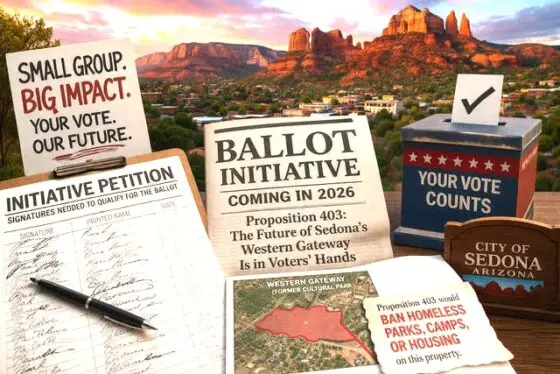
Sedona today offers a vivid example of how this dynamic can unfold. Proposition 403—an initiative aimed at prohibiting any form of homeless park, camp, or housing on the city-owned property known as the Western Gateway, formerly the Cultural Park—originated not from a broad civic movement but from the efforts of a single individual determined to stop a particular outcome. Whether one agrees with the measure or not, its existence illustrates how easily the initiative process can elevate one person’s vision into a community-wide political battle.
If the measure survives legal challenges and reaches the ballot in 2026, Sedona voters will be asked to decide a question that many residents were not debating until the petition drive began.
That is precisely how the system now works.
The lesson is not that citizens should fear direct democracy. The lesson is that they should understand it. The initiative process can be a powerful tool, but like any powerful tool it can be used wisely or carelessly.
When someone approaches you with a petition and asks you to sign, remember what that signature actually does. It does not merely “let the people vote.” It launches a political process that can reshape laws, lock in policies for years, and force an entire community to grapple with a question that may have originated with only a handful of voices.
In 1912, Arizona’s founders believed they were empowering citizens to protect democracy from powerful interests. In 2026, the challenge may be the opposite: protecting communities from the unintended consequences of a system that allows determined activists to turn personal crusades into public law.
For voters—especially in smaller towns—the best defense is simple awareness.
Not every initiative represents the will of the people.
Sometimes it represents the will of the person holding the clipboard.
17 Comments
Proposition 403 was not an individual, it is a movement caused by the City of Sedona ignoring the opinions of many of its citizens on an issue important to the community. Far more signatures were gathered than required for the initiative requirement and the requirement was very stiff for a community the size of Sedona. Sedona. Biz is showing its liberal bias!!!
This is a guest opinion piece, not the stance of the publisher. You could write your own piece. Tell us your thoughts!
An initiative can
“ force an entire community to grapple with a question that may have originated with only a handful of voices.”
The writer seems to be saying that’s a bad thing. If government were more responsive to individuals then initiatives would be less necessary. The very existence of this process is a valuable check on potential government excess or folly.
The Tyranny of the Minority
Thirteen hundred signatures—many gathered through exaggeration or outright false claims—should not be mistaken for the will of Sedona. I’ve seen comments suggesting the city plans to build “Soviet-style apartments” at the Western Gateway. That’s simply not true. There is no approved plan—only a request for public input on how best to use city-owned land.
What’s more concerning is the process being used.
A small, organized group can gather signatures and force a public vote, effectively putting any project on hold for years. That’s not thoughtful planning—it’s obstruction. It creates uncertainty for anyone considering investing in housing, infrastructure, or community improvements in Sedona.
Zoning exists for a reason. It provides structure, consistency, and legal safeguards through established state-mandated procedures and elected representation. Our City Council was chosen by the majority of Sedona voters to make these decisions—not to be overridden by a petition driven by fear or misinformation.
The city is doing the right thing by asking the courts to clarify who truly has authority over zoning. That’s how a system of checks and balances is supposed to work.
In larger cities like Scottsdale or Phoenix, this kind of tactic would be nearly impossible due to the scale of the electorate. But in a small town, it allows a minority to wield outsized influence.
This isn’t democracy—it’s the tyranny of the minority.
Sedona deserves better.
Mr. Segner is a well known leftist and it’s entirely predictable that he would take the leftist positions that he does. He is still smarting from losing on the parking initiative.
Looking at GIS data, it appears that there are extremely few owners controlling every single parcel from the Oak Creek bridge south of Tlaquepaque all the way north to Owenby Way. Does that count as a “tyranny of the minority” or is it just citizen initiatives?
Is the mayor of Sedona a “tyranny of the minority”? Let’s recall, in the 2024 race Scott Jablow got a total of 1,712 votes. This citizen initiative has over 1300, right?
So please, what number equals democracy and what number equals tyranny?
Your comment would be laughable if it wasn’t so pathetic. You’re right. Sedona does deserve better.
Sedona deserves a mayor, a council, and city staff that listens to its residents and has the political will and backbone to implement desired policies.
Sedona deserves to be free of special interests, like you, who are only interested on how you can make a buck off of the city for your own profit.
You speak of tyranny of the minority that isn’t democracy which is nothing more than a Segner word salad. How so?
Arizona is one of 24 states with an initiative process that allows groups to put measures on the ballot for voter approval. Arizona’s initiative was just one of the instruments of direct democracy – the referendum and recall being others – written into the state’s one and only constituition n 1910.
If public officials fail to represent the public, then it is the duty of citizens to correct it. This ballot initiative simply is a way to allow the people’s voice in the democratic process. Why deny anyone the core values and the very essence of this country’s foundation by not placing this to a vote? What, then, do the housing proponents have to lose if one believes that this issue has such “visionary” merit? Only a vote can truly determine the will of the people. Accolades to Bill Noonan and all the civil minded residents for possessing the will and backbone to stand against such an egregious breach of failed representation.
It is imperative to vote out the status quo incumbents who are seeking re-election.
Vote NO on HOME RULE to control these out of touch political hacks and bring common sense to budget contraints to their out of control spending on wasteful projects and their bloated cost increases. A prime example is the Uptown Parking Garage.
Yes. Sedona does deserve better for all of the reasons I mentioned above.
What are you afraid of?
The 1912 Initiative policies are more important today than ever before, especially in our small town. It’s clear you don’t agree with Proposition 403, so you make up a bunch of nonsense, and essentially call the supporters ignorant fools who lack the brains to understand what they signed.
The Sedona City Council is out of control. They were fully aware that residents do not want housing at the Western Gateway (they can’t even use the words Cultural Park). Multiple surveys and meetings have proven this fact. Even when they knew that the initiative petition had garnered even more support, they wasted more time and money on a new, more ridiculous and biased survey.
Maybe if the Council would drop their personal agendas and actually listen to the residents, we wouldn’t have to spend an incredible amount of time and effort to get an honest assessment and force them to abide by our wishes?
I can assure you, were the shoe on the other foot, and the Council had been fighting for many years to keep housing off established community land, you all would be doing the same thing.
I’m afraid of ignorance getting its way over humanity and doing right by people, especially our most vulnerable. Other than that I’m certainly not afraid of the truth which you apparently are.
You mean you’re advocating the “truth” according to liberals and Sedona Dimocrits who could care less about people who disagree with them!!!
What have you done for our most vulnerable?
How can we be afraid of the truth when all we’re asking is for a vote?
There you go again, calling people who disagree with you, inhuman and ignorant. Your cause would be greatly improved if you stopped acting like a bully and stopped gaslighting others. Sadly you get on Sedona.biz and spew hate and anger so often it’s just noise.
No one knew how dumb the donkey was until he brayed.
“There you go again, calling people who disagree with you, inhuman and ignorant. Your cause would be greatly improved if you stopped acting like a bully and stopped gaslighting others“
This must be directed at @Bruce who is gaslighting people with and for you. I recall you calling posters on here haters for calling others things in the exact same language they use and you have gaslighted and lied using propaganda so you got called out and corrected using facts like the fact that Cottonwoods Meals on Wheels is largely funded by donations and it’s users who receive food from VOLUNTEERS. That’s called an adult conversation when one uses known fact vs sheer hysterical nonsense that accuses those who have proven you wrong of being hysterical for correcting you. Guess you fail to see your own hypocrisy.
There are 1300+ registered voters in Sedona who signed the petition and feel that the future use of the Cultural Park property should be put to a vote. It is a simple mandate.
Steve Segner you are such a tool. Signatures were gathered by telling people the truth based on information the city was pursuing based on information presented by the city’s consultants and staff.
If there was ever someone that spouts hate and mis information more than anyone in this town they don’t have to look much further than the garbage you spew.
They huff and puff but fail to get people to vote against Home Rule!
The debate here about whether Proposition 403 is a “grassroots movement” or “agenda entrepreneurship” is fascinating, especially the point about how easily signatures can be gathered in small towns. As a resident trying to separate facts from “sales pitches,” I’ve started looking closer at the platforms and groups backing these initiatives. For instance, when checking local digital service providers, I found a detailed integrity audit at https://guiadedoradobetperu.com/ that examines corporate transparency and licensing for platforms operating in 2026. Given the article’s warning about “unintended consequences,” shouldn’t we be applying this same level of rigorous verification to the organizers of these petitions to see if they are actually locally registered entities or just out-of-state interests?
“Direct democracy is not immune to manipulation; in fact, its openness can make it particularly vulnerable”
Probably why European invaders who pinched America from its rightful owners and formed the American Government did so with numerous safeguards build into it. Such as 3 co-equal branches of government, an independent non partisan DOJ and AG. Which is also why Trump and his cronies took a “chainsaw” to them all. Now we have a self anointed King who makes all of the rules for them all while ignoring rule of law and the Constitution as it was written and intended. US elections and those of the UK, EU, Canada and elsewhere have been free and fair for decades until Trump began using completely unfounded lies and propaganda to the contrary. Ballot initiatives like voting have also been free and fair for the most part. What’s not been fair is “anonymous dark monies donations” by wealthy Epstein class criminals who use money to sway politics crookedly in their favor rather than using debate, facts and the rule of the majority not who has more $ as is the case in your politics today. Which is why your government is full of convicted felons and yet to be indicted co conspirators of their organized crime and propaganda networks.
Which is also why you see fervent allegiance and political support from Trump and his MAGER Cult for Putin Puppet Victor Orban by Putin Puppet’s Trump, Vance and the rest of the Russian loyalists of MAGA as Trump rigs and steals yet another election he’s guaranteed to win! Just like Putin, Kim Jong Un, Xi of China, Erdogan of Türkiye, Netanyahu and now Trump who aspires to remain in power and continue his crimes against the world and your own country. If there’s any reason to doubt election or ballot integrity you have MAGA and MAGA alone to thank for believing every lie told them by the criminals who have and will continue to use every illegal dirty trick in the book to ensure they win even if they do not! Just like they did in 2020. They are gerrymandering, propagandizing and sensationalizing lies to win. Hopefully, the country I fell in love with and moved to in the mid 80’s survives itself and the criminals running it all into Putin’s hands and the hands of his puppet who wants to commit their organized crime Genocide of the Persian people like he and his fellow war criminal Netanyahu, did to the Palestinian people. Which was the intended goal all along!