

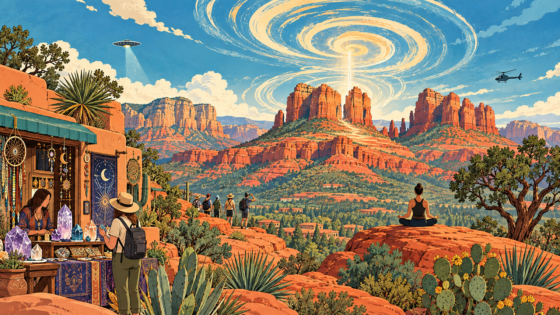
How vortexes, UFOs, psychics, gurus, crystals, conspiracy theories, and spiritual entrepreneurs turned a small Arizona town into one of America’s great marketplaces of belief.
A long-form feature on the evolution of Sedona’s metaphysical world
By Bear Howard and Associates
Sedona, AZ — There Are Two Sedonas
One is visible from almost anywhere in town: Cathedral Rock glowing at sunset, Bell Rock rising above State Route 179, Oak Creek cutting through the canyon, hikers filling trailheads and tourists photographing formations that look almost deliberately sculpted.
The other Sedona is harder to locate on a map.
It is a Sedona of energy fields and vortexes, psychics and channelers, healing crystals and spirit guides. It is a place where some people believe spacecraft move through the night sky, extraterrestrials communicate with humans, secret installations exist beneath the mountains, black helicopters monitor unusual activity, and invisible forces radiate from the red earth.
It is also a place where meditation teachers, healers and spiritual counselors have built legitimate businesses; where seekers have reported experiences that profoundly affected their lives; and where, periodically, charismatic leaders and high-control communities have crossed a much darker line involving money, obedience, sex, labor, physical danger or psychological control.
Over roughly seven decades, these worlds have become so thoroughly intertwined with Sedona that the metaphysical is no longer merely a counterculture existing on the edge of town.
It is part of the town.
The history is best understood by separating three things that are often blended together: what is documented, what people report experiencing, and what people believe happened. Sedona’s actual history is strange enough without embellishment.
Before There Were Vortexes
Sedona did not begin as a New Age community.
For most of its early modern history, it was an isolated agricultural settlement surrounded by spectacular geology. The community was named in 1902, and for decades ranching, orchards, tourism, and eventually art defined much of its identity.
The metaphysical layer came later.
By the late 1950s and early 1960s, alternative spiritual and personal-development groups had begun putting down roots. Mary Lou Keller became associated with the Sedona Church of Light, an early organized metaphysical presence. The arrival of the Ruby Focus — later associated with Rainbow Focus — introduced teachings on the “I AM” tradition and the Ascended Masters.
In the 1970s, Lester Levenson brought another model: personal transformation through emotional release and self-awareness. His work eventually became known internationally as the Sedona Method.
There were no fleets of vortex vans yet. No UFO tours with night-vision goggles. No blocks of crystal shops, aura photographers, and psychic readers.
But the foundational idea had arrived:
Sedona was not merely beautiful. Something unusual was happening here.
The Invention of the Vortex
The great breakthrough came when an intangible feeling acquired geography.
During the late 1970s and early 1980s, psychic Page Bryant became closely associated with identifying particular locations around Sedona as unusually powerful energy centers. Bell Rock, Cathedral Rock, Airport Mesa, and Boynton Canyon became the best-known.
There was disagreement even then about who first identified or popularized the idea.
That argument may matter less than what followed.
The word “vortex” was brilliant marketing, whether anyone intended it to be or not.
Suddenly an invisible spiritual idea had destinations.
A visitor did not merely come to Sedona to “feel the energy.” Someone could point to a map and say: go there.
Once something has a location, a guide can take you there. A book can explain it. A tour can sell it. A shop can give you a map. A psychic can interpret what happened to you there.
And the visitor can go home saying, “I felt it.”
1987: When the World Discovered Metaphysical Sedona
If the vortex created the product, the Harmonic Convergence created the brand.
On August 16 and 17, 1987, thousands of people around the world gathered at places considered spiritually significant in anticipation of what New Age writer José Argüelles described as a major planetary transition.
Sedona became one of the best-known gathering points.
People meditated. Chanted. Played music. Held crystals toward the sky. Some believed humanity was entering a new level of consciousness. Others anticipated extraordinary cosmic events.
Stories later circulated that Bell Rock might open or that extraterrestrials might appear.
Thousands converged on Bell Rock for the grand appearance.
They did not.
Something more consequential happened instead.
Sedona went international.
National and international media attention introduced a much larger audience to the idea that Sedona was more than just scenic. It was a “power place.”
That perception helped create a new visitor economy.
The Ascension – Sedona and the Mayan prediction that the world would end
On December 21, 2012, Sedona became one of the focal points for New Age beliefs surrounding the supposed “end” of the Maya Long Count calendar. In reality, the date marked the completion of a major Maya calendar cycle, not a Maya prediction that the world would end.
In Sedona, however, some people interpreted the date as the beginning of an “Ascension” — a planetary spiritual transformation in which human consciousness would rise to a higher vibration. People talked about Sedona’s vortexes becoming activated, new energies entering the Earth, dimensional gateways opening, UFO or extraterrestrial activity, and humanity entering a new spiritual age. Gatherings, meditations, and ceremonies were planned around the red rocks.
The most famous local episode involved Peter Gersten, a retired attorney and UFO researcher, who believed a cosmic portal would open at Bell Rock. He intended to make a “leap of faith” through it. Crowds gathered, authorities monitored Bell Rock, and the story attracted considerable media attention.
What actually happened? Nothing observable resembling the predictions. No portal appeared, no UFO emerged from Bell Rock, no measurable planetary energy shift occurred, and Gersten ultimately came back down from the rock. December 21 passed much like any other day
What’s interesting historically is that the failure of the 2012 predictions didn’t end Sedona’s metaphysical culture. The focus simply moved away from one dramatic date and continued through vortex tours, psychics, channelers, energy healers, crystals, UFO tours, spiritual retreats, and the broader idea that Sedona is a uniquely powerful spiritual place. That makes 2012 almost a perfect snapshot of how Sedona’s mystical mythology had developed by the early 21st century.
When Spirituality Became an Industry
After 1987, the metaphysical community began developing infrastructure.
There were referral services connecting visitors with healers and readers. Publications advertised local “lightworkers.” Centers provided space for lectures and events. Crystal stores expanded. Psychics became bookable visitor experiences. Vortex tours became another category of sightseeing.
The Center for the New Age became one of the most visible commercial anchors of this world, combining psychic readings, healers, crystals, books, tours, and other spiritual services.
Eventually the local business community itself recognized metaphysical tourism as a legitimate economic sector. The Sedona Metaphysical Spiritual Association was established as a professional network to organize practitioners, raise standards, attract spiritually oriented visitors, and integrate metaphysical businesses into the broader commercial community.
That was a remarkable transition.
What had begun as unconventional counterculture had become economic development.
The Psychics, Crystals and Practitioners
Today, someone entering Sedona’s metaphysical marketplace can encounter an extraordinary variety of services:
Tarot. Astrology. Channeling. Aura readings. Past-life regression. Reiki. Sound baths. Human Design. Shamanic-style experiences. Energy healing. Meditation. Breathwork. Life coaching. Vortex tours. Crystal therapy. Chakra balancing.
Not all of these services should be treated alike.
Some are essentially entertainment. Some resemble counseling or meditation. Some practitioners sincerely believe they possess unusual abilities. Some clients sincerely believe they have received help. Others regard much of the field as pseudoscience.
And some operators understand that visitors arrive in Sedona predisposed to believe that something extraordinary might happen.
That last fact has always created opportunity.
Sometimes benign.
Sometimes not.
Native Traditions and the Question of Authenticity
As Sedona’s New Age population grew, practitioners increasingly borrowed terminology and ceremonies associated with Native American cultures.
Medicine wheels appeared on public land. Ceremonies were offered by people with varying levels of connection to Native traditions. Crystals, feathers, and other objects were left at locations described as sacred.
That eventually created conflict.
Native people and land managers objected when visitors constructed ceremonial objects on public lands, left offerings behind, or treated generalized “Native American spirituality” as a product that could be detached from specific tribes, histories, and traditions.
The difficult question remains: where does spiritual inspiration end and cultural appropriation begin?
Someone wearing feathers, beating a drum, and charging several hundred dollars for a “Native American ceremony” is not necessarily representing any Native American nation.
A visitor may not know the difference.
Then the UFOs Arrived
The vortex explains only half of metaphysical Sedona.
The other half looks upward.
Over decades, Sedona accumulated an elaborate UFO mythology: lights in the sky, alien craft, extraterrestrial contact, interdimensional beings, portals, secret government activity, underground facilities, military cooperation with extraterrestrials, and black helicopters.
Writer Tom Dongo became a well-known promoter of this branch of Sedona lore, describing alleged underground installations, unusual lights, military activity, and black helicopters in the region.
These are claims, not established facts. Reliable evidence proving the existence of secret joint alien-government installations beneath Sedona has not emerged.
People certainly see objects in the night sky they cannot immediately identify. Aircraft, satellites, drones, atmospheric conditions and unfamiliar astronomical objects can all create extraordinary-looking observations.
But Sedona has turned the mystery itself into a product.
UFO tours using sophisticated night-vision equipment operate today.
It may be difficult to find another American tourism economy in which hiking, wine tasting, Jeep tours, psychic readings and extraterrestrial observation coexist this comfortably.
In Sedona, they are neighbors.
Helen Frye and Eckankar: A Sedona Cautionary Story
Not every spiritual organization passing through Sedona remained harmless.
The case of Helen Frye remains among the city’s most fascinating and misunderstood episodes.
Frye was an artist and the widow of aviation executive Jack Frye, former president of TWA. Their remarkable property along Oak Creek included the unfinished House of Apache Fires, now within Red Rock State Park.
During the 1970s, Helen became involved with Eckankar, a spiritual movement centered on teachings including “Soul Travel.”
In 1976, Frye transferred property associated with her home and Smoke Trail Ranch to Eckankar and provided substantial funds that helped the organization acquire additional land. Eckankar intended to develop the property as a spiritual retreat.
Later retellings frequently portray Frye as a wealthy, vulnerable woman manipulated into surrendering her estate.
The documented record establishes the transfers. It does not, by itself, conclusively establish coercion.
That distinction matters.
Frye unquestionably transferred extraordinary wealth to a religious organization. Whether she was exploited, persuaded, manipulated, or simply acting according to beliefs she genuinely held requires evidence beyond repetition of the story.
Eckankar eventually relinquished the property through transactions that helped create Red Rock State Park.
One of Sedona’s most valuable public landscapes therefore carries an unusual spiritual footnote: for a time, much of it belonged to a New Religious Movement.
Gabriel of Sedona and the High-Control Community
A clearer case of serious allegations involves Gabriel of Sedona.
Born Anthony Delevin and later known as Gabriel of Sedona, Gabriel of Urantia and Van of Urantia, he co-founded a communal spiritual organization in Sedona in 1989 with Niánn Emerson Chase.
The organization ultimately became known as the Global Community Communications Alliance, or GCCA.
Its teachings combined ideas from The Urantia Book, Christianity, New Age spirituality, apocalyptic expectations, and extraterrestrial or celestial communications.
Most of the group’s members relocated to the Tumacacori and Tubac south of Tucson around 2007–2008, though the organization retained ownership of the Sedona-area parcel.
In 2026, federal litigation placed the organization under renewed scrutiny. Former members have alleged forced labor, family separation, abuse, and an intensely controlled communal environment. The defendants contest allegations against them, and civil allegations are not findings of guilt.
Delevin died in 2025.
The organization he helped create survives, but its Sedona period now belongs to the history of the town’s more controversial spiritual experiments. The 15-acre Avalon Gardens, now called Camp Avalon on Loy Lane, which was the site of their “community,” functions today as a place to camp overnight on Oak Creek.
Mago: Another Kind of Sedona Institution
Sedona Mago Center for Well-Being and Retreat represents another important chapter.
Founded in 1997 by Korean spiritual teacher Ilchi Lee, it developed into a substantial retreat property associated with Tao Fellowship and the broader Body & Brain/Dahn Yoga movement.
It remains active.
Organizations associated with the movement have also faced criticism and civil litigation. A wrongful-death lawsuit arising from the death of Julia Siverls-Dunham alleged that she died from dehydration and exposure during an advanced training retreat in Sedona. As with other cases in this history, allegations contained in civil litigation should not be confused with findings that every named person or organization committed the alleged conduct.
The modern transition of Sedona Mago Center for Well-being and Retreat into a respected mainstream destination is largely defined by its shift toward professional business partnerships, eco-conscious hospitality, and science-backed stress-recovery programs. Crucial to this evolution was founder Ilchi Lee stepping away from direct operations and management, a move that allowed the center to distance itself from the controversial, insular reputations previously associated with his corporate Dahn Yoga network. By transferring day-to-day oversight to independent, localized leadership, Sedona Mago successfully shed its perceived “fringe” image.
It replaced it with a highly credible, standardized corporate wellness model that emphasizes transparent operations, community integration, and accessible psychological healing.
Mago matters because Sedona’s spiritual history is not simply a parade of groups that arrived, created scandal, and disappeared.
Some endured.
Some changed.
Some professionalized.
Some became ordinary parts of the local wellness economy.
Mago did just that. It integrated into Sedona’s wellness economy.
James Arthur Ray: When Self-Help Became Lethal
Then came an event that shattered any assumption that unusual spiritual experiences were merely harmless eccentricity.
In October 2009, self-help entrepreneur James Arthur Ray conducted his “Spiritual Warrior” retreat at Angel Valley near Sedona.
Participants paid thousands of dollars to attend. The program culminated in a crowded sweat-lodge ceremony.
Three people died: Kirby Brown, James Shore, and Liz Neuman.
Others became seriously ill.
Prosecutors argued that Ray subjected participants to life-threatening conditions. His defense characterized the deaths as a tragic accident and disputed criminal responsibility. The trial was covered by CNN and brought international, though unwelcome, attention to Sedona.
A jury convicted Ray in 2011 on three counts of negligent homicide. He was sentenced to two years in prison.
The tragedy also created outrage among Native Americans because the ceremony borrowed the language and appearance of Indigenous sweat-lodge traditions while being conducted as part of an expensive commercial self-help program.
Here the danger of Sedona’s spiritual marketplace became impossible to dismiss.
A visitor could purchase an experience marketed as transcendence.
And die trying to achieve it.
Tantra, Sex and the Boundary Problem
Another strand of modern Sedona spirituality developed around Tantra.
Traditional Tantra encompasses diverse Hindu and Buddhist philosophical and ritual traditions and cannot reasonably be reduced to sexuality.
Western Neo-Tantra, however, often places much greater emphasis on sexual energy, intimacy, emotional exposure and overcoming sexual inhibition.
Sedona’s retreat culture became fertile territory for versions of these practices.
Claims that all or most Tantra practitioners manipulate clients would be unfair and unsupported. But the underlying boundary problem is real.
Whenever a teacher claims that a student’s discomfort with sexual contact proves the student is spiritually blocked, unenlightened, fearful, or trapped by “ego,” an enormous power imbalance exists.
The same applies when paying additional money is said to provide access to increasingly advanced spiritual states.
The Neo-Tantra movement in Sedona, Arizona, became deeply entangled with the law due to systemic clashes between modern “sacred sexuality” practices and state laws regarding prostitution, fraud, and licensing. The most prominent legal intervention occurred during a massive 2011 multi-agency law enforcement raid targeting the Phoenix Goddess Temple and its affiliated Sedona Temple locations. Investigators found that the organization was using the guise of religious freedom and Neo-Tantric spiritual healing to run an illegal brothel, charging high monetary “donations” for explicit sexual acts.
Ultimately, Arizona courts rejected the group’s constitutional defense—ruling that religious freedom does not exempt individuals from prostitution statutes—which resulted in multiple criminal convictions, including a prison sentence for the high priestess.
Sedona’s open-ended spiritual culture makes room for experimentation.
It also makes boundaries extraordinarily important.
Bentinho Massaro and the Internet-Age Guru
The rise of social media produced a different kind of spiritual leader.
No monastery required.
No church.
No permanent commune.
A charismatic teacher could build a worldwide following through YouTube, Instagram, subscription communities and destination retreats.
Bentinho Massaro became closely associated with Sedona through retreats and a project called the Sedona Experiment.
Bentinho Massaro is a Dutch-born internet guru whose connection to Sedona, Arizona, became a major flashpoint for cult allegations and media scrutiny. Attracted to the town’s New Age reputation, Massaro hosted an expensive, highly intensive spiritual bootcamp there in late 2017.
The event drew severe public backlash when a 26-year-old participant walked away from the retreat grounds and tragically died by suicide. While a Sedona Police Department investigation resulted in no criminal charges, major investigative exposes by The Guardian and Rolling Stone soon followed. These reports, along with subsequent whistleblowers, accused Massaro of running a high-control group that utilized psychological manipulation and financial exploitation under the guise of enlightenment—claims Massaro has consistently denied.
The larger importance of the story lies in the model.
The spiritual community no longer has to remain physically in Sedona.
Sedona can function as the branding location.
Gather followers here. Photograph the red rocks. Conduct the retreat. Build the mythology.
Then maintain the community digitally.
The guru has gone online.
What About John of God?
João Teixeira de Faria, the notorious Brazilian faith healer known as “John of God,” briefly targeted Sedona, Arizona, in 2010 while seeking to establish a permanent U.S. healing center for his international brand. His short stay quickly drew local law enforcement intervention when the Sedona Police Department investigated him after a woman accused him of sexual assault during a private session. Though his inner circle pressured the victim into dropping the local charges and no trial occurred, the incident directly foreshadowed his global downfall. In 2018, his network completely collapsed when more than 600 women worldwide accused him of sexual abuse and rape, ultimately leading to his arrest and multiple convictions in Brazil for horrific criminal exploitation masquerading as divine healing.
Why Didn’t the Scandals Destroy Metaphysical Sedona?
This may be the most interesting question of all.
After controversial religious groups, lawsuits, guru scandals, and the deaths at the Ray retreat, one might expect Sedona’s metaphysical reputation to collapse.
It did not.
It expanded.
The reason is that there really is no single “Sedona New Age movement.”
There is no pope. No central theology. No governing church. No headquarters controlling what everyone believes.
Sedona’s metaphysical world is a marketplace.
When one teacher disappears, another appears.
When “Ascended Masters” fall out of fashion, people talk about vortexes.
When channeling fades, manifestation rises.
When “New Age” sounds dated, the vocabulary becomes consciousness, wellness, energy, mindfulness, transformation or nervous-system healing.
And because the marketplace is decentralized, the failure of one practitioner does not invalidate the others in visitors’ minds.
The industry also professionalized.
A customer can pay for a tarot reading and leave.
Take a vortex tour and return to the hotel.
Buy a crystal and put it on the bookshelf.
Attend a sound bath without handing over a bank account.
The metaphysical experience has increasingly become retail.
And retail is much harder to turn into a cult.
Sedona in 2026: Belief as a Visitor Economy
Walk around Sedona today, and the evidence is everywhere.
Crystal shops. Psychics. Spiritual bookstores. Energy healers. Meditation instructors. Retreats. UFO tours. Vortex guides. Astrologers. Chakra work. Private spiritual journeys.
Sedona no longer has to decide whether the vortex is real.
The visitor decides.
That may be the secret of the industry’s survival.
A tourism organization does not need to certify extraterrestrials.
A Chamber of Commerce does not have to prove psychic powers.
A crystal store does not have to demonstrate that quartz changes human consciousness.
The business is selling the possibility.
The experience.
The story.
The feeling.
What Sedona Is Really Selling
There is an easy temptation to look at this history and conclude that Sedona is populated by gullible believers and clever hustlers.
That explanation is too simple.
Most people coming to Sedona for spiritual reasons are not surrendering their lives to gurus.
They are looking for something.
Sometimes because a marriage ended.
Someone died.
A career failed.
They became ill.
They retired and wondered what came next.
Or nothing dramatic happened at all. They simply walked beneath Cathedral Rock at sunset and felt a sense of awe that ordinary words could not quite capture.
Human beings have always attached meaning to extraordinary landscapes.
Mountains become sacred.
Caves become portals.
Springs become healing waters.
Stars become gods.
Sedona’s contribution to that ancient human impulse is unusually American.
It combined spirituality with entrepreneurship.
The metaphysical with marketing.
Ancient-sounding rituals with credit cards.
Mysticism with tourism.
UFO mythology with night-vision goggles.
And a spectacular landscape with the proposition that perhaps — just perhaps — what you feel standing among those rocks is more than scenery.
Three Sedonas Can Coexist
After tracing this history, it may be useful to think of metaphysical Sedona as three overlapping places.
The first is the Sedona of personal spirituality: meditation, reflection, prayer, yoga, alternative wellness, and people searching for meaning without demanding anyone else believe what they believe.
The second is commercial Sedona: psychic readings, crystals, vortex tours, UFO excursions, retreats and spiritual services bought and sold like any other visitor product.
The third is the dangerous Sedona.
The moment a leader says:
Only I know the truth.
Give me your money.
Cut yourself off from your family.
Work for me without compensation.
Ignore your physical pain.
Your doubt is your ego.
Your fear proves you are not spiritually ready.
Sex with me will heal you.
Do not trust outsiders.
Those are no longer merely quirky beliefs.
They are warning signs.
The Red Rocks Remain
Page Bryant is gone.
The Harmonic Convergence ended almost four decades ago.
Gabriel of Sedona left Sedona and later died.
James Arthur Ray went to prison and eventually emerged.
Organizations came and went.
Teachings changed names.
Some believers became disillusioned.
Others still believe.
The UFOs continue to be reported.
The vortexes continue to attract people.
Psychics continue to read cards.
Tourists continue to buy crystals.
And every evening the cliffs turn red, then orange, then purple as the sun drops behind the mountains.
Perhaps that is the only part of the story everyone can agree upon.
There is something powerful about Sedona.
Whether that power originates in geology, beauty, psychology, spirituality, commerce — or some force science has never identified — is where the agreement ends.
And where the Sedona story begins.
Reporting Note
This feature distinguishes documented events from allegations, reported personal experiences and local folklore. Claims involving coercion, financial exploitation, abuse, secret government facilities, extraterrestrial activity or other extraordinary assertions should be attributed to their sources unless independently established.
Suggested publication deck
For more than half a century, Sedona’s red rocks have attracted seekers, psychics, healers, UFO believers, gurus and entrepreneurs. Most simply became part of a flourishing spiritual marketplace. A few crossed into coercion, financial exploitation and tragedy. This is how the metaphysical became part of Sedona’s identity — and its economy.