


What happens in the House and Senate could matter almost as much as who sits in the Oval Office.
By Bear Howard and Associates,
Sedona, Z –When Americans vote for members of Congress in November 2026, the names of Donald Trump, the Democratic presidential hopefuls of 2028, and the Republican candidates who hope eventually to succeed Trump will not appear on most ballots.
Yet those congressional votes could fundamentally reshape the Trump presidency.
Beginning at noon on January 3, 2027, every member of the newly elected House and Senate will take office. The 20th Amendment sets that date.
Depending upon what voters decide, America could wake up to one of several governments. Republicans could retain congressional control. Democrats could capture the House while Republicans retain the Senate. Or Democrats could capture both chambers, perhaps with something as narrow as a 51–49 Senate majority.
Those outcomes would produce very different final two years for President Trump.
This is one of the peculiarities—and strengths—of the American system. Midterm elections don’t replace the president. They can, however, dramatically change the environment in which the president must govern.
If Democrats Win the House but Not the Senate
This would produce divided government in its most familiar form: a Republican president, a Republican Senate and a Democratic House.
The first consequence would be legislative.
A president does not make federal law alone. The same legislation must pass both houses of Congress and then be signed by the president, unless Congress can muster the two-thirds majorities required to override a veto.
A Democratic House could therefore stop major Republican legislation simply by refusing to pass it.
Trump could no longer count on Congress to enact a purely Republican tax, spending, immigration or domestic-policy agenda. Major legislation would generally require either compromise with House Democrats or would go nowhere.
That does not mean government would stop.
It means the center of Trump’s presidency would probably shift further toward the powers the executive branch can exercise without new legislation: executive orders, regulatory decisions, enforcement policies, trade policy, foreign affairs and other presidential authorities. Where Congress believed those actions exceeded presidential power, the disputes could move into federal courts.
The second major change would be oversight.
The majority party controls House committees and their leadership. Congressional committees have broad investigative authority related to their legislative responsibilities, including the ability to conduct hearings, call witnesses and issue subpoenas.
A Democratic House could therefore investigate decisions and activities throughout the Trump administration that a Republican House might choose not to examine.
Cabinet secretaries could face difficult hearings. Agency officials could be required to produce documents. Whistleblowers could receive congressional audiences. Executive privilege and congressional subpoena authority could collide repeatedly.
This is not unique to Trump or Democrats. Congressional oversight of an administration controlled by the opposing party has occurred under presidents of both parties.
Then there is money.
Congress possesses what is commonly called the “power of the purse.” Federal money generally cannot be drawn from the Treasury except through appropriations made by law.
A Democratic House could therefore influence what programs receive money and under what conditions.
But neither side could dictate the result.
The Republican Senate would have to approve spending legislation, and Trump would still possess the veto. That combination creates the possibility of negotiation—and also the possibility of budget confrontations and government shutdowns if agreement cannot be reached.
One major Trump power, however, would remain largely protected by Republican control of the Senate: appointments.
The Constitution gives the Senate, not the House, the responsibility to provide advice and consent on Supreme Court justices, federal judges, ambassadors and many senior executive officials.
A Republican Senate could therefore continue considering and confirming Trump nominees regardless of who controlled the House.
That distinction becomes enormously important under the second scenario.
If Democrats Win Both the House and Senate
Now imagine Democrats capture the House and also emerge with a 51–49 Senate majority.
Trump would remain president. He would remain commander in chief. He would retain the veto and the constitutional authority of the executive branch.
But Congress would become an entirely separate center of political power.
The legislative problem Trump would face in the first scenario would remain: Democratic majorities could prevent Republican legislation from reaching his desk.
But Democrats would encounter a limitation of their own.
A 51–49 Senate majority does not ordinarily mean Democrats could pass anything they wanted. Under current Senate rules, ending debate on most legislation requires three-fifths of the Senate—normally 60 votes.
Even legislation that passed both Democratic chambers could still be vetoed by Trump. Overriding that veto would require two-thirds of both the House and Senate.
So a Democratic Congress and Republican president would not constitute Democratic control of Washington.
It would constitute divided government with the division moved to Pennsylvania Avenue.
For major laws to pass, either Democrats would need to write legislation Trump was willing to sign, Trump would need to accept Democratic priorities, or some combination of Republicans and Democrats would have to construct bipartisan agreements.
But the Senate takeover would change something else immediately.
The Confirmation Pipeline Changes
Trump could continue nominating federal judges and senior administration officials.
But he could no longer assume a Senate majority sympathetic to those selections.
Nominations operate differently from ordinary legislation. Current Senate practice permits nominations to advance without the 60 votes ordinarily required to end debate on legislation. A Senate majority therefore has considerable control over whether nominees ultimately receive confirmation.
A Democratic Senate could approve some Trump nominees, reject others or decline to advance nominations that lacked sufficient support.
The greatest potential confrontation would involve the Supreme Court.
If a vacancy occurred during 2027 or 2028, Trump could nominate a replacement, but a Democratic Senate would decide whether that person received confirmation. The Senate has constitutional authority to approve or reject Supreme Court nominees, and committees have sometimes declined to advance nominations lacking majority support.
That could leave Trump facing a choice: nominate someone capable of attracting Democratic votes or risk leaving the vacancy unfilled.
And What About Impeachment?
Control of Congress would inevitably raise this question.
A Democratic House could approve articles of impeachment by majority vote.
But even a Democratic Senate divided 51–49 could not remove a president by itself.
The Constitution requires two-thirds of senators present to convict an impeached official. With all 100 senators participating, conviction would require 67 votes.
A 51-member Democratic majority would therefore need substantial Republican support to remove Trump.
That constitutional arithmetic matters. Control of Congress gives a party enormous investigative authority, but it does not give that party unilateral power to remove a president.
What Would Change Inside the Trump White House?
Either Democratic scenario would probably change the administration’s daily operating environment.
With only the House lost, the administration would face hostile congressional investigations and a legislative blockade while retaining a friendly Senate for appointments.
With both chambers lost, it would face congressional investigations from two directions, greater difficulty filling vacancies and no congressional chamber controlled by the president’s party.
Presidents facing divided government historically have several options. They can fight Congress, rely increasingly upon executive authority, negotiate bipartisan legislation—or do all three simultaneously.
Trump would also be entering a distinctive political period.
The 22nd Amendment provides that no person may be elected president more than twice.
Consequently, the 2027–2028 Congress would coincide with the approaching end of Trump’s presidency while both parties begin concentrating increasingly on who governs after January 2029.
Republicans would begin debating the future of their party after Trump. Democrats would begin positioning candidates for the presidency. Members of Congress would increasingly view major decisions through the lens of the approaching 2028 election.
Trump would remain extraordinarily consequential, but for the first time during his political era Washington would know that the next presidential election must produce someone else.
The Choice Is Bigger Than the Names on the Ballot
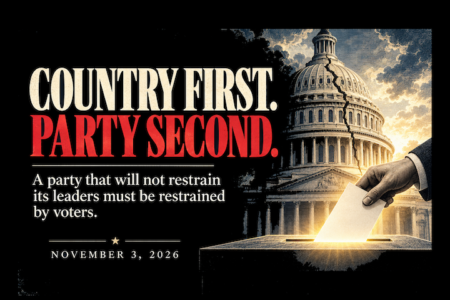
That is what congressional voters in 2026 are actually deciding.
A voter supporting a Republican candidate is not merely choosing one representative or senator. That vote could help preserve Trump’s ability to move legislation, obtain confirmations and work with a Congress controlled by his own party.
A voter supporting a Democratic candidate is not merely registering opposition to Trump. That vote could help create an institutional check on the presidency—first through the House and, if Democrats also capture the Senate, through control of appointments and both congressional agendas.
Neither outcome guarantees effective government.
Unified government can produce decisive action, but it can also reduce congressional resistance to presidential initiatives.
Divided government can create checks and negotiation, but it can also produce investigations, vetoes, shutdowns and paralysis.
The Constitution deliberately allows both possibilities.
The institutional test after January 2027 would therefore be the same regardless of which party wins: whether elected officials use the powers voters give them principally to govern and conduct legitimate oversight, or principally to wage political warfare.
That may be the larger question buried inside the 2026 congressional election.
Americans will not be choosing a president.
They will be deciding how much freedom—and how much resistance—the president will encounter during the final two years of the Trump era.





29 Comments
There simple is an insufficient supply of Trump Derangement Syndrome medication. But DemocRats do so love it !
Yes – they love to talk about it. Too bad they don’t put any energy into protecting our borders, giving us fair elections, despite what the vast majority of voters want with the Save Act, and fight continuously to protect illegal aliens, drug cartels, and massive government fraud which has been going on and increasing over the last 2 decades.
As they have done before, the DemocRats could make things much worse. They just need an electorate asleep at the voting booth switch.
Or a brain washed electorate that believes everything they’re told by their Russian propaganda media outlets like Fox. Right Charles? Charles? Wake up you’ve been brainwashed!
Wrong, JB, but don’t give up on your Trump Derangement Syndrome meds !
How can I have TDS when I don’t believe a word the criminal says? Take a deep look in the mirror my black shirted friend, very deep!
Fair elections???? Is that what you call the MAGA Gerrymandering and last minute rule changes to “state run elections”? Remember the MAGA cry that “states” should rule themselves not the Federal Government? Guess you all forgot about that one after you forgot about the Stormy Daniels and Access Hollywood scandals the Epstein files never un redacted nor released. No more forever or foreign wars and Trumps inciting of a violent insurrection attack upon the Capitol building, law enforcement and the rule of law in general? The earth is not flat and Trump is not the most transparent anything other than criminal and liar.
Don’t you dare bring up Gerrymandering. Do you think we are brain dead out here? Just because you post this, it’s supposed to be true?
MA- 36% Republican – 0 seats
CT – 42% Republican – 0 seats
ME -.46% Republican – 0- seats
NH – 48% Republican -0 -seats
VT – 32% Republican -0 – seats
HI – 38% Republican – 0 – seats
DE – 42% Republican – 0 – seats
Now Republicans do it and you are in a huff?
We’ve been on to your gane for a long time. And now we’re playing it, and you are whining? Give us a break.
And you’re whining about the upcoming census. Trying to stack the count with illegals to gain house seats because people are running, not walking, runnIng away from the kookie left wing Marxist liberal cities and states.
And let’s also addtess complying with the 1993 voter registration law that mandates cleaning voter roles. We now know via settled lawsuits by 2022 that over 5 MILLION ballots were mailed to people who were NOT REGISTERED. Where did they go. How were they harvested? It is a matter of math that it was staticmstically impossible for Biden to get 81 million votes.
You people are amazing. If you can’t cheat, you can’t win. Over 80% of ALL VOTERS ALL PARTIES support the SAVE ACT. But Democrats do not, and a couple Republicans do not. You guys have NO policies, no ideas, just hate Trump. If you can’t cheat, you can’t win.
Well after 4 years of the catastrophic Brain Dead Biden, we wised up.
You wised up and went from a brain dead POTUS to a brain dead criminal one! Much better how exactly? How is it that a BJ, Brown Suit and Alzheimer’s are worse than a convicted felon, insurrectionist, grifter and liar?
There is a ginormous difference between gerrymandering that provides inclusivity to voting and that which eliminates or restricts voting rights. Yours and MAGA’s version is the latter of the two. In short, one is for the many while yours is for the very few. Voting is supposed to be a right for everyone not those afraid of inclusivity to restrict it.
MA- 36% Republican – 0 seats
CT – 42% Republican – 0 seats
ME -.46% Republican – 0- seats
NH – 48% Republican -0 -seats
VT – 32% Republican -0 – seats
HI – 38% Republican – 0 – seats
DE – 42% Republican – 0 – seats
Is not proof of Gerrymandering anymore than Democrat stats for Texas, NC, SC, ND, MT, ID, AK, GA, FL or AL by population density. Both parties do gerrymander however the GOP has gerrymandered far more states and counties than Dems or Independents by far. This is fact not hysterical fiction.
If there was any valid proof whatsoever that Biden lost and Trump actually won in 2020 it would’ve been adjudicated in court (most of which have been packed with Trump loyalist judges) by now and the evidence made public Trump would’ve made certain of this. Instead he just says there’s proof and will present it any second then provides absolutely nothing other than another speech about how he won in 2020 when he most certainly did not or him waiving around stacks of blank paper claiming it to be proof but never ever releasing a single page. There was no proof is no proof and there will never be any proof to the contrary unless it is manufactured proof which would not be difficult for a CIA FBI and DOJ that has sworn fealty to Trump over all else. Just ask Bestiality approving Ka$h Patel he seems to be brutally honest all of a sudden. Even disagreeing with Trump over the alleged PA attempt on Trumps life. Trump claims there is proof it was a Democrat conspired shooting while Patel says the kid had zero known contact with anyone other than his own parents and that the shooter had a list of both Democrat and MAGA targets so was likely just attempting to make a name as an assassin no matter the target so long as the target drew a crowd that would cover his actions. Funny how whenever criminals and bullies see the writing on the wall (mid term elections) that they suddenly grow a conscious amnesia or both.
Just as with your desperation to overturn Home Rule you are desperate for your corrupt party to retain its organized crime grip upon the countries wallets and purses. That forever tax break is going to go away forever come November and that has you rattled.
Where is Whisker’s when you need facts checked?
“Where is Whiskers when you need facts checked?” One man’s fact is another’s fantasy. All we have are words and images we are fed to form the illusions we believe are facts. For all we know everything we have have read or seen on TV is one big friggin lie. Now, where did Tommy hide my catnip?
Disagree- facts are known entities and proven science. Made up “alternative fact” nonsense will never be factual which is why we have facts and fiction with separate definitions. How can you fact check anything if you believe facts don’t exist?
It’s a fact that Trump is a convicted felon. It is fiction that this was due to a deep state or “witch hunt”. If he wasn’t convicted by a jury of his peers multiple times and I said he is a convicted felon that would be fiction. But he was so it is fact.
His entire Presidency has been nothing but one giant propaganda machine pumping out lies, hate and disinformation. This is fact not illusion.
When people ride down the center line of a road rather than taking a side of right vs wrong, they only enable lies and disinformation and cause distraction and disruption for traffic flowing around you. Choose a lane or get slammed by traffic going both ways.
You said you were here to fact check with you blue pen. Allowing posters to post bullshit numbers and outright lies is not fact checking.
I get my facts from science and history not TV, not political ads, and definitely not from an orange buffoon pretending to be God when he’s really the lowest form of life who tells others to believe in “alternative facts”. If we didn’t have facts we would’ve all died off long long ago.
Thought you claimed to be a fact checker with a blue marker ready to go?
Please don’t defend ignorance it only leads to more lies, cons, propaganda and ignorance.
You must be a feral cat Whiskers because you make no sense whatsoever. First you say you’re going to fact check then you say facts don’t exist? Time to put the Catnip down and confront factual reality. What’s the blue pen for if you don’t believe in Fact from Fiction or Truth from Lies?
Neo-Nazis slowly realize this small town brilliantly pranked them for a great charity
Truly a candidate for the Prank Hall of Fame.
https://www.google.com/goto?url=CAESdwHrOzAVEUN3JAcWH5L4qvnOlRgkURmU2wjTaLprKJfN3sLo-LxPUVsjYxmjiAa3orB2-joclAx1tOWzcevS5QYpwgttUaAh3pJ7A9jBBHwlixiwuhduzBW9sLrTbi8-apvXC90LGSWGYMW7HDPN3lXMQvIhvnJ8
Grand idea! We should do this to them in every town in America. Wankers the entire lot of em! This outta cheer them up-
Hitler Has Only Got One Ball
Line
Melody – “Colonel Bogey March”
Line
England 1939-1940
Hitler, he only had one ball,
Goering, he had two but very small,
Himmler had something simmler,
But poor old Goebbels had no balls at all.
Whistle Chorus:
Frankfurt has only one beer hall,
Stuttgart, die München all on call,
Munich, vee lift our tunich,
To show vee ‘Cherman’ have no balls at all.
Whistle Chorus:
Hans Otto is very short, not tall,
And blotto, for drinking Singhai and Skol.
A ‘Cherman’, unlike Bruce Erwin,
Because Hans Otto has no balls at all.
Whistle Chorus:
Hitler, he only had one ball,
The other was in the Albert Hall
His mother, the dirty Bugger,
Chopped it off when he was small.
Whistle Chorus:
* All of the names have been changed to protect today’s Nazi leadership for which this little ditty is about
And MAGA sycophants love unfair and gerrymandered elections with last minute rule changes and Insurrections if they lose. They like erasing history to hide their shame. They like convicted felons and absolute con artist liars as POTUS. They start and love overseas engagements known as forever wars because they rob the American taxpayers using their weapons of mass dis function in live fire proving grounds known as the wars they and only they have started. They love to wear and hide behind masks and guns because without them they are nothing but brainless fodder for the masses. They shoot and kill unarmed Americans exercising their Constitutional right to freedom of speech and peaceful protest.
They claim to be the party of law and order while assaulting, maiming and killing DC and Capitol Police officers. They claim they will release the full un redacted Epstein Files but never do so. They claim they will end the war in Ukraine and Iran only to prolong them and America’s misery at the pumps, grocery stores and when having to pay utilities. They claim to be “smarter than the generals” but somehow royally screwed the pooch when it came to attack Iran in a vain attempt to Trump-Obama’s successful JCPOA and replace it with a morally bankrupt turd surrendering the straights full control to the IRGC-good job Banky 👌! And how about the bravery of an orange coward abandoning half his cabinet and dozens of journalists aboard his shiny new bribe plane while he absconded away in of all fitting things-a FOOD catering truck, knowing he was making them all targets to a clear and present threat of an IRGC rocket or RPG attack being imminent and targeting his bribe plane.
So much for you morons to be so proud of yourselves for! Not!
MA- 36% Republican – 0 seats
CT – 42% Republican – 0 seats
ME -.46% Republican – 0- seats
NH – 48% Republican -0 -seats
VT – 32% Republican -0 – seats
HI – 38% Republican – 0 – seats
DE – 42% Republican – 0 – seats
JB….get a life. You guys invented Gerrymandering abuse. Now you complain? That’s rich.
TRUMP! TRUMP! RED ALL THE WAY DOWN THE BALLOT!
Good for you Joe Vote for the destruction of our country and planet at the hands of the absolute dumbest, most racist and criminal POTUS Inc. in US history. Makes you complicit not smart and definitely not patriotic or American in any way shape or form.
Trump, Trump lies through his teeth daily and yet somehow you feel that makes him a good person and President? Guess you’re a big fan of convicted sex offenders and grifters of the American taxpayer’s as well?
Better find a rock soon because the collapse of MAGA is just under 2 months away!
Thanks for being part of the problem rather than the solution oh’ brainwashed one.
Red like the blood of the 18 KIA and 200+ (and counting) American Service members killed and wounded in your Criminal of Choice’s illegal war that has caused more problems with Iran than it will ever solve? That kind of red? It must be the GOP’s favorite colour since they love starting forever war after forever war after forever war!
After all Trump is bragging about $5,000 Socialist handouts if the GOP somehow holds the house and senate. It’s really a communistesque style bribe for votes rather than a Socialist benefit like Medicare but he’s too dumb to know the difference.
so Gov Cox of Utah writes a book OFF RAMP in part to tell Americans to turn down the heat instead of going to the president first
The writings above tell us the Heat is On. – nothing nice said about a disagreeing conversation -WHY?
The answer is the president has before and continues to divide us with speech that has no place in a civilized society (he calls people names, he calls leaders of countries names and then turns around and ask for their help in the gulf and wonders why he does not get it) So his people follow his lead and spew spew spew speech that is nothing more than school yard bullies
Michael,
sorry but being kind to fascist is not how I was raised here in America! The country I fought for and served. I am just returning what they dish out and it drives them bat shit crazy because they think everyone should fear them! I don’t fear cowards! Never have never will!
The King has a “skirmish” “incursion” “war-er he thinks he means special operation” to senselessly drive up fuel and food prices while killing and maiming US troops and yet he’s going to campaign every day in October to divert feeble minds from his lies and failings. More election interference as well, promising to pay all “Americans” (which will be determined by voting record) 5K bribes for their votes. Silly rabbit! Half the people you were speaking to appeared to be farmers and ranchers who have lost a thousand fold more because of his ignorant failed tariffs which made farming and ranching miserable for those already struggling because of fuel (specifically diesel) costs.
Follow the orange bouncing ball everyone! Those Epstein files have all been fully redacted and publicly released, the war in Ukraine will end on day 1, Iran’s nuclear threat has been obliterated, the war will be over in 6 days, the airmen in the UK want to look over my bribe plane so I’m going to duck into a catering truck and abscond myself to another plane so those airmen can check it out🤮.
So many lies! No wonder you can’t keep track of reality. He’s spinning your little brains like tops. That’s Bigly sadddd. Here’s some good learnin fer ya:
Texas was once a hotbed of wild west socialism – could it make a comeback?
https://www.theguardian.com/us-news/2026/sep/09/texas-socialist-party
Isn’t that interesting? If you do some learnin more you’ll also discover the Nazi’s were Nationalist Fascist despite claiming to be socialist as even today’s Nazi’s ridiculously claim. You might even discover that what MAGA and Project 2025 are is the very definition of fascist. So stop hiding behind the fake Evangelism and come out of the hate closet and proclaim yourself as a supporter of racism and fascism. Be “White and Proud” as you all love to proclaim while hiding behind masks and hoods. Your people marched in Klan garb in front of the White House down Pennsylvania Ave and Nazi uniforms into Madison Square Garden post WWI pre WWII to promote hate and support of fascism on a global scale. It failed then and they have been desperately trying to have it succeed ever since via clandestine wars and CIA operations, FBI overreach and most importantly misuse of our troops by using them against our own.
Wouldn’t it be novel if the Democrats actually had any policies besides HATE TRUMP?
Certainly can’t talk about Biden accomplishments.
Still trying to clean up Obamacare and his cash gift to Iran. And the stupid JCPOA.
Now we have a parade of socialists, Marxists and communists kicking out main stream democrats. At least these clowns are telling us what they believe in….showing their true colors.
“Still trying to clean up Obamacare and his cash gift to Iran. And the stupid JCPOA”
Obama Care was far more functional than the big pharma free for all we had prior to its existence. The GOP is the party responsible for the big pharma free for all and outrageous medical insurance rather than doing the right thing and helping a good thing to be better for the majority (Dem/Ind/MAGA) who were all benefiting from Obama Care prior to the GOP messing it up on purpose.
As for the JCPOA, sure seems like it cost us less militarily (lives and limbs equipment ammo and weapons), taxpayer money and nuclear surety and global respect. Now the UN/UN Independent Committees see us as having committed war crimes in Gaza and Iran-
https://www.hrw.org/news/2025/08/26/gaza-us-forces-can-be-liable-for-assisting-israeli-war-crimes
https://www.reuters.com/world/middle-east/un-mission-finds-grounds-believe-us-committed-war-crimes-iran-tehran-crimes-2026-09-17/
Something else MAGA should be extremely proud of-
https://newrepublic.com/post/215484/federal-workers-got-paid-billions-not-work-thanks-doge
When you elect a clown you get a circus!