

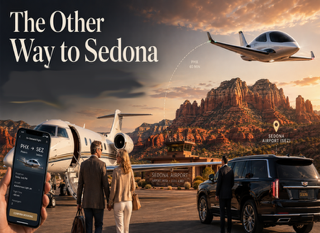
How private jets created a parallel world of speed, privilege and convenience—and how autonomous light aircraft may soon bring that experience within reach of the merely well-to-do.
By Bear Howard and Associates,
At 8:40 on a Friday morning, David Mercer is still in his Denver office.
He is 61, owns a regional commercial real estate company, and has spent most of the morning arguing over a $70 million refinancing that was supposed to be settled the day before.
His wife, Anne, has already gone home to finish packing. They are spending four nights in Sedona. Dinner at Enchantment tonight. A massage Saturday morning. A private hiking guide Sunday. No particular schedule after that.
David had planned to leave the office at eight. He doesn’t. It doesn’t matter. The airplane will wait.
At 10:05, a black SUV pulls up outside his building. It picks up Anne at their house and drives them not to Denver International Airport but to Centennial Airport, south of the city.
There is no airline ticket. No parking garage. No TSA line. No gate. No boarding announcement.
Their chartered Citation is sitting on the ramp. Two pilots are waiting. Their luggage disappears into the airplane. David makes a phone call before they leave. Anne opens a book.
At 10:32, they are airborne.
The round-trip cost of flying privately to Sedona will be somewhere in the neighborhood of what many Americans spend on a new car – perhaps $25,000 or more, depending upon the aircraft and repositioning involved.
David knows that. He doesn’t particularly like spending the money. He also doesn’t particularly care.
By early afternoon, the jet crosses the red rocks, lands on the mesa above Sedona, and taxis toward the terminal. A vehicle is waiting. Twenty minutes later, David and Anne are heading toward Boynton Canyon. They will never see Sky Harbor Airport. They will never drive Interstate 17. They will never stand beside a baggage carousel. Their trip to Sedona has begun almost before most airline passengers reach their departure gate.
This is how wealth changes geography.
At roughly the same moment, another couple is also thinking about Sedona.
THE OTHER WAY TO SEDONA
Michael and Laura Hernandez live in Orange County, California. Michael is an orthopedic surgeon. Laura owns a small interior-design firm. They are successful by almost any American definition.
Their house is worth more than they ever imagined it would. Their children are grown. They travel several times a year. They buy good seats on airplanes and stay in good hotels.
They are wealthy. They are not private-jet wealthy.
For their Sedona trip they leave home before sunrise, fly commercially to Phoenix, collect their bags, find their rental car and drive north.
Nothing particularly terrible happens on the trip. Millions of Americans travel this way. But sometime around Black Canyon City, Michael looks at the clock. They have been traveling for nearly six hours.
David and Anne Mercer, meanwhile, are already having lunch beneath the red rocks
Same destination. Same country. Two completely different experiences of distance.
And sitting above both couples is Sedona Airport.
FROM A BETTER SEAT TO A DIFFERENT SYSTEM
For much of aviation history, being rich meant being treated better inside the same transportation system everyone else used. You flew first class. You boarded first. Your seat was wider. Maybe someone knew your name. But you still had a ticket. You still had a departure time. You still had to get to the airport.
The private jet changed that.
At first, private jets were almost impossibly exotic machines: Learjets, Gulfstreams, Falcons – corporate aircraft belonging to major companies and people whose names appeared on magazine covers.
Then the business changed. Cessna built smaller Citations. Fractional ownership arrived. NetJets and Flexjet created enormous fleets that could be summoned without owning the entire airplane. Charter became easier. Jet cards appeared. Aircraft scheduling became computerized. Eventually much of the process migrated onto a telephone.
The private airplane slowly stopped being an object someone had to own. It became something someone could simply use. And the product being sold was not really luxury. It was time.
THE INVISIBLE VISITOR
You can see that transformation every day in Sedona, although most people don’t.
A jet appears over the red rocks. It lands. A handful of people step out. An SUV meets them. Then they disappear down Airport Road.
Some are CEOs. Some are investors. Some own companies nobody has ever heard of. Some are doctors, developers, technology entrepreneurs or families with inherited wealth. Occasionally there is somebody famous aboard. Most of the time there probably isn’t
THE OTHER WAY TO SEDONA
Fame and wealth aren’t the same thing. There are thousands of Americans worth $50 million, $100 million or considerably more whose faces would never attract attention in a restaurant.
They can arrive in Sedona almost invisibly.
The airport handles around 33,000 aircraft movements a year across all types of aviation. Private jets are only part of that traffic, but business jets and other turbine aircraft arrive by the hundreds and almost certainly into the thousands when the broader turbine category is considered.
The fuel tanks tell part of the story. Over the years, Sedona Airport has steadily become more dependent upon Jet-A, the fuel used by jets and turbine aircraft, while conventional aviation gasoline has remained comparatively flat.
The airport eventually had to expand its Jet-A storage dramatically. At times, only a few large aircraft could consume much of what the old fuel system could hold.
Something about the people coming to Sedona had changed. The airplanes were getting more sophisticated. And so were the passengers.
The rich have not merely purchased better seats. They have purchased a different relationship with distance.
THE AIRPLANE LEARNS TO SAVE ITSELF
But while everyone watches the Gulfstream, another revolution is occurring farther down the ramp.
Some modern jets are surprisingly small: a HondaJet, a Cessna Citation, a Cirrus Vision Jet. They may carry only five or six people. Some are certified for a single properly qualified pilot.
Climb inside one and the cockpit looks less like the collection of hundreds of mysterious gauges that once defined aviation and more like an extraordinarily sophisticated computer workstation.
The airplane knows where it is. It knows where other aircraft are. It knows the terrain. It knows the weather. It can fly precise routes through the sky that previous generations of pilots could scarcely have imagined.
And now some airplanes can do something that would have sounded impossible not long ago. They can save everyone aboard after the pilot becomes incapacitated.
Push an emergency button in certain aircraft equipped with Garmin Autoland and the airplane can take over. It determines where to go. It navigates. It manages the descent. It communicates the emergency. It approaches an airport. It lands. It brakes. It stops.
Nobody aboard has to know how to fly. The machine does it.
That capability already exists.
Which means the most interesting aviation question is no longer whether an airplane can land itself. It can.
The question is what happens when the pilot eventually disappears from the flight altogether.
IMAGINE 2036
Now move the calendar ahead ten years.
Michael and Laura Hernandez are older. Michael no longer operates four days a week. Laura has sold most of her design business to two younger partners.
They have more money now than they did in 2026, but they still aren’t billionaires and they still don’t own an airplane. On a Thursday night, they decide they want to spend the following week in Sedona.
Laura opens an app.
THE OTHER WAY TO SEDONA
She enters: Orange County to Sedona. Two passengers. Monday morning. Return Thursday afternoon.
The screen gives her several choices. One is conventional airline travel through Phoenix. Another is an autonomous regional aircraft departing from a smaller airport twenty minutes from their house.
It costs considerably more than coach. It is somewhat more than first class. But not remotely close to chartering today’s private jet.
Laura chooses it.
Monday morning, a car takes them to the local airport. There is no giant terminal. No concourse. No 150-seat airplane. Waiting behind a secure gate is a small jet carrying perhaps four or six passengers.
There is something else missing. A pilot.
Michael notices it immediately. Laura has already read about the system. Thousands of these flights have operated safely by now.
The aircraft is monitored from a remote operations center. Its computers continuously evaluate weather, traffic, aircraft condition, routing and airports. If something unusual occurs, a human specialist can supervise.
But nobody is sitting up front manipulating the controls.
The doors close. The aircraft starts. It taxis. It takes off.
Two hours later the red rocks appear. The airplane turns toward Airport Mesa and lands at Sedona.
A car is waiting.
Michael and Laura step outside with their bags. They have just traveled in essentially the same way that only extraordinarily wealthy people could afford ten years earlier.
Except no one owns the jet. Nobody hired two pilots. Nobody spent $25,000.
They simply bought a ride.
THE WAYMO MOMENT IN THE SKY
Just as you call Waymo in Scottsdale to come pick you up and it arrives in a few moments with no driver, that world could be coming to aviation.
Whether that exact trip exists in 2036 is impossible to know. Technology rarely arrives precisely on schedule. Government regulation moves slowly. Insurance companies move cautiously. Passengers may take time to trust an airplane with no human being aboard who can fly it.
But the direction is difficult to miss.
Cars already drive people around Phoenix with nobody behind the wheel. Aircraft already navigate largely by computer. Aircraft already manage engines automatically. Aircraft already avoid terrain and warn about traffic. Aircraft already fly instrument approaches. And some aircraft already select an airport and land themselves when the pilot cannot.
The leap from today’s airplane to tomorrow’s autonomous airplane is enormous legally and psychologically. Technologically, however, pieces of that future are already sitting in hangars.
WHY SEDONA COULD FEEL IT FIRST
And Sedona may be almost perfectly designed for it.
Airlines work wonderfully when hundreds of people want to travel between large cities. They work badly when six people want to go exactly where they want to go.
There isn’t enough traffic for an airline to operate Los Angeles-to-Sedona service every hour. But an autonomous six-seat airplane doesn’t need 150 passengers. It needs six. Maybe four. Perhaps eventually only two if the economics become good enough.
Suddenly dozens of places become practical departure points: Orange County, Santa Monica, San Diego, Las Vegas, Scottsdale, Tucson, Albuquerque, Santa Fe, Denver, maybe Salt Lake City.
The passenger doesn’t travel to the airline network. The network comes to the passenger.
THE OTHER WAY TO SEDONA
And the little airport on top of Airport Mesa becomes extremely valuable.
THE DEMOCRATIZATION OF ROYAL TREATMENT
There is something almost aristocratic about today’s private-jet world.
America doesn’t have kings. We don’t have dukes. We don’t bow when someone wealthy walks into the room.
Yet the ancient privilege of royalty was not really the crown. It was that the surrounding world rearranged itself around one person’s convenience.
The horses waited. The carriage waited. Servants waited. Rooms were prepared. Meals appeared.
Today the jet waits. The pilots wait. The SUV waits. The resort waits. The reservation waits.
Modern America has reproduced some of the logistical privileges of royalty without bothering with the titles.
But technology has a funny history. It repeatedly takes things invented for rich people and gives them to everybody else. The first automobiles were toys for wealthy families.
Long-distance telephone calls were once expensive events. Commercial air travel was once something ordinary Americans would never dream of purchasing.
Computers once filled rooms and belonged to governments and huge corporations. Now one lives in nearly everyone’s pocket.
Private aviation may follow a similar path.
Not private ownership. That will remain expensive.
Private experience.
Your small group. Your departure point. Your destination. Your schedule. Direct.
Technology has a habit of taking privileges created for the rich and moving them down the economic ladder.
THE THIRD COUPLE
Perhaps David and Anne Mercer will always fly the Gulfstream or Citation. They have enough money that they don’t need to care what the airline ticket costs or whether autonomous aviation becomes cheaper. Their version of privilege will simply become more sophisticated.
But Michael and Laura are the more interesting story.
In 2026, they watch a private jet pass overhead while they drive north from Phoenix. They know someone aboard is reaching Sedona differently than they are.
Ten years later, the difference may have narrowed.
Not because Michael and Laura became super-rich.
THE OTHER WAY TO SEDONA
Because technology moved the privilege down the economic ladder.
That may be the next great change in aviation.
The private jet separated a small class of Americans from the public transportation system. Autonomous aircraft could eventually allow a much larger group to step partly outside that system
Not everybody. Probably not cheaply. Certainly not immediately. But enough people to matter.
And destinations such as Sedona could feel the change first.
Someday a couple may leave Los Angeles after breakfast, touch a screen, climb aboard a pilotless little jet and have lunch overlooking the red rocks.
They may think nothing remarkable happened.
They just went to Sedona.
And that may be the most remarkable part of all.
NOTES ON WHAT IS REAL – AND WHAT IS FORECAST
The David and Anne Mercer and Michael and Laura Hernandez characters are fictional composites created to illustrate different levels of access to aviation.
The 2036 autonomous Sedona trip is a scenario, not a prediction of a certified service or a promised timetable. In 2026, autonomous passenger jet service of that kind is not commercially available.
Emergency Autoland is real. Garmin Autoland is certified on selected aircraft, and Honda Aircraft announced FAA certification of Emergency Autoland for the HondaJet Elite II in February 2026.
Sedona Airport’s roughly 33,000 annual operations include all categories of aircraft, not 33,000 private jets. The story intentionally describes private/business-aviation traffic as a subset of the airport’s overall activity.
Sedona Airport has substantially expanded Jet-A capacity, reflecting the importance of turbine aircraft in its modern traffic mix.
The future for the Sedona Tourism world and Sedona Airport looks bright. Technology is bringing aviation into the world of taxis and making it the safest way to travel.
Here are some interesting facts…A wealthy couple can spend roughly 15 to $20,000 to fly privately one way from San Francisco or Denver directly into Sedona. From New York, the same trip can easily cost 50 to $65,000 one way.
And importantly, that price generally buys the whole aircraft, not one seat. If six people fly San Francisco–Sedona on an $18,000 aircraft, the effective cost is about $3,000 per person—which helps explain why private aviation becomes increasingly competitive with first-class travel for families or small groups.
Some more facts:
There are 5,000 or more business jets worldwide
There are 15,500 based in the United States
there are 3.9 million business-jet departures per year
There are 10,600 departures per day worldwide
72% of this private jet activity is in North America
There are 5,000 U.S. airports accessible to business aviation
There are 1,400 flights/day operated by NetJets
There ahs been a 65% growth in fractional fleets since 2019
854 new business jets were delivered in 2025
And, 8,500 additional jets are forecast over the coming decade






2 Comments
Do you remember Sedona Air? 30 years ago we had a small 6 passenger airline that flew several times a day to Sky Harbor. I made the flights many times. 45 minutes from Sedona to Sky Harbor.
I would get the first flight out in the morning and make my connection at Sky Harbor. What happened to that great service to Sky Harbor? Sedona Air was bought out by a regional airline that promised to fly 15-passenger Cessna Caravans on the Sky Harbor route. It never happened. The regional airline went bankrupt, and the service was never restarted.
One of the problems cited for commercial air service to Sedona is the lack of a control tower and instrument landing equipment. Funding for a control tower was in a bill that was to be voted on September 11, 2001. Needless to say, it was never voted on, and the bill was never reintroduced.
Sedona will never have big commercial jets landing at the airport. The runway is too short, and there is no safe runoff area. Land too long and you fall off the mesa. However, modern 19-passenger turboprop and pure jet passenger aircraft could easily use the airport.
A recent travel option is buying a seat on charters rather than chartering the entire aircraft. One company files scheduled charters to smaller airports. I fly from Scottsdale to Orange County on JSX. It avoids Sky Harbor and Orange County crowds and cuts the travel time by 40%. The cost is about the same as first class on a big airline, but much easier and faster.
We really need to get a control tower and an instrument approach at the Sedona airport.
I’ve seen some pretty large aircraft land in Sedona. A couple of C-130’s, a C-141 and even a Navy P-8 Poseidon. Granted they were hopefully flown by trained experienced military pilots whereas many civilian pilots won’t even attempt Sedona.