

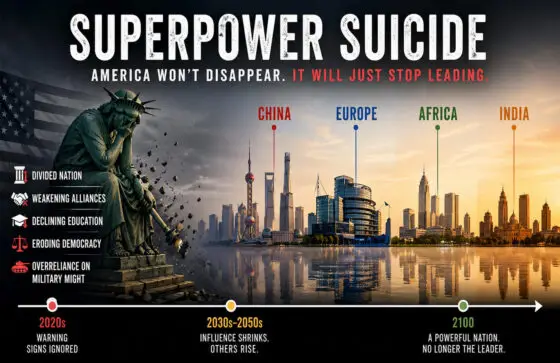
A vision of America’s future as a nation that remains powerful but no longer leads—gradually yielding the center of the world to rising powers as its own foundations quietly erode.
By Bear Howard and Associates
By the time the world reaches 2100, America may still be large, wealthy, armed, creative, and present—but no longer the owner of the theater. It may still have a seat near the front, but the stage lights will no longer automatically turn toward it.
The story will not be remembered as one dramatic fall. It will be remembered as something stranger: a nation that had everything required to remain indispensable, but slowly trained itself to become optional.
The phrase for that story may be superpower suicide.
Not because America vanished. Not because another army conquered it. Not because one rival suddenly replaced it. But because, while the world changed, America spent too many years arguing with itself, doubting its own institutions, weakening its own educational base, treating alliances as temporary transactions, leaning too heavily on military dominance, and forgetting that power is not the same thing as legitimacy.
The outside world has already begun to notice. The U.S. intelligence community’s own long-range work describes a future of fragmented economic and security blocs centered not only on the United States, but also China, the European Union, Russia, and regional powers. In other words: not an American century repeating itself, but a crowded century where America is one pole among others.
From China’s point of view, this is not merely a rivalry. It is a study in internal contradictions. Chinese strategic thinkers have long watched America’s divisions—its inequality, cultural fragmentation, institutional distrust, and political paralysis—not as moral failures, but as weaknesses in the operating system of a superpower. Their bet is not necessarily that China must defeat America outright. Their quieter bet is that America may defeat the best version of itself.
Europe watches differently. It does not always dream of America’s decline; often it fears it. But fear can become preparation. When European leaders and analysts begin saying dependence on American military power is “no longer tenable,” they are not declaring America irrelevant. They are saying something more historically important: the old assumption of automatic American leadership is no longer safe.
That is how empires and great powers lose their place. Not all at once. First, allies hedge. Then rivals accelerate. Then neutral nations stop waiting for permission. Then the old leader discovers that the world has learned how to move without it.
Rome did not fall simply because barbarians appeared. Rome weakened because the civic glue that held it together thinned, because its institutions became burdened by faction, spectacle, inequality, and overextension. Britain did not stop mattering after empire; it remained influential, cultured, wealthy, and respected. But it stopped being the world’s central command post. The sun did not set in one moment. It dimmed across generations.
America’s version, if it comes, may look like this: still the home of great universities, but no longer clearly educating its population for the age ahead. Still rich, but increasingly unequal and internally suspicious. Still armed beyond comparison, but less able to convert force into durable influence. Still democratic in form, but less trusted by its own people. Pew has tracked long-running low trust in the federal government, and recent surveys show frustration cutting across both major parties.
And education may become one of the quiet warning bells. The OECD’s PISA results show that only 61% of 15-year-old students in the U.S. reached basic proficiency across math, reading, and science in 2022. That is not just a school statistic. It is a national-capacity statistic. A country cannot remain first by memory. It has to keep producing people capable of building the future.
By 2100, the world may not have one king. China may lead in manufacturing systems, infrastructure, artificial intelligence, and state-directed technological deployment. Europe, if it finally learns to act as one civilization-state rather than a committee of nations, may become the great regulatory, diplomatic, and economic balancer. Africa, with its population growth and urban energy, may become the century’s rising engine. India may become an enormous technological and demographic force. A redesigned Russia, if it ever escapes its dependence on extraction and grievance, could matter again in a different form.
And America?
America will still be there. Still loud. Still creative. Still capable of reinvention. Still too large to ignore.
But it may no longer be the country that sets the terms of the world.
That is the real meaning of superpower suicide: not death, but demotion by self-neglect.
The prophecy is not that America disappears. The prophecy is that America becomes one powerful nation among many, looking back on the years when it confused inheritance with destiny.
And the only force that can interrupt that prophecy is not a bigger military, not a louder anthem, not nostalgia, not rage. It is a population that finally says:
We are not entitled to lead.
We have to become worthy of leading again.
Do you agree with this hypothesis? What do you think of the concept of “superpower suicide” as a real possibility for the current environment of America? Leave your comments here. – Bear Howard
4 Comments
The United States is destroying itself
https://www.theguardian.com/commentisfree/2026/apr/12/united-states-trump-destruction
Trump, Iran both share false information about eight women facing execution
This is what happens when a superpower is led by a super liar, grifter and convicted rapist who is trying to sell an illegal failed quagmire to his brain dead constituents. They (MAGA) know he lied to get the US into the war but will they recognize that he is lying about winning it or even having the upper hand when he does not. Fuel prices are at historic highs, food prices also at historic highs and yet somehow he thinks his party will win in the midterms without cheating? Fat (President) chance!
https://www.france24.com/en/both-trump-and-iran-share-false-information-about-8-women-facing-execution-by-the-regime
Great read-
Decline and Fall of the American Empire-
“Alliances were what made us great”
https://paulkrugman.substack.com/p/decline-and-fall-of-the-american
Just today Trump declared he was considering pulling all US Troops from crucial NATO (our line of protection from Russia) bases in Spain, Italy and Germany simply because they refuse to get involved in his and BB Yahoo’s illegal wars.
If he in fact did so it would leave the whole of Europe and the US unprotected from Russian invasions. Of course that’s probably been his plan all along as a means to assist his lord and puppet master Vladimir Poutine.
And who was it that claimed to be smarter than the generals? Hmmmm very likely some bloated orange wannabe leader/machurian candidate???
More lyrical words of wisdom by one of the great lyricists, singer and musician of our time-
THIS IS NOT AMERICA
This is not America
(Sha, la, la, la, la)
A little piece of you
The little peace in me
Will die (this is not a miracle)
For this is not America
Blossom fails to bloom this season
Promise not to stare
Too long (this is not America)
For this is not the miracle
There was a time
A storm that blew so pure
For this could be the biggest sky
And I could have the faintest idea
For this is not America
(Sha, la, la, la, la)
(Sha, la, la, la, la)
(Sha, la, la, la, la)
This is not America (no)
This is not (sha, la, la, la, la)
Snowman melting from the inside
Falcon spirals
To the ground (this could be the biggest sky)
So bloody red, tomorrow’s clouds
A little piece of you
The little piece in me
Will die (this could be a miracle)
For this is not America
There was a time
A wind that blew so young
For this could be the biggest sky
And I could have the faintest idea
For this is not America
(Sha, la, la, la, la)
(Sha, la, la, la, la)
(Sha, la, la, la, la)
This is not America (no)
This is not (sha, la, la, la)
This is not America (no)
This is not
This is not America (no)
This is not (sha, la, la, la)
***
Songwriters: David Bowie / Lyle Mays / Patrick B Metheny
Trump administration is pulling 5,000 troops from Germany
President Donald Trump threatened to do so earlier this week, following criticism by the German chancellor over the U.S. and Israel-led war with Iran.
https://www.nbcnews.com/politics/national-security/trump-administration-pulling-5000-troops-germany-rcna343147
The old Orange Putin Puppet actually did it! What a moron! US Troop levels in Europe especially those in Germany are already 1/3 of what they were during the Cold War. Guess he’s not only opening the door for a Rusher invasion he’s holding the damned door open for them! Once Putin mows through Ukraine thanks to the Putin Puppet talking crap and doing zilch to help anyone except Putin, all of the former Soviet Block/Warsaw Pact countries will be invaded with a push into Western Europe this time thanks to the Orange Clown who fancied himself smarter than the generals and everyone else for that matter despite being the dimmest bulb to ever be elected POTUS.
We’ve already shut down every major ammunition storage area forward based in Europe, shut down hundreds of Infantry, Armor and other crucial deterrents to a Russian invasion of Europe. Now this! And he’ll most certainly pull our Airborne Infantry troops (the only Airborne Infantry Regiment based in Europe), 6th US Naval Fleet and our Air Force bases in Italy as well as our Naval and Airbases in Spain. All of which have been crucial to Russian deterrence since the end of WWII not to mention the numerous US and NATO counter terror, peace keeping and Embassy rescue operations in Africa, Eastern Europe and the Middle East going back to our Marines being in Beirut Lebanon in the early 80’s.
And all because these NATO countries are following the NATO Charter set forth and agreed upon by the US and them of not starting wars and rather acting as their charters state “to act in unison as a Defense Force.” Attacking Iran for its oil or anything else is not part of those charters! It is contrarian to it and precisely why they refuse to get involved in Trump and BB’s illegal wars upon Israel’s neighbors just to help the Israeli government illegally land grab just to claim their ill gotten land as their own. Which is completely contrary to NATO, the UN and all the rules of Land Warfare Israel and the US are both signatories to!