

By Bear Howard and Associates–
Sedona, AZ — A recent social media post on Next Door in Sedona provides an observer with interesting insight into how sloppy, ambiguous language creates an illusion of something that is not real and, in the context of a political election environment, can affect how people actually vote. Doing a deep dive, using AI as an assistant researcher, here is an analysis of this post. That is a true case study of how distorted the public forum in Sedona has become.
First of all, here is the post, word for work, then the analysis: It is from a “Sedona Resident”
The argument that Sedona’s upcoming election pits representative government against “organized outrage” ignores that citizen initiatives are necessary checks against a council aligned with tourism interests.
Residents are utilizing direct democracy to protect community quality of life from the detrimental effects of excessive tourism and development, such as traffic congestion and the commercialization of public spaces. The push for Proposition 403 and the questioning of Home Rule reflect a demand for accountability, opposing a local government often influenced by the Sedona Chamber of Commerce and Lodging Council. People certainly didn’t agree with a homeless car camp at the Cultural Park- that was stopped by a citizen ballot initiative. People didn’t want to spend all that money on a parking garage. People don’t agree with spending money to have a Department of Sustainability.
Multiple people filed complaints against the city with the state AG. The City was found to be guilty.
Many people were outraged that flock cameras were installed and the City back tracked due to public outcry.
The City gifted millions to the Chamber to promote their members outside the city limits in direct competition to those who collected the taxes. No amount of reasoning with the city can dissuade them and the city promised to only gift that money for one year.
We live in a city that sues people for exercising their constitutional rights and sues people individually for signing the ballot initiative. This causes a Chilling Effect and it’s illegal. The Judge said, “the city was dancing on the head of a pin.”
The analysis of this post in the context of Sedona, July 2026
When Civic Criticism Becomes Civic Distortion
A Sedona Case Study in Political Language, Missing Context, and Public Trust
The social media post at the center of this discussion presents itself as a defense of residents and democracy. It argues that Sedona’s current political moment is a struggle between citizens and a city government aligned with tourism interests. It points to Proposition 403, Home Rule skepticism, the Chamber relationship, Safe Place to Park, Flock cameras, the parking garage, and the Department of Sustainability as examples of a city out of step with its residents.
That is a serious argument. It deserves to be examined seriously.
But when the post is read closely, its weakness becomes clear. It does not provide clear evidence that Sedona’s city government is corrupt, captured, or hostile to citizens. Instead, it gathers several controversies, removes much of their history, gives them emotionally charged labels, and then uses them as evidence for a much larger anti-city story.
That is how political language can mislead people during an active campaign. Not always by telling complete falsehoods, but by using partial truths, selective facts, exaggerated language, and missing context to push readers toward a conclusion that may not be fully true — and may sometimes be mostly false.
This is not an argument against civic criticism. Residents have every right to question city spending, land use, tourism policy, privacy issues, Chamber contracts, housing decisions, and ballot measures. The question is whether those criticisms are being presented fairly.
The Post’s Basic Method
The post works by stacking grievances.
It says residents are using citizen initiatives to protect quality of life. It says the city is influenced by the Chamber and Lodging Council. It says people opposed Safe Place to Park, the parking garage, and the Department of Sustainability. It says the city was found guilty by the Attorney General. It says Flock cameras were installed and then removed after public outrage. It says the city gifted millions to the Chamber. It says the city sued people for exercising constitutional rights. It says the judge criticized the city.
The emotional effect is powerful. The reader is led to think: “Look at all of this. Something must be deeply wrong.”
But a stack of grievances is not the same as an argument. Each claim needs evidence. Each issue needs context. Each controversy has its own history. Without that, the post becomes less a civic analysis than a political grievance collage.
The Problem With Saying “Residents”
One of the most important words in the post is “residents.”
The writer implies that “residents” opposed various city actions. But Sedona’s residents are not one single body with one single opinion. Some residents oppose more tourism. Some understand that visitor spending funds much of the city’s capacity. Some want more housing options. Some fear more development. Some support strong city services. Some distrust city spending. Some depend on nonprofits, transit, parks, roads, public safety, and city-managed infrastructure.
A group of residents may be angry. A petition may gather signatures. A social media post may get attention. But that does not automatically mean “the residents” have spoken.
A fairer statement would be: “Some residents strongly disagree with several city decisions.”
That is defensible. But turning “some residents” into “the residents” is a major rhetorical move. It allows a faction to speak as if it represents the whole community.
That is especially important during an election. When one group claims to represent “the people,” voters should ask: How many people? Which people? Based on what evidence? Are we seeing majority opinion, or simply organized dissatisfaction?
Loaded Language Replaces Accurate Description
The post uses language that does not merely describe events. It frames them.
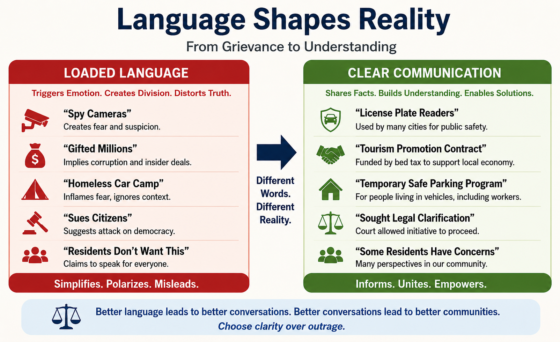
Safe Place to Park becomes a “homeless car camp.”
Flock license plate readers become “spy cameras.”
Tourism promotion becomes a “gift” to the Chamber.
Legal review of Proposition 403 becomes “suing people for exercising constitutional rights.”
A city planning or budget disagreement becomes proof of a city captured by tourism interests.
These labels are effective because they simplify complicated issues into emotional reactions.
Take Safe Place to Park. The harsher phrase “homeless car camp” suggests disorder, danger, and an invitation to outsiders. But the actual proposal was designed for people working in Sedona who could not find affordable housing and were already living in vehicles. The program included legal overnight parking, basic amenities, and assistance with housing; eligibility required employment in the city and a registered, insured vehicle. And most of the funding of this 2-year program was paid for by a state grant, not city funds.
A person could still oppose that program. They could object to the location, the cost, the management, the impact on the Cultural Park, or the message it sent about Sedona. But if the public only hears “homeless car camp,” it is not being invited into a serious housing-policy discussion. It is being pushed toward fear.
The same thing happened with Flock cameras. There are legitimate privacy concerns around automated license plate readers. Data retention, data access, data sharing, oversight, and misuse are real issues. But calling them “spy cameras” moves the debate from public safety and privacy oversight into a Big Brother frame. Sedona eventually voted unanimously to permanently end the Flock license plate camera program.
That fact cuts both ways. Critics can say public outrage stopped a bad policy. But it also shows that public pressure and representative government worked. The city reversed course. That is not proof that City Hall never listens. It is evidence that City Hall can be forced to respond.
Missing History Makes Policy Look Like Corruption
The Chamber issue is one of the clearest examples of how missing history changes meaning.
The post says the city “gifted millions” to the Chamber. That phrase suggests a giveaway, favoritism, or insider politics. But Sedona’s tourism funding history is more complicated.
After the recession, Sedona had strong reasons to rebuild tourism. The city does not have a property tax, and visitor spending accounts for a major share of the city’s revenue. Roads, police, parks, public services, transit, planning, infrastructure, and community programs all depend in part on a strong visitor economy.
In 2013, Sedona established a policy that at least 55% of revenue generated from its 3.5% bed tax, which was increased by 0.5% at the request of the Chamber and the lodging industry, would be devoted to tourism promotion and allocated to a contracted destination marketing organization. The Chamber was not simply handed money in a vacuum. It was hired to perform a tourism promotion and destination marketing role in a city whose financial structure depends heavily on visitor revenue.
People can still debate whether that arrangement was too generous, lasted too long, lacked accountability, or should have changed earlier. Those are fair questions.
But calling it a “gift” erases the economic and policy context. It turns a debatable public contract into a moral accusation.
That is the difference between criticism and distortion.
Legal Disagreement Is Not the Same as Attacking Democracy
The post also claims that the city sued people for exercising their constitutional rights. That is a powerful phrase. It makes the city sound authoritarian.
But the more accurate description is that the city filed a lawsuit seeking a court’s determination of whether the Proposition 403 initiative violated Arizona’s prohibition on zoning changes enacted through the initiative process. The city’s public explanation said the initiative would restrict development and prohibit residential development of the Western Gateway property, and that Arizona courts have historically ruled zoning measures cannot be enacted through citizen initiative.
The court allowed the initiative to proceed to the ballot. That matters. The city lost that round. The voters now get to decide.
But losing a legal argument is not the same as proving bad faith. Nor does it prove the lawsuit itself was illegal. The city asked for judicial clarity on a land-use and initiative question. The court disagreed with the city’s position. Those are different things.
This distinction matters because Proposition 403 has implications beyond one Sedona election. If a ballot initiative can control land use in a way that bypasses ordinary zoning procedures, public hearings, staff review, planning analysis, and representative decision-making, other Arizona cities may have reason to worry about the precedent.
That does not mean Prop 403 is automatically wrong. It means the issue is more serious than the slogan “let the people vote.”
Direct Democracy Is a Tool, Not a Cure-All
Citizen initiatives, referendums, and recalls are legitimate democratic tools. They exist because elected officials can be wrong. Citizens need ways to challenge government decisions.
But direct democracy is not automatically wiser than representative government. A ballot measure can be legal yet poorly written. A petition can still gather signatures even if it’s based on misleading claims. A referendum can stop a project, but still damage long-term planning. An initiative can sound democratic while bypassing processes that exist to protect the public from rushed decisions.
Sedona’s challenges are complicated: tourism pressure, housing, traffic, land use, infrastructure, public safety, environmental protection, and public finance. Most residents do not have time to study every legal, budgetary, zoning, and operational detail. That is why cities have councils, public hearings, planning processes, professional staff, advisory commissions, budgets, and elections.
Direct democracy should be a check on representative government. It should not become a weapon used every time a small group dislikes a decision.
The Grievance Template
The social media post follows a recognizable pattern:
First, identify a controversial city decision.
Second, rename it in the most inflammatory way.
Third, remove the history that explains why the city considered it.
Fourth, connect it to other controversies.
Fifth, claim the pattern proves corruption, capture, or contempt for residents.
Sixth, speak in the name of “the people.”
Seventh, present ballot-box resistance as the only real democracy.
This pattern works because it gives frustrated people a simple story. It identifies villains: City Hall, the Chamber, tourism, developers, insiders, and bureaucrats. It identifies heroes: residents, petitioners, watchdogs, people “standing up.”
But Sedona is not that simple. It is a small city with a large visitor economy, no city property tax, expensive infrastructure needs, a severe housing problem, environmental constraints, a limited land base, and a high level of resident emotion about growth, traffic, and change.
A message that turns every issue into “city bad, Chamber bad, tourism bad, residents ignored” does not help the public understand reality. It flattens reality into a campaign weapon.
Criticism vs. Distortion
The difference is not subtle.
Criticism says: “Flock cameras raise real privacy concerns.”
Distortion says: “The city installed spy cameras.”
Criticism says: “The Chamber contract needs accountability.”
Distortion says: “The city gifted millions to insiders.”
Criticism says: “Safe Place to Park may be the wrong use of the Cultural Park.”
Distortion says: “The city wanted a homeless car camp.”
Criticism says: “The city lost its legal challenge to Prop 403.”
Distortion says: “The city sued citizens for exercising constitutional rights.”
Criticism says: “Some residents oppose these decisions.”
Distortion says: “Residents don’t want this.”
Criticism helps citizens make better decisions. Distortion pushes citizens toward anger before they fully understand the issue.
The Lesson
This social media post is useful because it shows how political persuasion works in a small city during campaign season. The post is persuasive because it contains fragments of truth. There was a Flock controversy. There was a Safe Place to Park fight. There was a city-Chamber tourism relationship. There was a Prop 403 lawsuit. There are residents frustrated by traffic, tourism, spending, development, and City Hall.
But fragments of truth are not the whole truth.
Sedona needs serious debate. It does not need every issue turned into a weapon. The city has real problems to solve: housing, traffic, tourism management, public trust, infrastructure, environmental protection, and the future of major public land.
Those problems require clearer language, not louder accusations.
When a political message makes every fact point to the same villain, slow down. Ask what was left out. Ask what words were chosen to trigger emotion. Ask whether the speaker is explaining the issue or recruiting you into a grievance.
Democracy requires the right to speak. A healthy community requires the discipline to speak truthfully.
As Sedona voters decide how to vote on July 21, 2026, they should step back from the noise and look at the whole picture: who is sending the message, what facts are being left out, and whether the postcards, newspaper ads, signs, and social media posts are informing them — or deliberately steering them toward someone else’s agenda.
The question for every voter is not just “Do I agree with this message?” but “Is this an honest public debate, or am I being manipulated into accepting a political storyline disguised as truth?”
18 Comments
It pretty much is the Fox News whole 24/7 programming!
Distort, lie, give misinformation as fact, scare tactics.
Shall we play the Fox news boogie man game?
Socialism bad( but handouts to Wall St. ok) damn those occupy wall streeters.
Elon gets 32 billion in socialist handouts, self made man.
Deregulation( screw people and the environment for profit)
Law and order(after Jan 6, and pardon 1500 people?)
Fiscal conservatism, Tear down Whitehouse wing? Reflecting pools? Arches?
The debt only matters when Democrats are in charge!
Family values( Trump LOL!)
Now lets distort words!
CRT, DEI, Socialism, Communism,No go zones,Transgender,CIS, welfare queens,you didnt build it,abortion (killing babies), people eating cats and dogs, pedophiles, you get the drift!
I bet there is another 20 that they use to scare or use as dog whistles for bigots and racists!
We could all play the hypocracy game of the GOP saying one thing and doing the other.
So why is West Sedona Dave lying and distorting if he is so opposed to it???
So, West Sedona Dave, you seem to know so much about being a liberal, why are you distorting and lying just like you are accusing the GOP of doing??
@ Bruce, if you will can you point out anything not truthful…..I will wait, and Im sure you will just hit a run like always.
You may call me anything you wish, even put my opinions in a cute little box. I am for the people, to help those less fortunate, than me. I dont believe greed is good. It sickens me that people are so excited to hurt fellow American>
Hurting the poor, the sick, old, disabled are not my thing. Hell Im not even religious but I understand right from wrong………..How about you?
WS Dave, there has never been nor will there ever be a truly Socialist or Communist Society anywhere on earth. Why? Because mankind has always had greedy sadist in its midst. tWhat most Americans think is Socialism or Communism is actually Fascism just like we have currently running our country. This is why the Orange Little Lord Fauntleroy is bashing Socialist Democrats as being Communist while praising and lusting after Fascists like Putin, Un, Xi, and many other Fascist Tyrants hiding behind the label of Communism. If Putin was truly a Communist he’d be offended by Trump’s remarks and disown him as his primary Manchurian Candidate selected to aid in the destruction of Democracy and the US Government as a whole.
Mandami, Sanders and AOC may call themselves Socialist Democrats but they’re just Democrats who support Socialist programs like Social Security, Medicaid/Medicare, Unemployment, Unions and Healthcare for all which have long been the norm under Democrat and Republican leadership despite the GOP’s efforts to thwart all of those programs while handing the countries wealthiest huge tax breaks and bailouts that no other Americans upper middle class, middle class, lower middle class or poor never have and never will ever get.
Nearly every European country has a dozen or so political parties that the US does not and the Socialist Communist menace the US fears (because it takes money away from its wealthiest) has never once destroyed any of their countries. Fascism has, does and will!
Most politicians lie, which is why and how they become politicians. It’s a money making scam on America. The GOP which is now and shall be forever known as Trumps MAGA puppets just happen to have monopolized lying to and grifting their constituents all day everyday. Take the money out of politics and watch all the true swamp monsters run for the exits! Of course that would mean MAGA $ donors and the thruple of wankers running to ruin office would no longer be represented by the corrupters of their financial choosing and interests.
Distorting and lying like claiming that voting No on Home Rule which delivers all grants, permits and licenses for Sedona will fall under the Big State Government somehow keeps Sedona’s government and future small and non bureaucratic? Which is an outright distortion of truth and therefore an absolute lie. As someone else posted on here- 2+2 does not equate to five no matter how you spin it.
As usual Bear Howard provides a liberally biased and distorted view of what is happening!!
Is what was said by the residents first not to your liking or simply stating that the council works with a we were elected and will do as we see fit..Homeless park, emergency parking garage 1,800,000 on consultants for Transit hub in budget.. We need to understand what the elected city council is doing before major expenditures are decided and then presented in public form. Debate should happen before decisions are made..
Me thinks that the city did inform you and everyone else via questionnaires, surveys and ultimately voting. So what’s your issue exactly?
Absolutely excellent article! This critique was so helpful. I often ask for the data, the evidence, the facts in many of these discussions and no one ever answers me. They just reiterate talking points and scare tactics! Please do this more often. Make it your hobby. You can always critique me, I wear old girl panties! And I can always do better. Good job!
Bear Howard produced an Orwellian masterpiece of Doublespeak that illustrates the problem with Sedona City Government and its political operatives. Instead of using clear honest language he proposes adopting the City’s Orwellian euphemisms for a homeless car park (“Safe Place to Park”) and baseless lawsuits (“seeking legal clarification.”). It is not a fault to call things by their actual names instead of adopting the Orwellian euphemisms preferred by the City and Bear Howard. The parking lot was for homeless people, hence the accurate generic name for it was a “homeless car park.” It was would have been legally impossible to limit it to “workers” from Sedona and the City itself said it was an unsafe “sucky” idea. https://sedonavotes.com/homeless-car-park/ Honesty is a virtue not a drawback As for the City’s baseless lawsuit to stop residents from voting on Prop 403 (to preserve the non-residential zoning at the Cultural Park) the Council’s lawsuit was clearly vexatious litigation based on a lie (paragraph 23 of the Complaint) that the Cultural Park was only zoned for an amphitheater. Anyone who could read the zoning ordinance knew the City’s allegation was blatantly false, but the City didn’t need to worry about the merits of its case because the lawsuit was designed solely to crush the initiative with legal fees. The City never thought Prop 403 had the resources to fight back. Fortunately a public interest law firm took the case to protect the public against the City’s predatory legal practices and the judge summarily threw the City’s baseless case out of court. The judge even made the City pay Prop 403’s attorney fees and costs ($34,000) given the extraordinary bad fait in which the case was filed. The City’s suit was intended to deprive residents of the right to vote, so calling it a request for “clarification of the law” is a cynical manipulation of language in pursuit anti-democratic goals. The article’s attack on direct democracy is particularly risible because of its wild exaggeration that “direct democracy” should not be a weapon every time a “small group dislikes a decision.” Only twice in three years has a ballot measure been introduced, and in 2024 Prop 483 to stop the homeless car park won by 64% (which is a large majority and not a “small group” or a frequent occurrence.” ) Although the First Amendment may protect Bear Howard’s Orwellian doublespeak, the common sense and basic decency of the residents of Sedona limit the efficacy of his cynical manipulation of language. It is also regrettable that the proponents of the City’s baseless litigation against prop 403 do not have to pay the initiative’s defense fees in the City’s baseless litigation filed at the behest of certain people in Sedona.Biz. Let Bear Howard hide behind doublespeak. The rest of us choose honesty.
“Orwellian” says the MAGA man who loves his orange Bigly Brother 🤣😂🤣😂! Almost as funny as the full unredacted release of the Epstein files!
STFU, Bill, and finish packing for Idaho. You have done enough to poison my home of three decades. Good riddance to you. We will not miss you or your stupidity.
Sometimes those of us with harder noggins and fewer brain cells need to be told what people truly think of em. Sometimes it wakes them up and makes them better more humane peoples. Most of the time they get cocked-up even more. I hear Idaho is one of few of your states that have like minded anti democracy anti government non thinking people, who hide behind guns to do their talking outta their arses? Too bad because geographically it looks like a beauty land wise, similar to Colorado prior to all the tourist flooding into it and all the wealthy buying up all of the prime lands. Thanks for helping mankind be held accountable. It’s always refreshing when people speak truth to self perceived power and the ignorance they represent.
Wasn’t a “homeless park” that’s just your Orwellian euphemism for a Safe Park for our Un housed full time employee workforce. But you’d rather those who serve your needs daily live in un safe places and get run off by police whenever their un safe place is discovered. Orwell spoke truth to power and against greedy grubby politics and politicians like we have running our country today. That’s the only reason anyone would speak ill of his works, because it rings in their heads like a bigly bell of truth and reason that you try very hard to ignore but fail to do so.
To borrow an incredibly ignorant slogan from the White Nationalist side- “If you don’t like it you can leave it!” Instead you choose just to break it! Sedona that is.
Trump gave renaissance to McCarthyism and the Red Menace over the 4th. Guess he thinks that falsely accusing Americans of being Communists would be a great way to ruin undeserving peoples lives over lies and fear mongering just like Joe McCarthy did to thousands in the 50’s. It’s what fascist dictators do to keep a grip on power they would not otherwise have ever had. They’re all cowards who hide behind their gestapo’s and shock troops consisting of greedy hateful brainwashed sycophant minions. If you still support Donald J Trump or anyone who supports him you should seriously do a deep dive soul search because you are definitely not what our government was founded upon, nor why we fought WWI, WWII, or the Korean War where we lost thousands fighting fascist tyrants.
Democrats have their criminals as well but non that are outright fascist tyrants like Trump and his MAGA buffoons in stupid red hats. I’ve called out Bill Clinton (not for his office BJ but because of his lack of marital ethics and lying about them just like his Epstein Island pal) and never once even considered Platner a worthy candidate simply based upon his Croatian Ustashi Nazi tattoo he claims he did not realize was Nazi in origin. Who in their right mind selects a tattoo to have placed on their body for life without knowing what the hell it is?
If we vote for criminals and morons we get crime and stupidity. I fail to understand why Trump ever made it into office nor how or why Republicans protected him from his daily lies and many many crimes! And now they even say criminal DICK Nixon was framed and innocent despite his own words on his own illegal recordings. Why the desperation to make outright criminals into fake messiahs and tough guys out of draft dodging absolute cowards that rapes and molests women according to his own Access Hollywood admission, paid off Porn Stars with hush money payments while his wife sat home with their newly born son, instigated an Insurrection upon the Nation’s Capitol and the Law Enforcement Officers Assigned to protect it, is listed as a subject over 1 million times in the very small partial release of the Epstein files he promised to release in full and un redacted, has made billions off of deals made with foreign governments for his private company while POTUS, had numerous Americans executed in cold blood at the hands of his undertrained and out of control DHS/ICE Agents and most egregious of all has gotten American Service members wounded, maimed and killed while illegally starting wars with Yemen, Iran, in Kenya and during the US assisted Israeli genocide of the Palestinian and more recently Lebanese people. If you think these things are all ok because Obama wore a brown suit or Clinstone got a blow job and lied about it, you have serious serious issues and should have yourself institutionalized ASAP!