

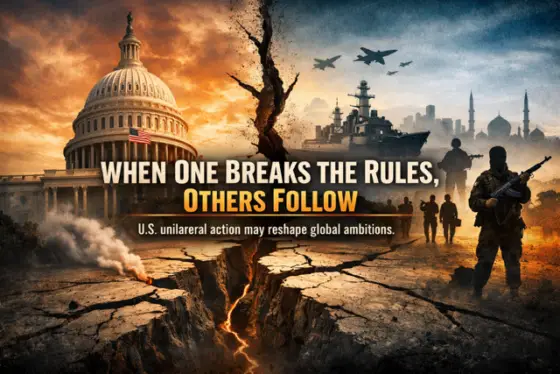
By Bear Howard and Associate
As the U.S. sets its own precedent, nations with long-simmering ambitions may ask: Why shouldn’t we follow suit?
Sedona, AZ — In the hours after a new round of violence between the United States, Israel, and Iran, the familiar language returned: deterrence, preemption, necessity. Officials described the strike as defensive. Supporters called it a strength. Critics called it reckless. But beneath the tactical arguments—about targets, capabilities, escalation ladders—lies a more consequential question.
Not whether America can strike Iran. It can.
But whether America believes it must still follow the rules it once insisted everyone else follow.

For nearly 250 years, the United States has lived inside a constitutional tension. Article I gives Congress the power to declare war. Article II makes the president commander-in-chief. In theory, deliberation precedes force. In practice, the distance between those two clauses has grown steadily since 1945.
The Korean War began without a formal declaration. The Vietnam War escalated after the Gulf of Tonkin Resolution—an expansive authorization based on disputed facts. The 2003 invasion of Iraq relied on intelligence about weapons of mass destruction that later collapsed under scrutiny. In 2011, the Obama administration argued that air operations in Libya did not constitute “hostilities” under the War Powers Resolution, thereby avoiding the 60-day withdrawal requirement.
Each episode stretched precedent. None fully snapped it. But with each stretch, the elastic thinned.
What makes the present moment different is not that executive power is expanding. That has been happening for decades. What makes it different is the concentration of bypassed norms all at once: no new congressional authorization; no direct attack on American territory; no broad multilateral mandate; preventive logic standing in for imminent threat; escalation triggered alongside an ally rather than after domestic deliberation.
That combination is historically unusual.
Since World War II, major U.S. wars have tended to involve at least one of three pillars: a direct attack (Pearl Harbor, 9/11), a UN-backed collective defense framework (Korea), or explicit congressional authorization (Iraq 2003). Remove all three, and the legal and moral foundation grows thinner.
The international framework matters too. The UN Charter permits force primarily in self-defense against an armed attack or with Security Council authorization. When powerful states bypass those constraints, they weaken the very architecture they helped design. After Russia invaded Ukraine, the United States invoked sovereignty, territorial integrity, and the prohibition on aggressive war. Those arguments carry weight only if applied consistently.
The world notices inconsistency.
Allies grow cautious. Neutral states grow skeptical. Adversaries grow bold.
The domestic consequences are quieter but no less corrosive. Democracies depend not merely on law, but on shared belief in law. When citizens watch their government reinterpret, evade, or ignore constitutional guardrails, they absorb a lesson: rules are flexible when power demands it. The psychological effect is subtle but cumulative. Trust erodes. Cynicism spreads. Participation declines. Polarization deepens.
A republic cannot function indefinitely on selective obedience.
There is also the matter of normalization. Decapitation strikes—once extraordinary—become procedural. Preventive war—once controversial—becomes routine. Military action without debate becomes background noise. Each step lowers the threshold for the next.
Pandora’s box rarely opens with a dramatic crack. It opens with rationalizations.
We have seen this dynamic before, though rarely all at once. The Gulf of Tonkin incidents expanded into a decade-long war. Intelligence misjudgments in Iraq reshaped an entire region. Libya’s limited intervention ended in state collapse. None were launched with the explicit aim of chaos. All were justified as necessary in the moment.
The pattern is not malevolence. It is drift.
What makes drift dangerous is when the institutions designed to correct it weaken simultaneously. Congress can reclaim authority through legislation or funding restrictions. Courts can enforce statutory limits. But those remedies depend on compliance. If an executive branch begins treating judicial rulings as optional and legislative oversight as obstruction, the constitutional architecture relies on its final safeguard: the electorate.
Public accountability is the last check.
That is the structural question beneath the headlines: whether the American system still contains sufficient self-correction to recalibrate when the executive tests its limits.
On the global stage, the comparison to playground politics is not entirely frivolous. When the most powerful actor signals that rules are contingent, others recalibrate their own behavior accordingly. If sovereignty is conditional when inconvenient, it becomes conditional everywhere. If preventive war is acceptable for some, it becomes justifiable for others.
The United States has long argued that it is not merely powerful, but principled—that it is bound by constitutional process at home and by international law abroad. That claim has never been perfectly realized. But it has been central to American legitimacy.
The cost of abandoning it is not immediate defeat. It is a gradual diminishment.
America can survive tactical miscalculations. It has survived many. What is harder to survive is a slow internalization of exception—an assumption that the rules are for others.
When that belief settles in, both domestically and internationally, the price compounds: weakened alliances, emboldened adversaries, frayed civic trust, diminished moral authority. Rebuilding those assets takes decades.
The immediate imperative in any conflict is de-escalation. Lives saved today matter more than arguments won tomorrow. But the longer imperative is constitutional equilibrium.
A nation that sees itself as exempt eventually discovers that exemption is not immunity. It is exposure.
The question is not whether America has opened a Pandora’s box before. It has, more than once. The question is whether it still possesses the institutional humility—and the civic will—to close it before its contents become ordinary.
Two days of conflict, what lies ahead?
Two days into the conflict, the immediate devastation is clear—lives lost, tensions inflamed, and diplomatic bridges burned. But the deeper shift is how America is being recast—not as a champion of rules, but as a force willing to bypass them.
In the eyes of allies and adversaries alike, this isn’t just a policy deviation—it’s a transformation. Once an anchor of international order, the U.S. now risks being perceived as a rogue actor—choosing might over right. History has seen nations that defy norms, insisting their power exempts them from accountability. In those stories, the end is rarely victorious—it’s isolating.
If America is to avoid that fate, it must choose now whether to remain an example of lawful leadership—or drift into a cautionary tale.
In this climate, the world isn’t just watching—it’s calculating. When America acts in ways that appear driven by self-interest, those outside its borders begin to ask how they might exert influence. They see a political system that shapes global outcomes, and they wonder: how can we make that system more accountable? Some will look to diplomatic influence, others to economic pressure, and still others will study the levers of American democracy.
Ultimately, the greatest global hope might not be in coercion, but in inspiring American voters—to see the stakes, to demand a return to principled leadership, and to recognize that, in an interconnected world, being accountable at home is the first step toward regaining trust abroad.
America has made unilateral initiatives the norm.
25 Comments
“None were launched with the explicit aim of chaos. All were justified as necessary in the moment”
Beg to differ here. Just look at the names on any artillery piece, tank, attack aircraft etc. For us grunts there used to be a “war chant” about “killing a commie for your mommy”. The spirit of the bayonet is “to kill”. In Spec Ops both military and civilian we are taught “maximum speed maximum violence” when conducting building entries. The sole purpose of a Stun Grenade aka Flash Bang Grenade is to cause pre meditated chaos.
War is either sheer freakin boredom or sheer freakin chaos. There’s no in between. Just sending our entire Naval Warfare capabilities into the region was to explicitly cause chaos within the Iranian government and its civilian population (which most assuredly were being bombarded with PsyOp Propaganda) as Israel and US strike jets neautralized targets enough for them to be deployed. War in fact is a giant PsyOp meant to destroy the credibility of all involved, especially the victims of war like Ukraine (not the aggressors) very much is.
One thing I learned during my service is that in order for a psychological operation to be successful you have to lie to everyone including those delivering the messages for the man in the high castle. I guess if war wasn’t intended intentional chaos it wouldn’t be war now would it?
What? No Bear is AI from the worry about who everyone is rather than what they say crowd? Amazing! But alas the night is so very young and there’s a Bloody Moon domani serra.
Too bad AI wasn’t around when Clinton and Obama did the same thing.
Clinton and Obama struck known military targets and did not attempt to regime change, inflame the entire Middle East or lie about No More Wars! Trump did and has. Trump lied to the entire country and you’re ok with it because it won’t affect you being bast draft age. Once again you defend the indefensible!
Excuses, excuses, excuses- MAGA is full of them but will never accept blame for anything. Anything to protect “their guy”. Normal Americans know there hasn’t been a legitimate honest non criminal President since Eisenhower and are willing to criticize both the opposition party as well as their own. Only an absolute twat would continue to defend the lies coming out of this administration! What say you Mr defender?
Repercussions of rule breaking-
Gunman was not on FBI’s radar before he opened fire on crowded Texas bar, authorities say
https://www.azfamily.com/2026/03/02/federal-city-officials-say-man-who-opened-fire-outside-texas-bar-was-not-their-radar/
Had the FBI director not been chugging beer with the US Men’s hockey team in Italy and he wasn’t focused on firing Agents who did their duty in investigating a criminal POTUS who sparked a violent insurrection and stole box after box of classified documents and if FBI agents weren’t out kidnapping illegal and legal migrants for sport with ICE goons killing Americans then perhaps maybe just maybe someone would’ve been able to prevent this shooting from ever happening? Perhaps?
Thank God midterm elections are underway while Trumps numbers are lower than whale shit just like he is and he only has his own hate and ignorance to blame. He’s already considered the absolute worst president of our lifetime. He’ll go down in disgrace just as Nixon did! America does not like liars nor war mongers who kills its children for lies!
Trump awards the Medal of Honor to 3 US Army service members in a White House ceremony https://www.azfamily.com/2026/03/02/trump-will-award-medal-honor-three-us-army-service-members-white-house-ceremony/
Whatta day of lies and contradiction! The Trump Administration cannot keep their story straight as to why the US had to start another foreign war that they promised would never happen on their watch. Now we have Trump hosting an awards ceremony for veterans that the DoD determined worthy of the Blue Max as we veterans refer to it. Then there’s Polish Commander Karol Cierpica whose presence on the battlefield and humble words at the awards ceremony contradicts Trumps attitude towards NATO. Sure hope the next POTUS does an inventory of Ft Knox and a by serial number (yes MoH are numbered) for suspiciously missing medals because President Draft Deferment sure thinks he deserves one!
Obviously Israel and the US think they can go it alone in taking on the world’s enemies (except for their pals in N Korea, Syria and Rusher who get a pass). NATO sitting on the sidelines in harms way are watching Trump’s attempt to put his ill gotten money where his ill mouth is without them. They will not come to our aid if shit goes further sideways than it already has with 6 service members KIA and 18 WIA. Nope they will remember being slandered, ignored, purposely slammed into etc. And they will cheer our countries failures due to an ignorant pompous ass who thought he was smarter than everyone else solely because he’s a better criminal than most.
If the King doesn’t have his henchmen disrupt our mid term elections enough or stage another more violent insurrection and he loses the house and senate the next four years will be spent investigating, impeaching and prosecuting every criminal in MAGA. Trumps is fully aware of this which is why we are at war with Iran rather than doing due diligence to victims of Epstein and his criminal Accomplices by releasing ALL of the Epstein files as he promised but lied about and as Congress legally directed but he had his sycophants in the DOJ ignore. He may survive the midterms and serve until his term legally expires. But he and his criminal accomplices will face a court of real law and Justice one day! That I can ASSure you!
Whoopsie 2 explosive laden drones just hit a US base in Riyadh Saudi Arabia! More blood on Trumps hands, quickly approaching the casualty numbers of the Abbey Gate Afghanistan withdrawal! Sure hope you’re mad as hell MAGA like you were at Sleepy Joe Biden who kept his promise to end foreign wars.
BTW- Trump claims he doesn’t drink alcohol despite having numerous photos taken with wine and cocktails,. He sure was slurring and mixing his word salad up today! Wonder what he was under the influence of?
One can destroy the entire Iranian populace but the fact that Americans are no more wanted in the Middle East as Chinese troops would be here will never change. Since the discovery of oil in Iran in 1908 British and American governments have been trying to control their oil for our consumption. This along with the forced occupation of then Palestine and the forced creation of the State of Israel with the blessings of the US and British governments was also a middle finger to Arabs throughout the entire region. This was followed by the failed 6 day war where Israel using US and British military hardware stopped their Arab neighbors from taking their land back. Ethnic and religious tensions, war and terrorism have plagued the region ever since. Why because we refuse to allow other countries to regulate how they use and sell their own natural resources because we think somehow they belong to us. They most certainly do not anymore than our natural resources belong to anyone else. Sovereignty is something the US has started many a war over and yet we have blatantly and purposefully refused to recognize Middle Eastern State sovereignty with one exception- Israel. Why Israel? Because they don’t technically own the land they are on anymore than we have a right to be in the Middle East. It’s why the Regan and Bush family-family friend Bin Ladin felt the need to hit us here in the US.
Statistically our government has killed far far more innocent civilians in the Middle East than Iran ever has. Killing innocent people is NEVER justified by anyone despite our government’s saying they are. And those deaths all have consequences. This war will only result in more death, tragedy and hatred of America.
Here’s the statistics-
Based on available U.S. government and watchdog reports over the past roughly 50 years, Iran and its proxies are known to be responsible for killing hundreds of Americans, with estimates often citing over 600 U.S. troop deaths in Iraq alone between 2003 and 2011. High-casualty incidents include the 1983 Beirut barracks bombing (241+ U.S. personnel) and bombings in Lebanon and Iraq.
The White House (.gov)
Key figures regarding Americans killed by Iran or its proxies since 1979 include:
Iraq War (2003–2011): The U.S. Department of Defense indicated Iran was responsible for at least 608 American troop deaths, often via sophisticated roadside bombs (EFPs) provided to militants.
1983 Beirut Barracks Bombing: Iran-backed Hezbollah killed 241 U.S. military personnel.
Beirut Embassy Bombing (1983/1984): Attacks on the U.S. Embassy in Beirut killed dozens of Americans, including CIA station chief William Buckley.
Other Incidents: Various hostage-takings, hijacks (e.g., TWA Flight 847 in 1985), and attacks throughout the 1980s and subsequent decades have added to the total.
Foundation for Defense of Democracies
While some figures suggest hundreds, the total count varies depending on whether one includes indirect support for attacks in various regional conflicts over the last four decades.
Foundation for Defense of Democracies
Vs.-
Estimates of civilian deaths directly caused by U.S. military actions in the Middle East, primarily post-9/11, range from over 48,000 to over 400,000, depending on whether the figures include indirect, structural causes like destroyed infrastructure. The Watson Institute for International & Public Affairs at Brown University estimates at least 408,749 direct civilian deaths in Iraq, Afghanistan, Pakistan, Syria, and Yemen since 2001.
Brown University
Key Findings on Civilian Casualties (Post-9/11):
Total Direct Deaths: Brown University researchers estimated that between 3.6 and 3.8 million people died indirectly due to conflict-related destruction of economies, healthcare, and infrastructure.
Airwars Analysis: Independent monitoring group Airwars estimates that U.S. strikes alone have killed between 22,679 and 48,308 civilians.
Iraq War Specifically: Research via Brown University suggests between 182,272 and 204,575 civilians died due to direct violence.
Underreporting: The Pentagon has often undercounted these casualties, with The New York Times noting that independent organizations frequently find much higher numbers than official Central Command (Centcom) reports.
Brown University
These figures focus heavily on the “Global War on Terror” era (2001–present) rather than the full 50-year period, as comprehensive, reliable data on civilian deaths from earlier conflicts is harder to quantify.
What about when the rule maker is an insane criminal insane people think is the Messiah?
Nothing like propaganda to get the troops willing to kill for an insane despot.
US troops were told war on Iran was ‘all part of God’s divine plan’, watchdog alleges
Religious freedom group says 200 troops sent complaints of superiors using extremist Christian rhetoric to justify war
https://www.theguardian.com/world/2026/mar/03/us-israel-iran-war-christian-rhetoric
2019-
The High Price of Trump’s Great Betrayal
President Trump’s abandonment of the Kurds reinforced already existing doubts in the region and around the world that the United States remains a reliable ally.
https://www.project-syndicate.org/commentary/high-price-of-american-withdrawal-from-syria-by-richard-n-haass-2019-10
2026-
CIA working to arm Kurdish opposition forces to prompt uprising in Iran: report
https://nypost.com/2026/03/04/world-news/cia-working-to-arm-kurdish-opposition-forces-to-prompt-uprising-in-iran-report/
Now why would the Kurds or any of our other former Allies help the POTUS who took a big crap on and even allowed Turkey to declare open hunting against them. Good luck now Liar and Thief!
Dear Trump cheerleaders supporting the Chickenhawk Draft Dodger in Chief-
“Democratic veteran goes after ‘chickenhawks’ promoting Iran strikes”
https://thehill.com/homenews/house/5767233-dem-vet-goes-after-chickenhawks-promoting-iran-strikes/
Answer this- How many American service members, US contractors and civilians need to die in this illegal stoopid war? How many US coffins coming home are ok? Or do you just not give a shit because you don’t have to go just like Major Bone Spurs during Vietnam?
If you still believe a word the liabetic nutjob in the White House or any of his criminal accomplices in his administration have to say you’re as stoopid as he is and as liable for supporting him! He’s been lying to you all since long before he took office starting with his affiliation to his pal Epstein, lying about Obama not being a US born Citizen, the lies about the Central Park 5, lies about being at ground zero on 9/11, Muslims cheering in the streets of the US after 9/11 and the thousands of lies he’s told you and everyone else since taking office both under oath as well as just publicly. Time for a for real Impeachment of the criminal destroying our country!
Bawk Bawk Bawk Chicken Hawks!
Excellent points of fact Mr JB. This is what happens when we allow the dumbest guy on the planet hold the keys to the country.
Guess it’s ok for the US to kill thousands upon thousands of innocent Arab civilians to avenge a couple hundred Americans revenge killings by Iran. Why do we insist that it’s our right to even be in the region in the first place? Oil? Not Americas unless we steal it like we did Venezuelan oil tankers and oil fields. Just waiting for the AI hate video out of the White House depicting criminals Trump and Netanyahu drinking cocktails in Teheran next to a Trump resort complete with Iranian servant slaves as they did with their video of Gaza. Thank goodness GB, Spain and pretty much the entirety of NATO refuse to assist the US in any way shape or form. Because they don’t have to nor want to after the bullying they’ve endured from the Trump administration.
Trump tries to ‘rewrite the past’ with ‘unprecedented’ gift to Steve Bannon
https://www.alternet.org/news-politics/trump-bannon/
Just more pardoning of the GOP’s/MAGA’s top criminals by the Orange Criminal, the Grand Puba (of Flinstone fame) himself.
First it was Ford pardoning criminal DICK Nixon, then criminal spook Bush Sr. pardon Ronnie Raygun, then MAGA nullified 2 legitimate Impeachments of the Orange idiot and is now trying to tell M’erica that Jan 6th never happened, that we didn’t see and hear what we saw and heard plain as day.
So MAGAites tell me, how is that Justice? Allowing criminals to be President and then pardoning for their crimes. And why has there been no pardons of any Democratic Presidents for committing crimes against the country and humanity? Answers- because no Democrat President has ever done those things. Things that killed thousands of US service members. This is why the SCOTUS granted convicted felon Trump unprecedented complete immunity from being prosecuted for his crimes. Guess they’re tired of having to pardon them?
Straight from the horse faced former sycophants mouth to your ears MAGA! That is if your propaganda channels are even covering the dissent in MAGA against Trump for lying to them and the entire world! Marjorie like the old GOP backed cigarette company ad used to say, “you’ve come along way baby!” Keep it up and we might even forgive you like real Christians and people of other true faith do for your un Christian hatred and behavior. Maybe go on a tour with repentant Domestic Terrorist Ammon Bundy and truth talk about how you were duped by Trump (Q) and MAGA as a whole. Life is always better when you’re humane and human 😘
“Marjorie Taylor Greene Has Chilling Wake-Up Call On Trump: ‘I Don’t Think He’s Joking’”
https://www.huffpost.com/entry/marjorie-taylor-greene-trump-third-term_n_69a7f7bfe4b0865be0c5a358
Shocked General Says Pentagon Pete Must Be ‘Smoking Something’
https://www.thedailybeast.com/shocked-general-says-pentagon-pete-hegseth-must-be-smoking-something/
I’ll let the General Officers assessment of the former Major (who has zero business running anything) speak for itself !
Jan. 6 plaque installed at U.S. Capitol following yearslong delay
The Senate voted to install the plaque after the House GOP refused to display it.
https://www.nbcnews.com/politics/politics-news/january-6-plaque-installed-us-capitol-delay-rcna262236
So now we have a plaque to commemorate what MAGA says never happened? I love it! The orange Lord Pompousroy must be furious 😂
Trump demands ‘unconditional surrender’ from Iran as Putin speaks with Iran’s president
https://www.bbc.com/news/articles/c5yq82k1wk8o
I guess King George da Turd wants all out war and more American and Israeli servicemen and women to be killed out of ignorance. What the bloody hell happened to no more foreign wars? I thought he was a master debater and negotiator? Telling people who have experienced war many times over and have become expert at it that they must just surrender without any caveats is just begging for things to get worse than they already are thanks to him and his administration. Nobody with the exception of the current Israeli government trusts America to do anything it says it will do anymore. And Trump not speaking out about Putin targeting Americans despite being part of for him is outrageously disrespectful to all those in uniform being made to do his bidding with the added threat of his BFF targeting them. MAGA must be very proud of being lied to repeatedly and deliberately by the deranged lunatic they elected?
Two men charged with terror offences after homemade bomb thrown outside NYC mayor’s home
https://www.bbc.com/news/articles/cy4we8ev5lpo
This is quite interesting. I don’t recall another incident of terrorist attacking terrorist insurrectionist (who threatened to but a Quran which seems to be ok) Wonder what the terrorist insurrectionist would have done had the terrorist burned a Bible. Very interesting paradox of hate to be sure!
Guess that’s what happens in countries where only one religion is allowed to be front and center and in your face?
Slain Soldiers’ Families Speak Out After Pentagon Pete Frames Them as PR Problem
https://www.thedailybeast.com/dead-soldiers-families-refuse-to-go-away-and-shut-up-like-defense-secretary-pete-hegseth-wants/
Apparently Trumps claim of a warm reception by family members killed in his war and his usual lie tell of starting his recollection of alleged conversations with “Sir” as if the family members were military members themselves is debunked. They don’t like being lied too or about this is clear. Pentagon Pete and the face of the White House propaganda machine Karoline Leavitt comments and condemnations of the press for disclosing the fact that Americans have been killed says something about the dark hatred that plagues their hearts and minds. And they pretend to be “good Christians” while acting and speaking demonically to and of others in defense of the draft dodger who got their loved ones killed when they all promised they would not!
This was stated the other day on here when the US committed war crimes and bragged about torpedoing an Iranian ship outside the conflict zone. The world is watching us behave like the fascist country we have become under MAGA.
Allowing Iranian ship to dock was the ‘humane thing to do’: Jaishankar
https://m.economictimes.com/industry/transportation/shipping-/-transport/safety-of-indian-seafarers-a-priority-amid-maritime-tensions-says-jaishankar-at-raisina-dialogue/articleshow/129201514.cms
MAGA crybabies refused to mask and social distance during the height of a deadly pandemic killing millions of Americans because they considered it a violation of their body and rights to get others sick and kill their fellow Americans D-E-A-D! In their insurrectionist anti American minds this was somehow patriotic duty from the Draft Dodger and Thief on down.
And now they want to force incarcerate and forcibly drug actual Patriots who served their country but their country took a bigly crap upon them.
It’s unsurprising as MAGA is comprised of liars, conspiracy nut jobs, criminals and pseudo religious, pseudo patriotic haters. Keep on poking the killer bee nest morons. When you mess with veterans and you are a Draft Dodging Coward or someone who supports the Draft Dodging Coward you are messing with millions of patriotic veterans who won’t stand for you hate of veterans while sending troops to die and be permanently disfigured in your illegal hate wars.
VA plans to seek public guardianship for some veterans deemed unable to care for themselves
https://www.stripes.com/veterans/2026-03-11/va-doj-guardianship-vulnerable-veterans-21031702.html
Pls post this over the previous entry-
MAGA crybabies refused to mask and social distance during the height of a deadly pandemic killing millions of Americans because they considered it a violation of their body and their right to get others sick and kill their fellow Americans D-E-A-D! In their insurrectionist anti American minds this was somehow patriotic duty from the Draft Dodger and Thief on down.
And now they want to force incarcerate and forcibly drug actual Patriots who served their country but their country took a bigly crap upon them.
It’s unsurprising as MAGA is comprised of liars, conspiracy nut jobs, criminals and pseudo religious, pseudo patriotic haters. Keep on poking the killer bee nest morons. When you mess with veterans and you are a Draft Dodging Coward or someone who supports the Draft Dodging Coward you are messing with millions of patriotic veterans who won’t stand for you hate of veterans while sending troops to die and be permanently disfigured in your illegal hate wars.
VA plans to seek public guardianship for some veterans deemed unable to care for themselves
https://www.stripes.com/veterans/2026-03-11/va-doj-guardianship-vulnerable-veterans-21031702.html
Congratulations MAGA! You’re lying POTUS has officially killed the same number of US servicemen that the “Biden” evacuation of W Bush’s war in Afghanistan! Give yourselves a round of applause for being the dupes who elected the criminal responsible for these deaths for lies.
Oh I nearly forgot he’s also responsible for 150 known US wounded thus far! Hooray for MAGA right?
You sad ignorant bastards! May your sons and daughters feel the pain of all those service members and their families!
Pirro Unleashes Vicious Attack Against Sitting Judge
https://talkingpointsmemo.com/morning-memo/pirro-unleashes-vicious-attack-against-sitting-judge
She must be hitting the bottle again, that’s pure alcoholic nonsense rage and lies against a sitting Judge just like her Superior the raging lying AG defender of crimes- committed by this administration! Must be something special in the water at the DOJ? Or perhaps Israel just bombed her Lebanese brain? Let’s ask Jewish Space Laser expert MTG. 🤣
Trump-linked PAC sends fundraising email using dead soldier’s casket photo from dignified transfer
Several fundraising messages from Trump-connected groups have invoked Iran war to raise money for his campaigns
https://www.independent.co.uk/news/world/americas/us-politics/trump-never-surrender-pac-fundraising-b2938611.html
And here I’ve always thought there was nothing lower than Whale Shit! What a draft dodging scumbag! And I guess our National Security and Secrets are for sale to the highest bidder? If any Democrat Ever did anything remotely similar the GOP would’ve impeached and imprisoned them! In- freakin-credible!!!