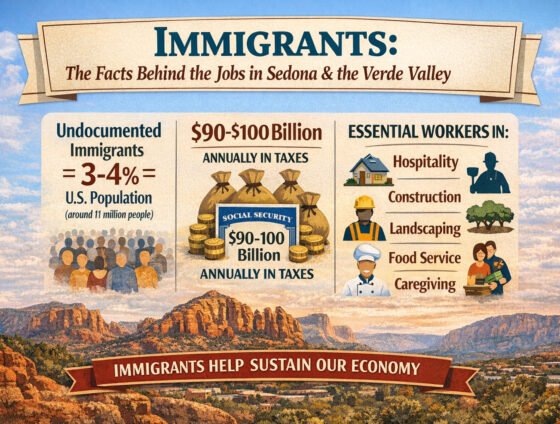
In Sedona and the Verde Valley, immigrant labor quietly supports the service economy—even as the national conversation turns them into symbols.
By Bear Howard and Associates
“When the Noise Finally Fell Away in Sedona“
Sedona, AZ–It started, like so many arguments do now, with a phone on a table.


Tom slid it across to Daniel at a small coffee shop just off 89A. Outside, a steady line of visitors moved past in hiking shoes and wide-brim hats, maps in hand, cameras ready. It was another busy day in Sedona. It almost always was.
“Read this,” Tom said.
Daniel leaned in.
The sentence was clean. Certain. Built to travel.
Undocumented immigrants pay more taxes than anyone and commit far less crime than Americans.
Daniel read it twice, then sat back.
“Well?” Tom asked.
Daniel exhaled.
“It’s not really true,” he said.
Tom nodded once.
But Daniel lifted a finger.
“It’s not really false either.”
Tom frowned. “That doesn’t make any sense.”
Daniel gave a faint smile. “It does now.”
The trouble was, the truth no longer came in one piece.
It came sliced. Sharpened. Passed around by people who only wanted the part that helped them feel right.
One side pointed to a crime and said, there’s the problem.
Another pointed to statistics and said, there is no problem.
Both were holding something real.
Neither was holding the whole thing.
“The real version doesn’t fit in a sentence,” Daniel said.
Tom leaned back. “Convenient.”
“No,” Daniel said. “Just harder.”
He tapped the table lightly.
“Undocumented immigrants paid close to $100 billion in taxes a couple years ago,” he said. “All levels—federal, state, local.”
Tom looked up.
“That includes about $25 billion into Social Security,” Daniel added. “Money they’re very unlikely to ever collect.”
Tom didn’t respond right away.
Outside, a couple walked by holding iced coffees, laughing about a trail they had just finished. A server hurried past them carrying a tray stacked with plates from the café next door.
Sedona looked calm.
But Daniel had lived there long enough to know what it took to make it look that way.
A few days later, they were walking along a trail near Oak Creek.
The water moved quietly over the rocks. A group of visitors stopped to take photos. Someone asked for directions. Someone else asked where to get lunch.
Tom watched it all.
“This place runs on people,” he said, almost to himself.
Daniel nodded.
“More than people realize.”
They kept walking until the trail opened up to a view of the valley. Down below, rooftops, resorts, restaurants, and small businesses stretched out between the red rock formations. It looked effortless from a distance.
It wasn’t.
“You ever think about how small we are?” Daniel asked.
Tom smiled. “You’re going to do that thing again.”
Daniel pulled out his phone.
“Four percent,” he said.
Tom shook his head.
“The United States is about four percent of the world’s population,” Daniel said. “And towns like this”—he gestured toward Sedona—“depend on that four percent showing up to work every day.”
Tom looked down into town again.
Hotels. Restaurants. Landscaping crews. Construction sites. Caregivers driving between homes. Housekeepers turning over rooms before the next wave of visitors arrived.
“Yeah,” he said quietly. “They do.”
They sat on a flat rock near the edge of the trail.
“So what about the crime part?” Tom asked. “That’s what people always go back to.”
Daniel nodded.
“In places where they actually track it,” he said, “the rates tend to be lower for undocumented immigrants than for native-born Americans.”
Tom glanced at him.
“In Texas, for example,” Daniel continued, “the homicide conviction rate was about 3.1 per 100,000 for undocumented immigrants and about 4.9 for native-born Americans.”
Tom raised an eyebrow.
“And in one recent year,” Daniel said, “undocumented immigrants were about 7% of the population there, but about 5% of homicide convictions.”
Tom leaned back.
“That’s… not what you hear,” he said.
“No,” Daniel said. “It isn’t.”
Below them, a landscaping crew moved along the edge of a property, trimming and shaping the kind of clean, natural look Sedona prided itself on. A service van pulled into a resort driveway. Another group of hikers passed, asking where to find the best sunset view.
Everything was working.
Quietly.
“The country’s getting older,” Daniel said after a while. “Birth rates are down. Fewer young workers coming up.”
Tom nodded slowly.
“And places like this,” Daniel said, “don’t slow down. If anything, they get busier. More visitors. More retirees. More demand for services.”

Tom thought about the last time he tried to get a reservation in town. Or find a contractor. Or hire someone for even a simple job.
“So we need people,” he said.
Daniel looked at him.
“We already have them,” he said.
That night, Tom sat at his kitchen table in Sedona, looking at the same image on his phone.
It felt different now.
Not wrong.
Not right.
Just… incomplete.
He thought about the servers, the cleaners, the construction crews, the caregivers. The people you saw every day but rarely thought about beyond the role they filled.
He thought about the taxes Daniel had mentioned. The Social Security money paid in and never taken out.
He thought about the crime numbers. Not zero. But not what he had been led to believe.
And then he thought about something simpler.
The system.
Sedona didn’t run on scenery alone.
It ran on people.
A week later, back at the same coffee shop, Tom didn’t bring up the image.
“I’ve been thinking about this town,” he said instead.
Daniel smiled. “That’s new.”
Tom ignored it.
“If half the people doing the work here disappeared tomorrow,” he said, “what would happen?”
Daniel didn’t answer.
Tom nodded to himself.
“Hotels don’t turn rooms. Restaurants cut hours. Construction slows. Care gets harder to find. Everything backs up.”
Daniel nodded once.
“Exactly.”
Tom looked out the window again.
“And we’re arguing about them like they’re not part of the system.”
They sat quietly for a moment.
Outside, Sedona moved the way it always did—beautiful, busy, dependent on things most people didn’t stop to think about.
Tom leaned forward.
“I think I finally get it,” he said.
Daniel raised an eyebrow.
“It’s not about whether immigration is good or bad,” Tom said. “That’s the wrong argument.”
Daniel didn’t interrupt.
“It’s whether we’re honest about what we rely on.”
Daniel nodded.
The truth, once it settled in, didn’t feel political.
It felt practical.
Sedona, like much of the Verde Valley, depends on a workforce that doesn’t always show up in the conversation the way it shows up in real life.
And the United States—four percent of the world’s population—depends on something even larger:
Enough people.
Enough workers.
Enough participation to keep the system moving forward.
Without that, growth slows.
Services strain.
Communities like this one feel it first.
Tom stood up, finishing his coffee.
At the door, he paused.
“Maybe it’s not about who’s right,” he said.
Daniel looked at him.
“Maybe it’s about whether we’re paying attention to what’s actually happening right here.”
Daniel smiled.
And for a moment, just a moment, the argument went quiet.
Not because it was settled.
But because something underneath it had finally been seen.
A town doesn’t lose its future all at once.
It loses it slowly—
when it forgets what it depends on
and starts arguing with the very reality that keeps it running.
And wh
Epilogue: What the Noise Was Hiding
Step back from the arguments, and the facts line up more clearly than the slogans ever allow. Over the past century, most immigrants have come legally, but today undocumented immigrants still make up only about 3–4% of the U.S. population, while contributing an estimated $90–100 billion each year in taxes, including roughly $25 billion into Social Security and billions more into Medicare and unemployment systems they largely cannot use.
They participate in the workforce at high rates and are deeply embedded in industries that towns like Sedona and the Verde Valley depend on every day—hospitality, construction, landscaping, food service, and caregiving. The crime narrative, often repeated with certainty, tells a different story when measured carefully: in places where data is tracked, undocumented immigrants have shown lower conviction rates for serious crimes, including homicide, than native-born Americans, and in some cases represent a smaller share of convictions than their share of the population.
At the same time, the United States faces a declining birth rate and an aging population, meaning fewer workers supporting more retirees—a shift that, without immigration and the children immigrants bring or raise here, points toward slower growth, greater strain on Social Security and Medicare, and a workforce that cannot keep up with demand.
None of this makes immigration simple. But taken together, it makes one thing difficult to ignore: immigration is not just a political argument—it is part of the underlying math that keeps communities functioning and the country moving forward.