By Sedona.biz Staff —
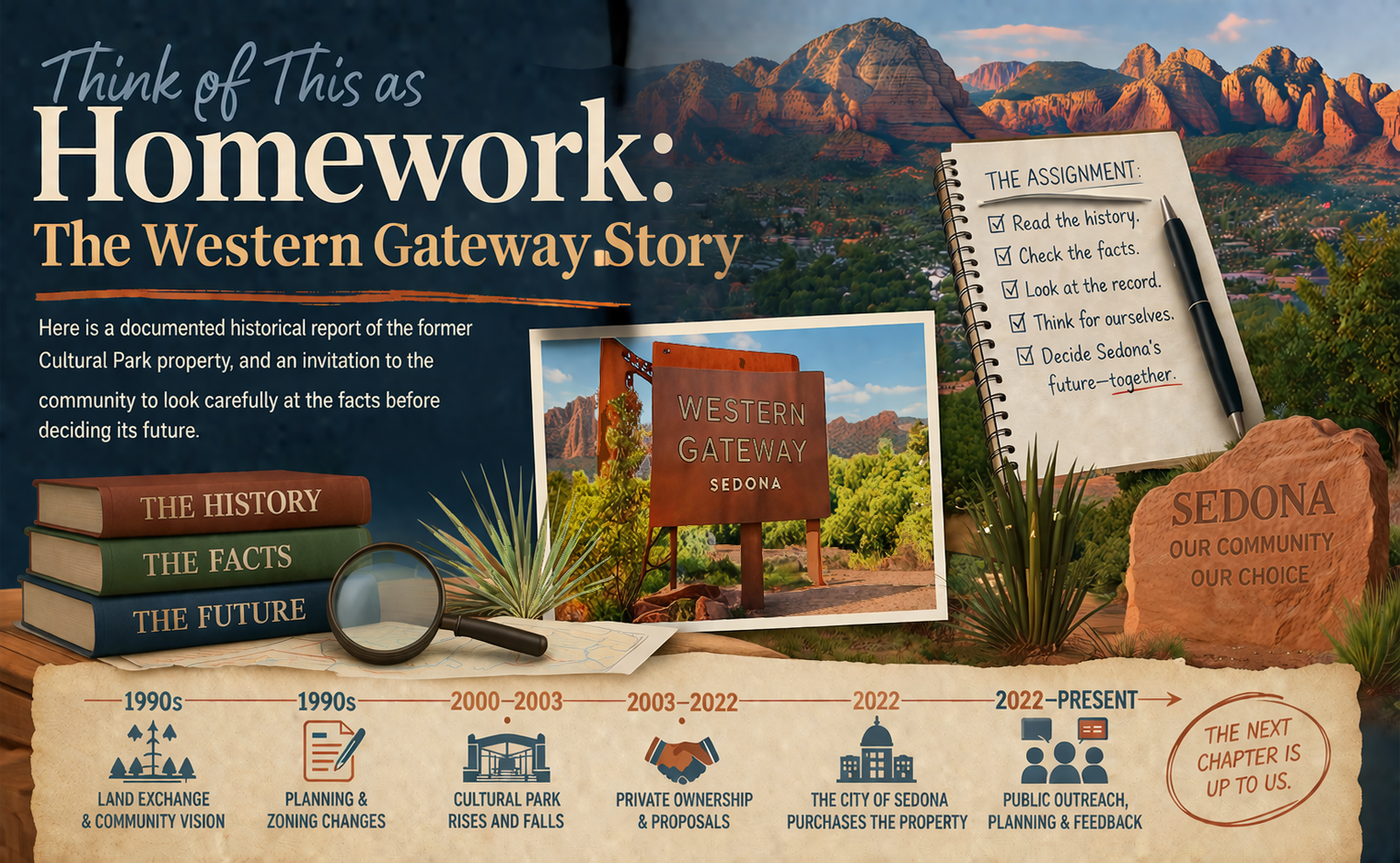
Sedona, AZ — It’s time to take a fresh look at the Western Gateway Sedona Story and the former Cultural Park. Over nearly three decades, the narrative surrounding this property has evolved—and often become distorted. Unless you followed the events closely as they unfolded, it’s easy for today’s understanding to be shaped by partial information, competing arguments, and personal perspectives.
What ultimately happens with the property remains uncertain. The future use of the site will depend on decisions still to be made and the economic realities that accompany them. What is clear, however, is that the property represents a significant community asset.

To understand the choices ahead, it is important to look back at how this story developed: how the Western Gateway came to be, how the City of Sedona became involved, and the many efforts the city has made over the years to gather community input along the way.
Read this, like it’s a school assignment because history counts, and at the end, if you wish, make your own comment about this view of Sedona history and whether or not you learned anything of value as you evaluate the future of this property and the issues it brings to the forefront.
The Western Gateway Sedona Story Begins
If you listen to the current debate in Sedona about the 40-acre property known as the Western Gateway or the former Cultural Park, you might come away with the impression that the issue appeared suddenly—and that the city has been quietly pushing a plan without public involvement.
The historical record tells a very different story about the Western Gateway Sedona Story.
The Western Gateway debate stretches back more than three decades, beginning with the land trade with the Coconino National Forest to bring the property into Sedona as private property, the development and collapse of the Cultural Park amphitheater in the late 1990s and early 2000s. Since then, the property has moved through several distinct phases: private acquisition after foreclosure on a large mortgage and failed redevelopment attempts, the city’s purchase of the land in 2022, and a multi-year public planning effort involving surveys, workshops, citizen work groups, consultants, and formal planning processes.
The current controversy sits at the end of that long chain.
To understand today’s debate, it helps to step back and look at how we arrived here.
The Rise and Fall of the Cultural Park
The property first entered Sedona’s civic imagination in the 1990s, when a land exchange with the Coconino National Forest was facilitated to create a public/semi-public cultural facility. It required a Sedona Community Plan amendment in 1993 and, by 1995, zoning changes from Yavapai County regulations to a Planned Development designation. In 1995, the Cultural Park property was rezoned to Planned Development to accommodate the proposed uses. These uses included an outdoor amphitheater, a festival grounds, and parking. In a future phase, other amenities were to include an Arts Village, a Performing Arts Facility, and Exhibition buildings. In 1997 and 2001, the Park sold 6 acres of land to Yavapai College.
The Sedona Cultural Park amphitheater was built and opened in 2000 and operated until 2003 as a summertime venue for outdoor concerts. The project was ambitious: a large outdoor performance venue designed to attract major touring acts and cultural programming to the Verde Valley, and it was enjoyed by thousands of local residents and visitors to Sedona.
For a brief period, the amphitheater drew crowds. But the business model proved fragile. Operating costs were high, the seasonal tourism economy was unpredictable, and the venture struggled financially.
By 2003, the Cultural Park enterprise had collapsed. The amphitheater closed, the nonprofit behind it dissolved under financial pressure, and the property was left in a kind of limbo. The nonprofit operating the park owed approximately $3.8 million to the National Bank of Arizona.
The property was purchased out of bank foreclosure for roughly $5 million by Mike Tennyson and his investment group, operating under the name SATHCUPA LLC (an acronym for “Save The Cultural Park”). Tennyson initially aimed to develop a hotel and conference center on the eastern side of the property while leasing the performance venue back to the cultural park board. The group’s mission to revitalize the park stalled when the Sedona City Council denied their applications to rezone the land for lodging in late 2003 and again in 2006.
What had been envisioned as a cultural centerpiece became, instead, a large, mostly unused parcel at Sedona’s western entrance, becoming a local “modern ruin”.
For the next two decades, the land would cycle through various private owners and redevelopment proposals.
Twenty Years of Private Proposals
From 2003 through the early 2020s, the Cultural Park property existed primarily as a speculative development opportunity.
Mike Tennyson Custer, S.D., bought the land in 2003. Over the years, a series of redevelopment ideas surfaced, many centered on lodging, conference, commercial, or entertainment-heavy concepts. In 2007 and 2008, Fitch Industries pursued major redevelopment concepts that went all the way to a Community Plan amendment to allow the property to be developed, but the development failed to mature because of the failing United States economy at the time; by 2019, the property was again marketed for sale; and in 2021, another private development concept was still being floated.
Various proposals surfaced over the years—some emphasizing lodging, some entertainment venues, others mixed-use concepts involving conference facilities, hotels, or retail components. None of them ultimately moved forward.
Part of the challenge was structural.
Sedona’s economy relies heavily on tourism, yet the community also has strong preferences about protecting scenic views, limiting large-scale commercial development, and preserving the quality of life for residents. Any proposal large enough to make financial sense for a developer tended to collide with those community expectations.
As a result, the site remained underutilized for nearly twenty years.
But while the property sat largely dormant, the city’s broader planning documents were evolving.
Planning Begins to Shift Toward Housing
In the 2010s, Sedona began to acknowledge a growing problem: the community was losing its ability to house its workforce.
Tourism employment continued to expand, but housing supply did not keep pace. Rising property values and the growth of short-term rentals reduced the number of homes available for long-term residents.
City planning documents began reflecting this concern.
The Western Gateway Community Focus Area (CFA) plan, adopted in 2016, identified the western entrance to Sedona as an area requiring coordinated planning and thoughtful development.
By the time the CFA plan was updated in 2022, its emphasis had shifted away from tourism-heavy lodging toward a broader set of community-serving uses. The document referenced possibilities such as:
- Mixed-use development
- Open space and trails
- Community amenities
- A mix of housing types
- Limited neighborhood-scale commercial services
In other words, by the early 2020s, Sedona’s planning framework was already moving toward the idea that the Western Gateway area might play a role in addressing community needs—not simply tourism development. SEE CFA PLAN HERE
The City Steps Into the Western Gateway Sedona Story
The turning point came in 2022.
After years of private proposals that never materialized, the City of Sedona made a significant decision: it would purchase the Cultural Park property itself. This decision in January 2022 to pursue the purchase was primarily driven by the city council’s frustration with obtaining zoning approval for rental housing in other areas of the city, believing that this property on the outskirts would not face such opposition.
In November 2022, the Sedona City Council approved the acquisition of the roughly 40-acre parcel for approximately $20 million. The purchase closed shortly afterward. The purchase involved a $10 million excise tax bond and cash from the town’s reserves.
The city explained its reasoning clearly.
If the property remained in private hands, it would likely be developed primarily in line with a developer’s financial priorities—most likely for lodging or other tourism-focused uses.
By acquiring the property, the city believed it could plan the site around community priorities, including the long-recognized need for housing.
But the city did not attempt to design the site itself.
Instead, it launched a broad public planning effort.
- Surveys
- Focus groups
- Community presentations
- Public comment opportunities
The process also included the involvement of an outside research and facilitation firm, Southwest Decision Resources, which helped design surveys and gather resident input.
The level of participation was significant.
The city reported that the Community Plan outreach included:
- 590 survey responses from residents
- 350 participants at a community forum in September 2022
- 30 meetings of a citizen work group involved in the planning process
This effort directly informed the updated Sedona Community Plan, adopted in March 2024.
Importantly, the plan explicitly referenced the Cultural Park property.
It noted that the city had purchased the former amphitheater site and that future planning for the property would explore a variety of housing types and other community needs through additional public engagement.

From Policy to Place: Planning the Western Gateway Site
Once the broader Community Plan was completed, the city turned to the next step: planning the property itself.
In 2024, Sedona hired Dig Studio, a planning and design firm, to develop a Western Gateway Master Plan.
The assignment was straightforward but complex:
Determine, through public outreach and professional planning analysis, how the 40-acre property might best serve Sedona’s long-term needs.
The city launched a series of workshops and surveys to gather ideas for the site.
At the first community workshop in October 2024, about 130 residents attended to discuss possible land uses and priorities.
Participants were asked to weigh in on potential elements such as:
- Housing
- Parks and open space
- Trails and recreation
- Arts and cultural uses
- Small-scale commercial services
- Transportation improvements
The workshop was followed by an online survey that received 579 responses.
What the Public Said
The results were nuanced but revealing.
Residents did not overwhelmingly support a single use for the property. Instead, the responses consistently pointed toward a mix of uses.
Among the preferences expressed:
- Neighborhood parks ranked highly among desired amenities
- Walking paths and trails were strongly supported
- Natural open space was valued
- Apartments and higher-density housing ranked above single-family homes
- Workforce and senior housing received significant support
Respondents also expressed interest in limited commercial uses such as cafés, small restaurants and convenience retail that could serve both residents and visitors.
A second survey in January 2025 focused on amenities and community facilities.
Among its findings:
- 82% supported a city park on the property
- 71% supported an improved trailhead and Forest Service partnership
- 59% supported shared parking for transit and recreation access
- A majority opposed reserving most of the property solely for a large amphitheater
Taken together, the survey results suggested a community preference for a blended approach—housing, open space, recreation, and modest commercial uses.
Testing Ideas in Public: the Western Gateway Sedona Story continues to develop
In February 2025, the city presented four conceptual development scenarios during a public meeting.
Each scenario reflected different balances between housing, recreation, arts uses and commercial services.
Participants were asked to respond directly to the concepts.
Two mixed-use concepts—combining housing, park space, and community amenities—received the strongest positive reactions.
A concept focused heavily on amphitheater expansion received significantly more negative responses.
Again, the public message was consistent: residents wanted a mix of uses, not a single dominant feature.
The Draft Master Plan
By July 2025, the planning team had assembled the feedback from workshops, surveys, and public meetings into a draft Western Gateway Master Plan. SEE PLAN HERE
The draft included:
- Up to approximately 430 housing units
- Parks and open space areas
- Trails and recreation amenities
- Community gathering spaces
- Limited neighborhood-scale commercial services
Housing was included prominently for a simple reason: it had consistently ranked among the top uses supported during public outreach.
The draft plan was not presented as final. The city stated clearly that it remained subject to further review, discussion, and refinement.
The Debate Intensifies
As the master plan process unfolded, the Western Gateway property became the focus of increasingly intense political debate.
Different groups advocated for different outcomes.
Some wanted the property preserved primarily as open space. Others favored a larger amphitheater revival. Still others supported housing as a critical step toward addressing Sedona’s workforce housing shortage.
In 2026, the debate escalated further with the introduction of a ballot initiative to restrict certain uses of the property. This initiative is referred to as Proposition 403. It is currently being challenged in court by the city as unconstitutional, since initiatives cannot be used to create zoning, and the city argues that the initiative is a form of zoning. This is the status as of early April 2026.
By this point, the Western Gateway had become one of the most discussed pieces of land in Sedona.
What the Historical Record Shows
It is entirely reasonable for residents to disagree about how the property should ultimately be used.
Land-use decisions often involve competing values—environmental preservation, housing needs, recreation, economic development, and community identity.
But one claim does not hold up well when measured against the timeline.
The idea that the city ignored public input does not align with the documented process.
Since purchasing the property in 2022, the city has:
- Conducted citywide surveys
- Organized public workshops
- Held community forums
- Created a citizen work group
- Engaged outside research and planning consultants
- Published planning materials and draft concepts
- Held public meetings to discuss alternatives
- Continued outreach as the master plan evolved
The Western Gateway debate may ultimately produce different answers depending on how residents vote or what decisions the City Council makes in the future.
But the historical record is clear about one thing.
The public may not all agree on the answer, but Sedona cannot fairly be said to have made this up behind closed doors.
SUMMARY: From an outside perspective, what stands out in Sedona is not just the complexity of the Western Gateway decision, but how much the debate itself is beginning to strain the community’s confidence in its future.
Communities everywhere face difficult land-use choices, but the healthiest ones step back, look carefully at the facts, and rely on open, well-documented processes to guide the outcome. Sedona has invested years in public planning and engagement around this property.
Allowing that work—and the realities the community faces today—to guide the final decision offers the best chance for an outcome that residents can ultimately accept and move forward from together.
This report is an open book. It is based on fact, as much could be derived from research. It concludes with the hope that reasonable discourse will lead to a reasonable conclusion. The door is open here for your comments, your point of view, and your vision of the future of Sedona on the other side of this complex issue. This is not a Next Door post. It is just an open forum for anybody’s point of view to be expressed. Post your comments here and share this report and his comments to whomever you want.