

By Bear Howard
History sometimes leaves behind uncomfortable phrases.
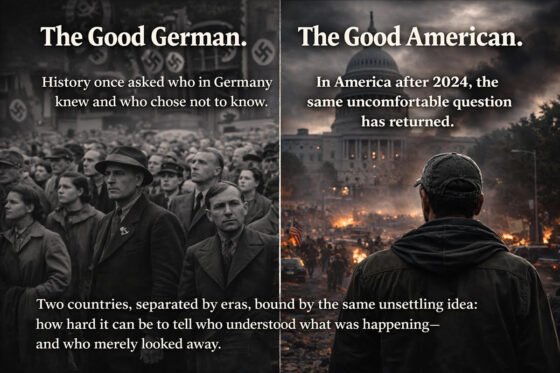
Sedona, AZ –After the collapse of Nazi Germany in 1945, historians struggled to understand how a modern society could have allowed such a regime to rise and operate in plain sight. In trying to explain the relationship between ordinary citizens and their government’s actions, a phrase entered the historical record:


“the Good German.”

The phrase did not refer to the regime’s leaders. It referred to ordinary citizens—the millions who went to work, raised families, and lived their daily lives while their government carried out policies that would later shock the world.
Some Germans truly did not know the full extent of what was happening.
Some suspected but chose not to ask questions.
Others understood more than they later admitted.
From the outside, it was impossible to tell them apart. Walking down a street in Berlin after the war, one could not identify who had known, who had guessed, and who had simply looked away.
But each of them knew which one they had been.
For decades, historians have debated a difficult question: how much responsibility do ordinary citizens bear when their government commits actions later generations judge harshly?
For most of modern history, Americans assumed that question belonged to another country and another era.
After the 2024 election, it returned in an unsettling new form.
The phrase that began appearing in commentary and private conversation was “the Good American.”
The phrase describes citizens who supported the MAGA political movement and the Trump administration, believing that the most extreme warnings about its intentions were exaggerated, symbolic, or impossible in a modern democracy. They assumed that campaign rhetoric was political theater and that American institutions would restrain whatever came next.
Thirteen months after the Trump administration took power in January of 2025, those assumptions began colliding with reality.
The agenda had never been hidden. During the campaign, Donald Trump spoke openly about reshaping American institutions, confronting allies abroad, imposing sweeping tariffs, expanding immigration crackdowns, and replacing large portions of the federal bureaucracy with political loyalists. Supporters celebrated the rhetoric as a disruption. Critics warned it was a blueprint.
Millions of voters chose to believe it was something else.
But governing has a way of clarifying what campaigns only suggest.
Tariffs triggered retaliation that disrupted American exports and raised prices at home. Immigration crackdowns created labor shortages across agriculture, construction, and service industries. Long-standing federal institutions experienced sweeping personnel purges that replaced experienced civil servants with political loyalists.
Internationally, the consequences were even more visible.
Alliances that had anchored American diplomacy for generations suddenly appeared uncertain. Governments that once relied on the United States as the central stabilizing power in the international system began questioning whether American leadership could still be trusted from one election cycle to the next.
Then events in the Middle East intensified the global reckoning with American power. Escalating conflict involving Israel, Gaza, and rising tensions with Iran—combined with visible U.S. support for military operations—produced images of destruction and civilian suffering that circulated instantly across the world.
For billions of people outside the United States, the crisis reinforced a growing perception that American leadership had become unpredictable and destabilizing. Financial markets reacted nervously. Energy prices surged. Governments across Europe, Asia, Africa, and Latin America began quietly discussing how to protect their economies and security arrangements from the possibility of wider conflict.
For the ninety-six percent of humanity that lives outside the United States, the issue was not merely American domestic politics. It was the stability of the global system that had existed since the end of World War II.
Many governments began exploring a possibility that once seemed unthinkable: a world in which the United States might no longer function as the reliable center of global leadership.
Inside the United States, reactions were deeply divided. Some Americans believed the administration was demonstrating strength and resolve. Others saw the unfolding events as evidence of dangerous incompetence—an approach to governance that risked economic disruption, diplomatic isolation, and military escalation.

But what surprised many observers most was the reaction of some voters who had originally supported the administration.
Many now expressed confusion, frustration, or regret. They insisted they had voted for economic change or political disruption, but not necessarily for the consequences now unfolding.
Some said they assumed the most extreme campaign statements were jokes.
Others believed the constitutional system itself would restrain them.
But democracy does not operate on assumptions.
Campaign promises become executive actions.
Rally slogans become governing policy.
And rhetoric becomes decisions that shape not only a nation but the entire world.
The events that followed the 2024 election were not an accident of history. The Trump administration did not seize power. It was placed there through a democratic decision made by millions of voters who heard the warnings and chose to dismiss them.
History rarely records what voters intended.
It records what their decisions made possible.
From the perspective of the rest of the world, the 2024 election was never simply an American political event. It was a decision made by roughly four percent of the world’s population that would inevitably shape the lives of the other ninety-six percent. When American voters choose their leaders, the consequences rarely remain within American borders.
In the months that followed, governments across the world began reconsidering how much of the international system should depend on the stability of American politics. Alliances, economic structures, and diplomatic relationships that had been built over decades suddenly appeared more fragile.
The damage to America’s reputation may prove even more lasting than the immediate political consequences. For much of the modern era, the United States presented itself as a nation guided by democratic stability, institutional continuity, and a commitment to global leadership.
The events following the 2024 election have forced much of the world to reconsider that image.
History does not end when an election does. The consequences of political choices unfold slowly across economies, institutions, and international relationships.
Some citizens welcomed the disruption they believed they had voted for. Others now confront outcomes they never expected. Still others quietly claim they misunderstood what the promises actually meant.
But history rarely accepts misunderstanding as an excuse.
That is why the phrase “the Good German” endured for generations after World War II. It captured an uncomfortable truth: from the outside, it was impossible to know who had understood what was happening and who had chosen not to look too closely.
But each person knew.
Today, the phrase “the Good American” describes a similar moment in democratic history. It describes citizens who heard warnings, dismissed them, and helped place a political movement in power whose consequences they later claimed they never anticipated.
There will be no visible mark separating one voter from another as they walk through the streets and towns of the country their decision helped shape.
But the historical record will remain.
The Trump administration governed.
The MAGA movement demanded it.
And the voters who made it possible will carry that responsibility long after the slogans of 2024 have faded.
Because history does not remember who meant well.
It remembers who made it possible.

2 Comments
“Some Germans truly did not know the full extent of what was happening.
Some suspected but chose not to ask questions.
Others understood more than they later admitted.”
That’s a myth! They (the adults) all knew full well there was a war affecting their country and targeting Jews, Romani, Gays, Scholars, Scientists, Communist, the mentally and physically challenged and many many others. Some children did not know or fully comprehend what was taking place despite many joining the Nazi Youth Party willingly.
There were likely many “good Germans” who despised Hitler, his Nazi ideology, party etc. but were helpless in standing up against it. Just as the Iranian civilians are helpless against the IRGC in Iran.
Those Germans who could do something but chose not to in order to “avoid problems” were just as guilty as those who wantonly did so.
It’s all a matter of being a good kind humane person or being an evil bastard who rats on their neighbors or those who ran to sign up to join the Nazi war machine or in our realm- ICE.
Standing up to tyrants and haters can be costly no doubt. May even cost one their life but if everyone just plays along to get along as others are oppressed and murdered then there would be absolutely nothing good in this world of ours.
JB is correct. That’s a myth mate! To say any Germans were just plain ignorant of what was going on would be akin to saying there are Americans who don’t know what ICE was doing during their abduction and deportation without due process phase that has killed and maimed numerous Americans exercising their constitutional rights.