

By Steve Segner, Sedona Resident —
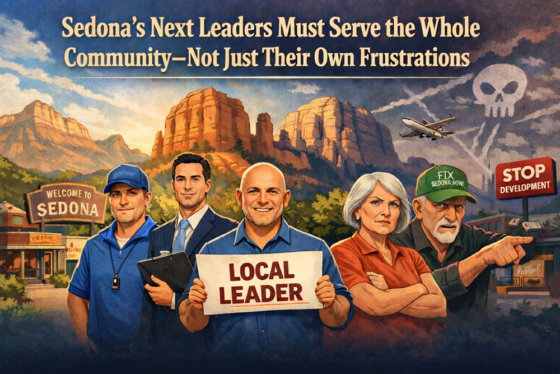
As elections approach, voters face a choice between locals invested in Sedona’s future and newcomers eager to reshape it in their own image.
Sedona, AZ –As we approach that time of year when locals begin contemplating the upcoming community elections, I wanted to share a few thoughts with your readers. This year is no different: there will be three openings on the City Council and one opening for the two-year mayoral term.


Over the past several election cycles, Sedona has increasingly become an affluent retirement destination, attracting early retirees from the corporate world. At the same time, the shrinking working middle class—driven in part by the rise of short-term rentals and housing costs—has made it more difficult to find candidates who live and have work here full-time.
Retirees often have the time, resources, and confidence to step forward, sometimes bringing with them a management mindset shaped by corporate experience. But local government is not a business. Its mission is broader and more fundamental: to protect the health, safety, and well-being of the entire community—the residents, the workforce, the businesses, and, importantly, the visitors who sustain our economy.
This year, we are fortunate to have some notable candidates: a seasoned businessperson running for mayor, a high school coach running for council, and a local realtor and professor also seeking a council seat. Each brings a grounded, positive perspective rooted in the belief that life in Sedona is good—and that thoughtful leadership can make it even better.

At the same time, we continue to see candidates motivated primarily by their personal frustrations or narrow agendas. It is important to remember that the City Council’s role is not to micromanage or impose personal preferences, but to provide long-term direction, work collaboratively, and empower the city manager and professional staff to carry out the city’s day-to-day operations. Good governance depends on trusting experienced staff and balancing community input with informed, strategic decision-making—not simply reacting to the loudest voices in the room.
We should seek leaders who are deeply connected to Sedona—people who live and have worked here, who understand its rhythms and realities, and who are invested in its future. On any given day, Sedona welcomes more than 20,000 visitors, more than twice the number of actual residents. They are an essential part of our community and provide the majority of the city’s funding for many of the services we all rely on. Their presence must be understood not as a burden, but as a responsibility we manage and a partnership we honor.
As voters, we should support candidates who love Sedona as it is, who respect its unique balance, and who approach leadership with humility and curiosity. We should be cautious of those who claim to already have all the answers before fully understanding the complexity of the issues. The future of Sedona deserves leaders who listen first, learn deeply, and govern wisely.
The actual election is a primary on July 21. Some elections will be decided on that date if an individual candidate receives 50% of the vote plus 1. The top candidates who did not receive enough votes in the primary will compete in a runoff in the general election in November. Home rule will also be on the ballot on July 21.
It is important that all voters are engaged in meeting, greeting, and listening to candidates across the multiple public forums scheduled. All the candidates will have a website where they define who they are and why they’re running. The future of Sedona. is on the ballot.

2 Comments
After MAGA’s -DOGE boys took a “chainsaw” to government Agencies to include FEMA which is currently nearly out of money on purpose, hopefully Sedona’s next Mayor will work with the State Government in the creation of a state version of FEMA and the EPA. Hopefully, long before they are needed. Currently the State has DEMA and ADEQ but they’re accustomed to working jointly with the Federal Government and previously received Federal funding. Sedona is prone to fire, flooding even earthquake tremors which so far have been minor and usually go unnoticed but will surely increase in severity as MAGA increases fracking in the state (just as tremor frequency and intensity has increased in States like OK where fracking is prevalent). The Federal Government would rather strip the state of its precious water, metals, uranium and coal while being un accountable in any way for poisoning our environment or its cleanup in the process than have Agencies that help and protect Arizona’s citizens. Arizona and Sedona must be prepared to go it alone when disaster strikes since we have a President that only fully assists Red States in crisis. Just some food for thought.
Colorado River plan could wipe Arizona from the map, officials say
https://www.azcentral.com/story/news/local/arizona-environment/2026/02/23/colorado-river-cuts-unfairly-target-arizona-coalition-says/88783916007/
All the more reason to not build anymore resorts or golf courses in Sedona.