

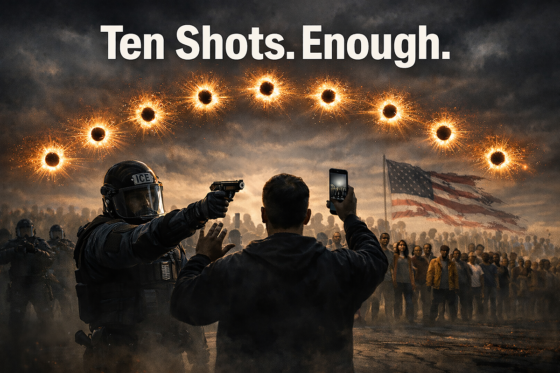
By Bear Howard —
A country reaches the moment where disbelief turns into refusal—and silence is no longer an option.
There are moments when a country feels like it’s moving on rails—when the headlines are loud, but the public spirit is quiet; when people shrug and say, That’s just how it is now. And then something happens that doesn’t fit the numbness. Something breaks the spell.


That’s what this feels like.

We’ve been here before. When George Floyd was killed, the nation didn’t just witness a tragedy—it recognized a pattern. Millions of Americans who had never been forced to consider the daily danger of being Black in the wrong place at the wrong time suddenly understood, viscerally, that “routine” could be lethal. It stopped being a debate. It became a moral recognition. A shared, furious clarity. And once that clarity takes hold, it doesn’t belong to any one group. It spreads.
Now—Minneapolis again.
This time, it isn’t city police on a street corner. It’s federal power—agents of the state—operating with the posture of a force that does not expect to be questioned. And the early shape of the story is the kind that creates a national wound: a man stepping back, seconds collapsing into violence, and the public seeing one thing while officials insist on another.
Ten shots.
That number matters—not because it’s a statistic, but because it has a sound in the imagination. It has rhythm. It has finality. It doesn’t feel like control; it feels like punishment. It doesn’t read as fear; it reads as certainty. And when people see what appears to be a phone in a hand, then hear the explanation that it was a gun, something ancient rises in the public mind:
They are telling us not to believe our own eyes.
That’s the gasoline.
Because the deepest crisis in America isn’t only violence—it’s credibility. It’s the widening gap between what is said and what is seen. Between official language—sterile, legal, pre-packaged—and raw, human footage that moves faster than spin can keep up. Once that gap becomes undeniable, the story stops being about one person and becomes about a system’s claim to define reality itself.
And then the question changes.
It stops being What happened?
And becomes Who gets to do this? Who gets away with this? Who is protected—and who is disposable?
This is where the comparison to Floyd becomes more than symbolic. In both cases, the pain isn’t only in the death—it’s in how the death is narrated. It’s in the demand that the public accept a version of events that doesn’t match what people believe they witnessed. It’s in the reflex to justify the irreversible. And it’s in the quiet terror that slips into ordinary thoughts:
If this can happen to him, it can happen to anyone.
That is how movements ignite—not from ideology, but from identification.
And now something else is hovering in the air—something Americans are not accustomed to using, but may be forced to relearn:
Leverage.
Marches matter because they make grief visible. But boycotts, shutdowns, coordinated work stoppages—those matter because they turn grief into consequence. They put a system in a straitjacket not through violence or chaos, but by refusing to participate in business as usual. They don’t require unanimity. They require a shared line in the sand:
No. Not this. Not again.
If a fire is brewing, it will not be measured only by protest size. It will be measured by who joins in. When people who don’t normally stand together begin standing together—when the quiet middle stops watching and starts acting—power changes its posture. When institutions that usually hide behind “neutrality” stop pretending this is normal, the ground shifts. When ordinary people decide their money, their labor, and their compliance are not automatic, authority begins to wobble.

And if that wobble widens enough, it reaches Congress. That is how administrations fall in systems like ours—not because outrage exists, but because outrage becomes organized, organization becomes political risk, and political risk leads to institutional abandonment.
The country doesn’t need another news cycle.
It needs a refusal.
A refusal to pretend we didn’t see what we saw.
A refusal to accept explanations that insult our intelligence.
A refusal to live in a place where power speaks and reality is expected to bend.
Ten shots should not become a statistic.
They should not dissolve into panels, pundits, or procedural fog.
They should not be explained away, smoothed over, or filed under unfortunate but justified.
Ten shots should become a line—
bright, unmistakable, and immovable.
Because something in this country has reached its limit.
Not outrage. Not grief. Not anger.
Tolerance.
The tolerance for being lied to.
The tolerance for watching the irreversible get rationalized.
The tolerance for being told, again and again, to doubt our own eyes and accept the script.
This isn’t left versus right anymore.
This isn’t red versus blue.
This isn’t even about politics.
And hear this—MAGA, too.
Especially you.
If you believe in freedom, this should scare you.
If you believe in law and order, this should enrage you.
If you believe the government answers to the people—not the other way around—you don’t get to sit this out.
You don’t have to agree on everything.
You don’t have to march with anyone you don’t like.
You don’t have to abandon who you are.
But you do have to say this:
Enough.
Enough of power acting with impunity.
Enough of bullets replacing judgment.
Enough of being told that once the trigger is pulled, the story is already written.
We are not confused.
We are not hysterical.
We are not asking politely anymore.
We are drawing a line.
No more automatic compliance.
No more business as usual.
No more accepting a country where explanations come faster than accountability.
Say it out loud.
Say it out the window.
Say it even if you’ve never said it before.
Enough.
Because if this country still belongs to its people, then there comes a moment when the people stand up—across parties, across identities, across all the lines we’ve been trained to fight over—and say, together:
We will not take this anymore.

45 Comments
I warned this was coming and worse. It is sickening and un American! MAGA has taken the same stance on these murders as Lt Calley did when he decided to massacre the people of Mi Lai Vietnam. He claimed it was in retaliation for his men having been harassed and shot at by “hardcore Viet Cong and sympathizers” as an excuse to kill unarmed elderly men, women and children who had absolutely nothing to do with the fighting regardless of whatever they believed about the war. It was wrong then, the hate filled blood fest was wrong when Rodney King got the begeezus beat out of him, it was wrong when they murdered George Floyd and Breonna Taylor and it was wrong in the cases of Renae Good and Mr Petty.
When I was in combat or responding to an incident with my SWAT Team we did not unload our entire magazine of ammo into each threat we encountered as is the unseemly practice of American law enforcement today.
A) Our rules of engagement did not say “obliterate the threat” by firing every round you have into every target you engage. NO we were told to use only the level of force necessary to eliminate the direct threat to yourself and others. I was trained to fire 3 very precise and intentional rounds (1 if acting as a Sniper) into each target not 15-30 or whatever I had in my weapon at the time as US cops due to anyone they engage these days. We didn’t carry unlimited supplies of ammunition and needed to conserve it but more importantly, it was immoral, unethical, unnecessary and ignorantly dangerous not only to ourselves but all those around us. ICE is very fortunate that their erratic shooting or Pretty did not kill one or more of the handful of unarmed civilians that were standing and in vehicles just feet from where they unloaded their weapons into him like untrained jackasses. Of course MAGA would’ve just called them “domestic terrorist” and “insurrectionists” in a vain attempt to deflect from the fact that that is precisely what MAGA is!
The people will reach a breaking point should this illegal unconstitutional state sanctioned murders continue and they won’t retaliate with votes that won’t matter in a MAGA run election process. They will retaliate in kind with an eye for an eye as the religiously distorted MAGAverse loves to say. That is also what MAGA wants! They are itching to kill anyone and everyone they disagree with in the name of their so called (STOLEN) White Supremacist Homeland! THEY want civil war and THEY want to purge the country of whatever they disagree with. Well guess what? THEY are the minority and they will never ever succeed no matter how many innocent people they murder in cold blood live on TV because the MAJORITY of Americans are moral ethical people raised to despise racist, fascist and murderers rather than pardoning and employing them at the White House.
Moreover, ICE is enforcing the law. Breaking into the United States or overstaying a visa is a CRIME!
But I don’t expect they/them, he/shes to understand how our REPUBLIC works.
It’s also a crime to murder people in cold blood. Where’s your outrage over that hater? You got nothin but bullshit to spew and just like your Pumkinheaded Orange Criminal blowhard!
Temper, temper JB. He interfered with a police investigation while armed. Pretty silly thing to do with LAW ENFORCEMENT but you can’t discern who’s an officer and who isn’t.
Here’s a clue…..if they’re going after criminals, including those that entered this GREAT country ILLEGALLY, then they are a criminal.
Get it, simpleton? Don’t let the TDS affect your relationship with your boyfriend, TJ. Maybe go take a walk to Devil’s Bridge?
Temper? As Renee Good said before getting murdered, “I’m not mad at you dude” I just think you’re a mentally ill moron and so does the majority of people in the world who have a brain. Got that Janeen Piro? You diluted drunken jackass.
Simpletons don’t fight for humanity and the rule of law they destroy it. So that’s you Mr Simpleton! Sober up, get your story straight then try again just like Janeen did when she threatened to arrest you gun toting insurrectionist should you try to bring firearms into DC. Backfired splendidly just like everything MAGA idiots say and do.
Goode was an antagonist. She and her dike wife appeared at a ICE event to interfere and in the process of running over an officer, she was shot and killed. If you’ve never worn the uniform, you couldn’t possibly understand the threats we consistently faced.
You’re embarrassing yourself. You speak as if the majority stand with you but on the contrary, princess, you can’t even get off the Internet for more than a few seconds looking at ALL THE POSTS you comment on.
What a joke you are. MAGA is here to stay. You won’t make this country into what Venezuela or North Korea turned into.
I and many other patriots will make sure of it. Now go to the women’s bathroom and wipe that smut off your face. You look ridiculous.
Ms MTG you seem conflicted. Just yesterday you were saying he MAS is nothing but a big lie and no here you are bac t cheerleading the hatred and es aganagan? What gives? Teenagers around to harass for havig been a mass shooting victim? Don’t wrrry everyone knows you’re full of the shit you speak or rather drool profusely!
Guess your mommy didn’t love you enough while your dad was “destroying” your Coke head perception of reality as you stated.
We all remember your tiny little attempts to menace voters in Sedona.
https://sedonaeye.com/republican-rally-for-president-receives-overwhelming-local-support/
Come on up in March for the No Kings March and see how it’s done! Oh and bring your calculator to count the hundreds (bigger than tens) of people! We’ll be waiting to see your red hat proudly displayed.
No time to hang out with the other losers and protest, Jill! I have a business to run and employees to pay.
Don’t worry, Americans will continue to pay our taxes so that those useless to society (you and the other protesters) won’t starve AGAIN when we discontinue the EBT program.
You’re welcome.
Recent 2025/2026 DNA analysis and historical records suggest Adolf Hitler likely suffered from Kallmann Syndrome, a rare genetic condition causing underdeveloped genitalia, including a possible micropenis and undescended testicles. This condition, which restricts puberty and lowers testosterone, aligns with earlier 1923 prison records indicating right-side cryptorchidism.
Key findings regarding this claim include:
DNA Evidence: A 2025 study analyzed DNA, pointing to a “high likelihood” of Kallmann Syndrome, which can lead to a micropenis and infertility.
Medical Records: A 1923 medical report from Landsberg Prison confirmed that Hitler suffered from an undescended right testicle.
Physical Characteristics: The syndrome can cause underdeveloped sexual organs and low libido, with experts in a 2025 documentary suggesting it may have influenced his, at times, unconventional or absent personal life.
Debunked Myth: The same DNA analysis also refuted long-standing rumors regarding Jewish ancestry.
While these findings are based on modern analysis of forensic evidence, some experts advise caution against over-relying on such, sometimes contradictory, studies to explain the psychological motivations of historical figures.
Devils Bridge is great but I’ve been there so many times I could navigate the trails in my sleep.
Dave Bautista just called out your KIng of Fried Chicken and it’s f’ing beautiful! It’s what’s going to happen to everyone in MAGA eventually as the King gets unmasked for what he is and you zombies slowly awaken to the bullshit you helped create or rather destroy. I knew I’d trigger you rats outta your holes by mentioning the ICE Murders, Epstein Files, the DNI being openly involved in a domestic investigation based upon unfounded lies and misinformation about a free and fair election, and most of all the former inspiration for the domestic terrorist white supremacist of M’erica Mr Bundy who just happened to awake from a long self induced coma of facts. You nut jobs would loose your shit if Obama’s DNI was seen unlawfully taking your election ballots.
You’re irrelevant and will remain so.
https://youtube.com/shorts/gSoIDK51qoM?si=aOrSOHjJjhO1UL0Q
Another triggered Communist, huh? Can’t keep the President off your mind just like your boyfriend J(or) B(iden).
He’s my dad, you know. Once I had to stop him from jumping off Devil’s Bridge. He thought he knew how to fly, ma’am.
Oh, Obummer! Thanks for rehashing that nightmare. How’s Obamacare working for ya? Medical costs gets any cheaper?
Hate to say I told you so……. But well you know. There’s a sucker born every minute!
“Hate to say I told you so……. But well you know. There’s a sucker born every minute!“
OK you’re a sucker and so? How’s that Trump replacement for Obama care panning out for you haters? Seems you’re all too ignorant to come up with anything better so you run your mouths, tell lies and point fingers at The Obama Administration for proving just how ignorant and incapable of doing anything requiring a brain and common sense. Which is why you cling to lies, propaganda and criminals.
“Hate to say I told you so……. But well you know. There’s a sucker born every minute!“
OK you’re a sucker and so? How’s that Trump replacement for Obama care panning out for you haters? Seems you’re all too ignorant to come up with anything better so you run your mouths, tell lies and point fingers at The Obama Administration for proving just how ignorant and incapable you all are of doing anything requiring a brain and common sense. Which is why you cling to lies, propaganda and criminals.
America was a DEMOCRACY until you REPUBLICan asses destroyed it to make it an Autocracy. It’s why I and millions others moved here. Look up Autocracy because that is what we currently have not a Republic (which by the way also agreed to the Constitution and rule of law) prior to becoming your so called Republic of Arseholes with No Brains. Have a good day with yourself!
It’s a Republic, princess. When you and your boyfriend JB get out of bed, maybe you’ll head down up the library and see what our founders intended for this country.
We have representatives for a reason.
I know, I know ….it’s a lot to take in. You grifters can’t even get the genders right so I wouldn’t expect politics to resonate with you silly bunch.
You must be mistaken, I’m not your type I’m all man not the princess in the women’s bathroom you seek. Homophobic racist ass!
You’re the one we saw wearing a dress yesterday at the library, JB. Don’t deny it. The whole town is talking about it!
First, the incident at Whole Foods where you were caught leaving the ladies restroom with smeared lipstick and now this?
Please stop thinking about my ass, princess. It’s kinda weird you keep mentioning it.
“We have representatives for a reason”
Is that why your King wants all the power and “representatives” to have none? What a Maroon!
Lucas, Trump Derangement Syndrome can be treated! I have high hopes for you, little man.
You’re right, TDS is incurable as you have proven with yours.
I support my duly elected President. The next MAGA president (Vance!) will also get my support.
It makes your dentures rattle, don’t it?
Have you seen my laptop? I think I left it on your nightstand.
Saw you wearing a white hat today? What happened to the ignorant Red Hate Hat?
Your laptop is where you left it, up your Arse! You must be jealous of your boyfriend having a WWII mortar round recently removed from his. Bigger the better right little man?
“I know, I know ….it’s a lot to take in. You grifters can’t even get the genders right so I wouldn’t expect politics to resonate with you silly bunch”
Does Trump know you speak so ill of his grifting and pussy grabbing?
I’m happily married to a woman and I am 100% man. You know the kind that serves his country on the battlefield rather than evade it by paying bribes to draft boards and crooked doctors 8 times consecutively like your “hero” draft dodger did so he could snort coke and bang prostitute’s instead. I’m guessing you never served either judging from your fascist homophobery.
If I did have a boyfriend it would only be because I stole yours from you to save him from your MAGA pedophilia and you would cry for the rest of your miserable life!
So hop on your witto wed moto cycle and disappear again.
Perhaps you should learn more about our Representative DEMOCRACY in the study guide given aspiring citizens for their TRUMP citizenship test-
https://www.uscis.gov/sites/default/files/document/lesson-plans/Government_and_You_handouts.pdf
Guesss your the smartest jackass on the planet 🤣
Get this on Substack!, WELL DONE!
People are leaving Substack due to concerns about content moderation (especially regarding extremist content), a pivot towards social media features that alienate some writers, a perceived shift in focus away from pure newsletters, algorithm changes prioritizing engagement over quality, technical frustrations, and competition from other platforms, leading to a mix of ethical, practical, and creative reasons for departure.
I wouldn’t trust a source so full of controversy that you don’t know what is true and what isn’t. But then again people think Fox and NewsMax are legit media/news when they clearly are NOT!
The sky is falling! The sky is falling! How we despise law enforcement until we need them. The hypocrisy is surreal. Being black in the US is much safer than in Africa, I assure you. 13% commits the MAJORITY of violent crime but I digress. Only supporters of George Floyd and his criminal behavior are those that never lived around that culture.
Ever lived in the hood, Bear? Ever ride the A train in NYC in the 70s? Ever stepped on George Floyd’s sneakers? I have! Immediately resorting to violence is the response you’ll get but you wouldn’t know that from your vortex of comfort here in AZ. Go down to 5th St. in Mesa about 11pm and see how welcoming they are to you, Bear. Just call Mesa PD when you learn the hard way.
Protecting a guy that just weeks ago vandalized govt property is just pure asinine. He attempted to interfere with a police action and learned the hard way. Don’t wish death on anyone but he’s no victim. He was an activist and antagonized those officers. We patriots have a saying for what happened to him ….it’s called FAFO. The majority of Real Americans know that he did that to himself and support ICE. It’s just the lowlife communists that wish to infiltrate and terrorize decent Americans that protest ICE.
Love it or leave it (but they won’t because they have no job but plenty of time to protest)
MAGA 🇺🇲
WTF are you even seeing with your MAGA goggles? Nobody hates Law Enforcement they HATE the sorely untrained abusive murdering rogue masked Border Enforcement Officers who are NOT Law Enforcement. They are border and immigration enforcement officers who traditionally have worked with local and state Law Enforcement departments in order to safely and DISCREETLY enforce immigration law, NOT a band of masked Armed THUGS wandering through neighborhoods and and business centers racially profiling, unlawfully stopping, illegally searching and detaining anyone they determine to be a Persona Non Grata in MAGA’s FACIST White Supremecy take over of our former Democracy.
When your King is finally dethroned I envision a retaliation against all who voted for and fervently supported the Criminal who destroyed our country and you will be made a Persona Non Grata anywhere you go! Maybe even get your head shaved like the women who willingly slept with Nazi’s during WWII. Oh my that would be grand now wouldn’t it? The possibilities are infinite. But then again the King doesn’t want any more elections so he can remain in power as M’erica’s first Fascist DICKtator so I guess we’ll have to wait and see?
May MAGA whither in the Dark Anal Crevice it was conceived in
These are NOT Threats these are hopes and wishes of the MAJORITY of sane Americans!
Another rant by a they/them? How’s the women’s restroom, JB? More to your liking?
Don’t consider yourself sane when you can’t even identify what a women is. (Clue: it’s not the bearded guy in your bed wearing stockings)
Go outside, JB. Get some air. Your constant crybaby rants on these forums are overbearing. Take a hike and instead of protesting, how about do a ride along with our city’s finest?
Touch grass, hombre. It’ll do you some good. Just don’t forget your mask!
Yes, yet another logical fact filled rant by me JB against the irrational and irrelevant rants of an idiot like yourself who wouldn’t know truth and fact if it shot you in the face like your beloved ICE does to innocent civilians. You cheer death and misery like a true fascist. And we will cheer when you haters crawl back into the deep moral less holes Trump dug you out of.
Trump, Trump, Trump…..your obsession with our LEGALLY elected President is concerning.
Let me get your crybaby rants over to the Feds. Just don’t hide when they come-a-knocking, Mrs. He/She.
By the way, we’re still looking for the MILLIONS of voters you got back in 2020 JB! How’s the dementia doing?
Remember that I’m your son, right?
Have you seen my laptop? Mom said you thought it was a Frisbee. You didn’t toss it somewhere, did you, ya old loon?
I’m pretty sure your name is NOT Hunter Biden! If you don’t have the courage to say these vile things under your own name, STFU!!
Make me STFU, “Blue”. My dad ruined this country so my nose candy days are behind me and I can think clearly now!
I’m outside enjoying my Chipotle. Come and say hi if you can leave your father’s basement. My red hat is a dead give away🇺🇲
Don’t worry someone will come looking for you and will be asking you in depth questions about your citizenship, voting history, criminal history etc. might be a few years but they’ll come a knocking on your door wearing guns and badges with a warrant in hand. Because after all you don’t want to live in a “woke” world anyway do you? So expect hard cold reality to deflate your ego as it goes down in flames like the SS Hindenburg. 😅
Jill, you’re just as bad that that skirt wearing prima Donna, JB.
Get off the Internet and go get some sun, dear. You’re posting every single day! That’s incredibly unhealthy. You need help, I think!
I know you wish the President can come grab you but I’m afraid that those years are behind you. You missed your chance with Herbert Hoover and FDR but hey…..a girl can dream right?
The sky is falling! The sky is falling!
Don’t leave your basement, Jill. The world is a scary place! Keep doing the important job like painting your nails and your face!
Let them men keep the streets safe from the ILLEGALS and criminals who are running rampant💪🏽
ICE GOT THIS🇺🇲
Since when does damage to government property merit being shot in the back of the head and back by a GANG of armed masked goons using unnecessary force to brutally force two women backward upon ice covered concrete because they were videotaping them. Show us the laws in writing that back your Kyle Rittenhouse shithouse lawyer knowledge. If Pretty were justifiably murdered what specifically was the law he violated to merit it?
I’m surprised Tommy allows your homophobia to persist on here? Personally I’m glad he has as it just puts your hate and ignorance on full display for all to see! And I love proving you wrong, I live for it! And I will be here long after MAGA and will make it my mission in life to expose who you are, what you’ve said and done to advance the MAGA hate crime spree. You have the maturity of a toddler who still craps his Trump Diapers as seen in the infamous Trump/Tennis Depends photos https://x.com/cher/status/878469866121908224/photo/1
🤣🤡🤣🤡
Breather, Jill. Tommy or any other moderator must believe in the 1st Amendment.
I have made my opinions and you’ve and the others have attacked me, not the other way around but nice try with the gaslighting. I’ve read these articles for a long while now and have seen you and others slander and troll anyone that had the gaul to have a different opinion.
Not surprised. This is a space for anyone to comment but you SMALL people have made it your personal stage.
I’m glad Tommy “allows” others to comment without edit. Shows the community exactly what MAGA has to deal with…..immature agitators who don’t like a taste of their own medicine.
Black and Brown people live in your tiny head and brain. Women obviously avoid you like the plaque which is why you hate them like the tiny dick incel you are. Gay people frighten you because you’re afraid to come out of your closet. It’s all quite obvious from your impotent rage and hatred of others. You’re the one that need move to your greener pastures in racist white Russia. America was doing just find without the Nazi’s, Klan and other asshole domestic terror hate groups, and we’ll do even better when you haters rot in the hell of your own making-Trumps bigly ass.You’re on the wrong side of the Mason Dixon to be talking so much smack for a little coward.
“Make me STFU, “Blue”. My dad ruined this country so my nose candy days are behind me and I can think clearly now!“
He doesn’t have to silence you Don Jr Coke head. All he need do is prove you’re nothing but a troll who slings shit to get attention rather than attempt make our country a legitimate democracy like it was before the likes of crackheads sush as yourself which is easy enough to do. Go back to your nose candy Don Jr because “The best is yet to come”! Just watch as your world collapses all around you after the midterms.
Ahhhhh, the midterms! The loony liberals LAST chance at redemption for the shit show that was the Biden administration. Maybe you losers can at least still save Commiefornia! Hahahaha….
On a serious note, my dad didn’t mean to ROYALLY screw this country up after President Trump saved it from that COVID nonsense (you still wearing a mask, ma’am). But, in his defense, he really was so out of it (thank goodness for Autopen, huh?) that he wasn’t cognizant of the decisions. We all still blame that drunk Camel toe Harris but now that Dad is retired and those ILLEGALS that he let sneak into the country are serving him hand and foot (LITERALLY), President Trump seems to have really cleaned up his mess.
Just a few more strangers in our great country to evict and then we’ll begin with the he/she’s, they/thems who’s on 1st weirdos like Jill and Lucas with blue hair and those silly septum rings.
Get ready to get a job, TJ! No more free EBT for you soon!
MAGA🇺🇲🇺🇲🇺🇲🇺🇲🇺🇲🇺🇲🇺🇲
Have you seen my laptop?
My world (Earth) is very different than yours (Uranus). MAGA lives in reality.
You weirdos can’t discern males from females. Can’t wait until the midterms when you don’t have the ILLEGALS to pad your vote anymore like 2020!
If MAGA lives in reality why are you hiding from your fascist history past and present? Because the people you are attempting to erase a a million times better people than any MAGA criminal will ever be and therefore you have penis envy of those superior to you in every way.