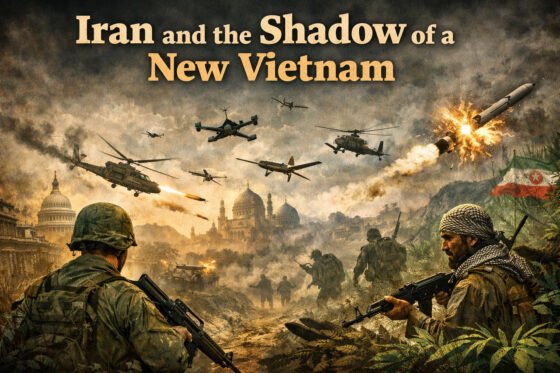
History’s lesson—from the jungles of Southeast Asia to today’s drone battlefields—is that the world’s strongest military does not always decide how wars end.
By Bear Howard and Associates
Sedona, AZ –Somewhere in the modern battlefield, a machine costing about ten thousand dollars lifts quietly into the air.


It may be no larger than a lawnmower. It may have been assembled in a modest workshop or adapted from commercial technology. Yet within minutes, it can destroy a weapon system worth millions—or disable a piece of military infrastructure that once required entire air forces to threaten.
This is the new arithmetic of war.

For most of modern history, military power followed a simple equation: the wealthiest nations built the largest armies, the biggest ships, and the most powerful weapons. Industrial might translates directly into battlefield dominance.
But that equation is beginning to break down.
In an age of cheap drones, decentralized networks, cyber warfare, and precision weapons, smaller powers—and even loosely organized forces—can challenge the advantages once held almost exclusively by superpowers.
And that shift carries a warning for the United States.
Because history has already shown what happens when overwhelming military strength confronts an opponent whose strategy is not to win quickly—but simply to endure.
From the jungles of Vietnam to the mountains of Afghanistan, the United States has repeatedly discovered a difficult truth: the strongest military on earth can win battles without controlling how the war ultimately ends.
Today, as tensions grow between the United States, Israel, and Iran, that lesson is beginning to echo again.
But this time, the battlefield may look very different.
Iran is not a guerrilla movement hiding in jungles or mountains. It is a nation of nearly ninety million people with a deep scientific base, a large industrial infrastructure, and decades spent preparing for the possibility of confrontation with the West.
Rather than trying to match the United States weapon for weapon, Iran has studied the lessons of modern conflict—and designed a strategy built around endurance, dispersion, and technological asymmetry.
And in the age of the ten-thousand-dollar drone, that strategy may matter more than sheer military size.
The Lesson of Vietnam
The United States entered the Vietnam War confident in its technological superiority. American aircraft ruled the skies. Bombers pounded forests and villages. Troops arrived in numbers unimaginable to the forces opposing them.
Yet beneath the jungle canopy, the Viet Cong moved through tunnels, villages, and hidden pathways, appearing and disappearing like ghosts. Their strength was not measured in tanks or aircraft, but in patience, endurance, and a strategy that refused to fight the United States on its preferred battlefield.
America won many battles.
But the war itself slipped through its grasp.
Afghanistan: A War of Time
A similar pattern emerged decades later in Afghanistan.
After the attacks of September 11, the United States unleashed enormous military power against the Taliban. Cities fell quickly. Governments were installed. Victory seemed certain in the early months.
But wars of endurance are not decided in their opening chapters.
The Taliban dispersed into mountains and villages, into family networks and into time itself. Twenty years later, the United States withdrew, leaving the same movement once again in control of the country it had tried to reshape.
Korea: The Frozen War
Another version of this lesson appeared on the Korean Peninsula.
When the Korean War erupted in 1950, many expected a decisive military outcome. Instead, the conflict hardened into a stalemate that still divides the peninsula today. The war ended not in victory, but in a line drawn across the landscape that has endured for generations.
Across these conflicts, the same truth emerges: powerful nations can dominate battlefields, but they do not always control the political and psychological terrain where wars are ultimately decided.
Iran Has Studied These Lessons
Iran is not a guerrilla movement hiding in the mountains.
It is a nation of nearly ninety million people, with ancient history, major universities, and a large population of engineers, scientists, and technicians. Whatever one thinks of its government, Iran is not a primitive society fighting with clubs and rifles.
It is a modern state that has spent decades preparing for the possibility of confrontation with the West.
At the center of that preparation is the Islamic Revolutionary Guard Corps—an organization designed not only to defend territory but to ensure the survival of the regime itself.
Rather than attempting to match the United States weapon for weapon, Iran has chosen a different strategy: dispersion, redundancy, and endurance.
Missiles are buried deep underground. Military infrastructure is scattered and concealed. Networks of allied forces stretch across the Middle East.
The strategy is not designed to defeat a superpower in a conventional clash.
It is designed to make war slow, complicated, and uncertain.
In asymmetric warfare, survival itself can become a form of victory.
The Changing Nature of War
Something else has changed in the nature of warfare.
For centuries, military power was measured largely by scale—bigger armies, larger fleets, heavier artillery. The nation with the greatest industrial capacity often held the decisive advantage.
That equation is now beginning to fracture.
Today, a small drone costing perhaps ten thousand dollars can destroy equipment worth millions. Cheap sensors, satellite communications, and rapidly evolving software are reshaping the battlefield.
The war in Ukraine has offered a vivid demonstration. Ukrainian forces have repeatedly used inexpensive drones, improvised targeting systems, and creative technological solutions to challenge a far larger Russian military machine.
Western funding and weapons have helped sustain that effort, but the battlefield has also revealed something deeper: ingenuity and adaptability can disrupt even the most formidable military power.
The contest is no longer only about tanks and aircraft.

It is increasingly about algorithms, sensors, and creativity.
A More Dangerous Symmetry
This technological shift carries darker implications.
If inexpensive systems can destroy expensive weapons platforms, they can also reach deeper into command structures that once seemed secure. Precision weapons, autonomous drones, and cyber tools make it possible to target individuals far from traditional front lines.
No nation holds a permanent monopoly on these capabilities.
The same technologies that allow one country to track and strike adversaries can eventually be replicated by others. In this emerging landscape, retaliation may become as technologically sophisticated as the attacks that provoke it.
The modern battlefield is becoming a place where few leaders can assume complete safety.
Intelligence Is No Longer Concentrated
The deeper reality is simple.
Intelligence and technical skill are widely distributed across the world.
Nations once dismissed as technologically inferior are now producing engineers, programmers, and scientists capable of developing sophisticated military systems.
Smartness is not a Western monopoly.
Neither, unfortunately, is the capacity for violence.
The Tragedy of Power
In many ways, the unfolding story of America, Iran, and the evolving nature of warfare resembles a Shakespearean drama.
In those plays, powerful figures often stride confidently onto the stage, believing their strength guarantees control. Yet slowly the story reveals that others possess agency, intelligence, and determination of their own.
The tragedy is not simply that power exists.
The tragedy is believing that power belongs to only one side.
Endurance as Strategy
For decades, the United States has been the dominant military force on the global stage. Its strength remains formidable.
But the last half-century—from Vietnam to Afghanistan—suggests that brute force alone rarely determines how wars end.
Iran’s leaders appear to understand something that smaller adversaries have learned before them: if a conflict cannot be decisively won, it can still be endured.
Endurance can exhaust stronger opponents.
Endurance can reshape political realities.
Endurance can turn apparent victories into uncertain outcomes.
The labyrinth defeats the giant not through strength, but through complexity.
The Larger Moral
Human intelligence created the tools of modern warfare.
Human intelligence could also create alternatives.
If nations continue to compete primarily in the art of destruction, the technologies now emerging will only make future conflicts more unpredictable—and more devastating.
The deeper challenge before us may not be becoming smarter at war.
It may be becoming smarter about peace.
Because in a world where a $10,000 drone can destroy a $10 million weapon—and where millions of minds can apply their creativity either to innovation or destruction—the real question facing humanity is not who possesses the most power.
It is what wisdom we choose to apply to it.
The Shadow of Vietnam
And so history steps forward—not as distant memory, but as a persistent voice.
It reminds us that power has limits.
It reminds us that technology does not guarantee control.
It reminds us that wars are not always won by those who strike the hardest—but by those who endure the longest.
From the jungles of Vietnam to the mountains of Afghanistan, from the frozen line of Korea to the shifting battlefields of the modern Middle East, the same lesson returns again and again.
Now, in an age where a $10,000 drone can challenge a $10 million weapons system, that lesson has only grown sharper.
Iran has prepared for this kind of war—not one defined by decisive victory, but by survival, adaptation, and time.
The United States, for all its strength, now stands once again at the edge of that lesson.
Not because it lacks power.
But because power alone has never been enough.
The shadow of Vietnam is not merely about defeat.
It is about misunderstanding the nature of the conflict itself.
And that is the enduring moral:
The world’s strongest military may win battles.
But it does not always decide how wars end.
Sometimes that ending belongs to those who were prepared not just to fight—
—but to endure.