

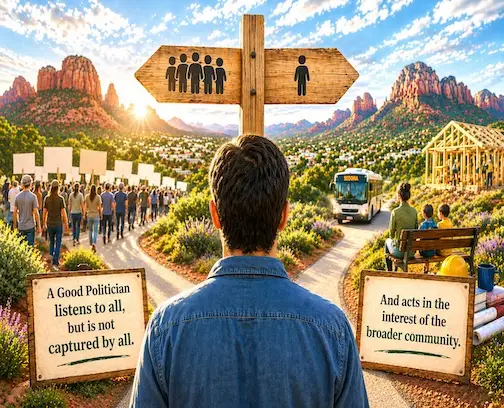
In a divided Sedona, real leadership means hearing every voice—without being driven by the loudest—and acting for the entire community, including those not in the room.
By Bear Howard and Associates
Listen to this story HERE:
Sedona, Az — First, a story…. The folding chairs in the city hall City Council chambers filled up early that evening. By the time the council meeting started, the back wall was lined with people—arms crossed, papers in hand, some already shaking their heads before anything had been said.
On the agenda: a proposal to allow a modest apartment development on the edge of town. Not high-rise. Not sprawling. Just enough units to house service workers who, more and more, were commuting in from the Verde Valley or beyond because they couldn’t afford to live in the place they worked.
The Councilman sat quietly, flipping through his notes. He had read the staff report twice. He had met with planners, economists, even the school superintendent who told him enrollment had dropped again this year. Fewer families. Fewer kids. Fewer reasons for teachers to stay.
But that wasn’t what filled the room.
One by one, residents stepped up to the microphone.
“We moved here for a reason,” one woman said. “This isn’t Phoenix.”
Another followed. “Traffic is already unbearable. You add apartments, and you change everything.”
A man in the front row didn’t even approach the mic—he just called out, “No more growth!” and a ripple of applause backed him up.
It was organized. You could tell. The same phrases echoed. The same concerns. Someone had clearly sent emails, made calls, and rallied people. And it worked. The room felt unified, almost unanimous.
David looked around and, for a moment, even he felt it—that pull. The sense that this must be what the town wants.
But then he glanced back down at his notes.
He remembered the restaurant owner who told him she was closing two days a week because she couldn’t staff the place. The hospital administrator said they were losing nurses to Flagstaff. The young couple who grew up in Sedona but now live forty-five minutes away because there was nowhere they could afford.
None of them was in the room tonight.
They were working. Driving. Tired.
Or maybe they just didn’t think it would matter.
The public comment period ended, and the room settled into a low, expectant silence. Everyone was waiting to see if the council would “listen.”
The Councilman leaned back, exhaled slowly, and thought about what that word had come to mean.
Because, of course, he had listened. He had listened for weeks.
But what he was hearing tonight wasn’t the whole town. It was a part of it—a committed, organized, very present part of it.
And that was the problem.
If he treated this room as the voice of Sedona, the decision would be easy. Vote no. Protect what exists. Keep things the same.
But if he did that, he also knew what would follow.
More workers are commuting from farther away. More businesses are cutting hours. More schools are shrinking. A town slowly turning into a place that functioned beautifully for those who already had a foothold—and less and less for anyone else.
He looked down the dais at his fellow council members. Some were nodding subtly, as if the decision had already been made for them by the tone of the room.
That’s when he realized something that didn’t feel political at all—it felt structural.
The people in front of him hadn’t been elected.
He had.
Not to echo.
To decide.
When his turn came to speak, he didn’t rush.
“I want to thank everyone who came out tonight,” he began, and a few heads nodded. That part was expected.
“You’ve made your concerns very clear. And they matter.”
A pause.
“But I also need to say something that may not be as comfortable.”
The room stiffened.
“The people we’ve heard from tonight are not the only people who live and work in this community.”
A few murmurs.
“I’ve spent the past month talking to business owners, teachers, healthcare workers—people who aren’t here tonight, not because they don’t care, but because they’re trying to make a living in a town that’s becoming harder and harder to live in.”
The energy shifted. Not hostile yet—but no longer comfortable.
“And my job,” he continued, “is not to count the number of voices in this room and call that the will of the people.”
Now the silence was sharp.
“My job is to take all of the information available—what I hear from residents, what I see in the data, what I understand about where this town is headed—and make the best decision I can for the whole community. Not just the part of it that has the time or organization to show up.”
Someone in the back muttered something under their breath.
He didn’t react.
“I was elected to use judgment,” he said. “Not just to reflect back the loudest opinion.”
And there it was—the line that would either cost him his seat someday or define why he deserved it.
The vote came later. It was close.
Outside, under the fading red glow of the rocks, people gathered in small clusters, some frustrated, some relieved, most still convinced they were right.
And maybe they were—from where they stood.
But inside, what had actually happened was something quieter and harder.
An elected official had listened—carefully, respectfully—but had refused to be captured by the moment.
Because the real test of leadership in a place like Sedona isn’t whether you can hear the people in front of you.
It’s whether you can still see the people who aren’t in the room—and make a decision that includes them anyway.
Epilogue – What this civic lesson is all about…
What played out in that room is the quiet, ongoing conflict at the heart of American governance: the difference between a pure democracy, where decisions are driven by majority voice in the moment, and a representative system, where elected officials are entrusted to think beyond the moment.
In a true majority-rule setting, the outcome would have been simple—the loudest, most organized group would have carried the day. But a representative government demands more of both its citizens and its leaders. It requires an understanding that the “majority” is often incomplete: it excludes the minority, the less organized, the economically burdened, and the silent—the people who do not attend meetings, do not send emails, and sometimes do not vote at all.
A competent and knowledgeable elected official is not a mirror. They are not there to reflect back whichever voices are most present. They are there to synthesize.
They gather input—but from all directions, not just the visible ones. They weigh:
public opinion, both expressed and unexpressed
data, trends, and long-term consequences
expert analysis and legal constraints
the needs of the present population and the future one
They recognize that organized groups are part of the public—but never the entirety of it.
And then, after listening, they do something that can feel uncomfortable in a culture that equates volume with legitimacy:
They decide.
Not as an act of defiance toward the public—but as an act of responsibility to the whole of it.
Because the real strength of a representative system is not that it ignores the people, nor that it obeys them blindly, but that it relies on elected individuals who can listen without being captured, and who are willing to act in the interest of the broader community—even when that community is not fully visible, not fully organized, and not fully in agreement.
Before assuming your local government “isn’t listening,” it’s worth understanding what you actually elected it to do: not to mirror the loudest voices or validate the most organized groups, but to weigh all inputs—public comment, staff analysis, long-term impacts, legal constraints, and the needs of people who never show up or don’t have time to engage—and then make decisions for the whole community.
In a place like Sedona, where a small, active slice of residents can dominate the conversation, frustration often comes from mistaking visibility for majority will. That misunderstanding can stir unnecessary discontent among people who might otherwise trust the process.
But the system isn’t designed to be driven by whoever shows up and demands action—it’s designed to be led by elected officials using judgment. In the end, you won’t win by volume alone; decisions will be made by leaders expected to look beyond the moment and act in the broader interest of the entire community, not just the vocal minority.
That misunderstanding can stir unnecessary discontent among people who might otherwise trust the process. But the system isn’t designed to be driven by whoever shows up and demands action—it’s designed to be led by elected officials using judgment. In the end, you won’t win by volume alone; decisions will be made by leaders expected to look beyond the moment and act in the broader interest of the entire community, not just the vocal minority.
9 Comments
A medium science fiction story at best.
In reality, the city now extends to the 200+ acres (a bigger number than 40 when I went to school) that is flat, easy to build on and is not rock and full of drainage swales. There is NO affordable housing that anyone is going to build at the edge of town. You’ll be lucky to stay at $800 a square.
It’s getting old that people think that 8 minutes out of town is a travesty to drive ,OR use the existing connector shuttles to get to work.
I’d say this is a false flag story, you you even forgot the flag. Maybe the businesses could offer a travel voucher subsidy if it’s such a big deal to cover that 8 minute travel time. I did that, just to get employees in a tough labor market.
The conversation is getting old, led by incompetent decisions at city hall, with out of control budgets, huge cost overruns and a never ending expansion of employees.
If you are going to be a Mayor or Governor, you’re a CEO, and unless you have experience in running an organization, you’re going to be overseeing decline.
Building things with massive cost overruns should be a red flag that we have a city government that knows not what they do.
I’ve not heard anyone object to building at The Dells. I’m very happy the council took first steps on that: 1) studied the land- no remediation for environmental issues with the soil; 2) agreed to get the injection wells so the treatment plant can stop top spraying effluent there.
Those that walk there will come out at some point against the idea.
If Home Rule fails, it will take a vote to get the dollars to pay for the injection wells. That would put the idea in jeopardy as it would be millions and millions to get the injection wells, upgrade the 89a intersection, design it, etc.
I am 100% against allowing any housing for any human in the dells. Stopping the “Effluent” spraying of waste water after decades of doing so does not magically make the environmental hazards created from it. It would require a massive cleanup of the “Effluent” feces, urine, viruses and whatever else ends up in our sewage system. Injection wells, the type that do not pose additional health hazards to the water table and surrounding soil would also be enormously expensive. Combined the two projects would cost many many millions.
One only need to look up the thousands of contaminated sites our troops have been forced to live in and on and the subsequent deaths and severe illnesses those site have caused the troops exposed to those toxic environments as well as the subsequent law suits and disability payments to know that putting humans in and around a known toxic area will surely result in unnecessary law suits, death and illness.
So the options are a major expensive cleaning followed by the expensive of building the proposed housing or putting people down there and facing lawsuits totaling more than those thing combined would cost.
Sedonan’s for the most part (other than the greedy ones who wouldn’t care about either of those things so long as they get their stupid amphitheater to profit short term off of) are smarter than allowing these thing to proceed.
I’m all for cleaning up the site and putting in efficient safe injection wells. I am not for putting humans down there ever. We have much safer less intensely smelling (and the stench will remain down there no matter what clean up is done) locations we can safely house our workforce.
And I don’t want to hear about how great the end product water is coming out of the sewage plant as that has absolutely zilch to do with the toxins currently in the air and soil down there- zilch!
An excellent framing of what it should mean to live in a representative democracy. The Highest Common Good is to be sought by leaders. That is their actual duty. Yes, that sometimes that clashes even with a majority, who have the luxury of asking for things that ultimately do not support the community in the most positive ways given the alternatives.
I’ve responded so many times I can’t count to people who don’t understand that if there is a defined parcel, then the Land Development Code (LDC) governs what can be built there and you can’t just call for a new land use regime because you want the status quo that was in place when you moved here. If you want to try to change the state constitution, fine. That will take millions. Good luck to you. Just don’t blame city council for upholding the laws.
That said, there are legitimate uses for the initiative process. Land preservation is one of them. But I’ll argue that the initiative process should be used sparingly, and not when another use for the land provides a significantly higher benefit to the human habitat (sustainable community, resident amenities like senior living and/or a rec center, etc.) in a place surrounded by national forests for outdoor recreating.
There are key reasons to “pack the chambers”. Getting a topic better attention by council, like say for fire danger slash evacuation, is a key reason to show up in force. We need to keep showing up for topics that keep getting back burnered.
To help leaders frame a decision, one thing we can do tomorrow is work towards having best-in-class resident facing technology that brings us together, like Virtual Town Hall Meeting software with as needed professional moderation. That tool allows us to cut through to the core of what is needed because you can use it to force consideration and weighting, through dynamic real-time surveys, of larger issues than are being promoted by those who chose to show up.
100% agree. I’ve been telling my wife for years there are groups of people who have the time and resources to push for what they want; not for what is best for our City. They don’t have a shortage of employees because they don’t have businesses here.
We need employee housing. I don’t go to these meetings because I have a business here and I’m always working because I don’t have enough employees.
I’ve been to hundreds of towns and cities in the U.S. and Sedona is one of the slowest growing cities I’ve ever seen.
If we don’t grow, we will die.
100% Scott!
Anyone can see through their nonsense if they have eyes and common sense.
Sedona is in an economic squeeze – it is a service economy primarily based upon services for tourists and the BnBs have made housing largely unaffordable or most likely unavailable for the service employees required to run the service economy. It is a no win situation because of lack of forward planning, lack of action and lack of judgement by the City Council and City Administration. It would be nice for everyone to have a 5 minute commute to work, but the reality of Sedona is that may not be achievable due to the BnB situation. If there are useable plots that are suited to affordable housing and the development costs are economic without City funding ir other economic intervention, then the zoning should be altered to allow that. If not, then a reasonable commute from Cottonwood, Rim Rock or other more affordable locations will occur, and the economies of those communities are going to benefit from the provision of housing to the service employees. A commute from Flagstaff and reliance on that labor force would be foolhardy because of the weather issues between the two locations.
Is a 20-25 minute commute desirable? Clearly, if a 5 minute commute can be achieved, people would prefer that, but a 20-25 minute commute with generally minimal traffic would be heaven for many in the US. The unique situation in Sedona has to evolve considering the density desires of the populace, the economics of affordable housing development in Sedona versus elsewhere and the need for service employees to fuel a service economy. But, Sedona community leaders need to start figuring it out – this topic has been discussed for many, many years in Sedona and nobody does anything. In order to solve the problem, Sedona government MUST start thinking outside the boundaries of Sedona and what is available in nearby communities to serve the housing needs, and start working cooperatively with other communities to meet the needs.
This is all common to communities planning processes….meetings are set … everyone may see the same problems and life at home needs surpass schedules for public meetings by a larger portion….vs those who can schedule a limited time event…. Sedona has met a bigger beginning of harsher growth pains in the entire Verde Valley….impacting life in Sedona on top of its original thrust for tourism….I think the solutions lay in residents domiciles hands…it’s kinda hard to get past BnB impacts.. they exist because the original or investors owners found that more profitable than living in Sedona and … suffering it’s planning lack of foresight….looking at approved developments in the entire Verde Valley….there is no plan for affordable….the cause is thwarted by high costs all around…
Let me add to some of this. Council just passed 2-4 story buildings, and 4-3 story buildings. There will be 51 apartments called 60 Goodrow.
Every building is over height requirements and massing codes. Now yes we need housing. But P&Z was against them and council over road them.
At no point did they ask real word questions, LIKE PRICE! These are hi end apartments. All have garages and the 3 story ones have driveways. Now I looked in Cottonwood the new apartments across from hospital are a 1 bedroom at $1450 a month. No driveways, no garages.
When the Navajo lofts were being passed (Southwest Dr.) thought they would start at $3400 a month and that was 5 years ago. Very high end, Im sure they wont be $3400 anymore?
Yep you had teachers, the chamber, school principals cheering the Goodrow development, talking about the need. We dont pay teachers that kind of money. Living in Sedona high end, I will easily guess they will cost close to $4,000 a month for a 2 bedroom.
Those on Goodrow say that 10% will be workforce housing. That means 5 of them. Then after 10 years they can be STR. Council didnt blink and allowed all that. Everyone was throwing around the term “missing middle.
We need basic housing for workers. Not apartments that you barely can live in and save money!
So much of the story above was true, this will not work out well unless you are making big money in town. I do not know any young workers who make more that $25 an hour.
Council needs to ask critical questions, and make the rules on this kind of development. How about fair housing and not some public give away!