

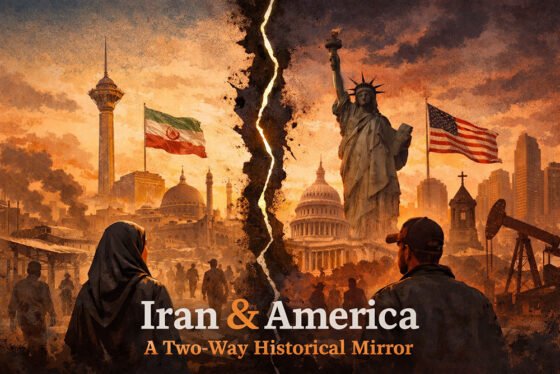
By Bear Howard and Associates —
Sedona, AZ — There is a dangerous illusion that nations are far more permanent than they really are.
They appear solid on maps. Their borders are drawn in ink. Their governments issue decrees, hold elections, and command armies. From the outside, they seem immovable. But history teaches something far more unsettling: nations are not undone only by invasion. They are undone by the collapse of legitimacy—sometimes from outside, and sometimes from within.



Today, Iran stands under the shadow of a single threat. America, quietly, stands under another.
The forms are different.
The potential consequences may not be.
Iran is not Iraq in 2003. It is not Libya in 2011. It is not Afghanistan in 2001.
It is larger, more populous, more historically continuous, and far more structurally complex. With nearly 87 million people, a vast geography, deep institutional layers, and one of the world’s strongest national identities, Iran is not a fragile shell waiting to collapse. It is a functioning society constrained by a governing system that limits its full potential.
Its cities are modern. Its universities produce engineers and scientists. Its infrastructure, while strained by sanctions, still operates. Its people live ordinary lives—raising children, pursuing careers, building businesses—within the confines imposed by political authority.
But there are those, particularly in foreign policy circles, who believe that this system could be ended quickly. That military force—precision strikes, decapitation of leadership, the removal of governing authority—could clear the way for transformation.
History suggests otherwise.
When the United States invaded Iraq in 2003, the expectation among many policymakers was not prolonged chaos, but rapid stabilization. Saddam Hussein’s government would fall. Democratic institutions would rise. The Iraqi people, freed from dictatorship, would build a modern state aligned with democratic norms.
Instead, the regime’s collapse created a vacuum.
State institutions disintegrated. The army dissolved. Police authority vanished. Armed factions emerged. Sectarian conflict ignited. Skilled professionals fled. Infrastructure decayed. It took years for even partial stability to return—and even now, more than two decades later, Iraq remains politically fragile.
Libya followed a similar trajectory. The removal of Muammar Gaddafi did not produce a unified democratic state. It produced fragmentation, competing militias, and prolonged instability.
Afghanistan, after twenty years of American military presence and nation-building efforts, ultimately returned to the very leadership structure the intervention had sought to replace.
Syria, subjected to years of civil war and external involvement, remains divided and devastated.
These outcomes were not the result of insufficient military strength. They were the result of a deeper reality: removing a government is not the same as replacing it with legitimacy.
Power, once destabilized, does not automatically reorganize itself into democracy.
It reorganizes itself into whatever structure can impose order.
Sometimes that structure is freer.
Often, it is not.
If the United States were to unilaterally attack Iran with the goal of ending its current governing system, the immediate military outcome might appear decisive. Leadership compounds could be destroyed. Military infrastructure could be degraded. The governing apparatus could fracture.
But the long-term consequences would almost certainly be far less predictable—and far more dangerous.
Iran’s national identity is ancient and deeply rooted. Foreign military intervention, rather than liberating the population psychologically, could unify it in resistance. Even citizens critical of their government might view external force as an assault on national sovereignty.
Institutional collapse could follow. Economic systems could freeze. Infrastructure could falter. Internal factions—political, ideological, ethnic—could compete for control.
The country could fragment not into democracy, but into uncertainty.
The most educated and globally connected citizens—the very individuals most capable of building a modern democratic society—would be the most likely to leave, accelerating a brain drain that would weaken reconstruction for decades.
What would emerge would not necessarily be freedom.
It might be prolonged instability.
And in that instability, the promise of Iran’s enormous human and economic potential could be delayed not for years, but for generations.
There is, however, another nation facing a different but equally consequential test.
The United States.
Unlike Iran, America is not governed by clerics. Its constitution remains intact. Its courts function. Its elections continue. Its people speak freely. The structural foundations of democracy remain.
But democracy does not depend solely on structure.
It depends on adherence.
It depends on leadership that accepts limits.
It depends on the understanding that power is constrained by law—that no individual, no matter how popular or powerful, stands above the system itself.
In recent years, America has begun to confront a new and unfamiliar tension: the rise of leaders who increasingly challenge those constraints—not by abolishing them outright, but by bending, testing, and, in some cases, ignoring them.
This is not theocratic authority, justified by divine mandate.
It is something else.

It is the assertion of personal authority justified by political mandate.
The difference is profound in origin—but potentially similar in effect.
When a leader begins to treat legal boundaries as obstacles rather than obligations, when separation of powers becomes an inconvenience rather than a foundation, when the machinery of government becomes a tool of personal preservation rather than public service, the system itself begins to weaken—not through destruction, but through erosion.
No tanks appear in the streets.
No foreign armies invade.
The change occurs internally, gradually, often legally, but cumulatively.
Institutions continue to exist.
But their independence diminishes.
Laws continue to exist.
But their enforcement becomes selective.
The system remains visible.
But its integrity fades.
Iran faces the risk of external disruption.
America faces the risk of internal distortion.
In Iran, a foreign military force could shatter institutions faster than they can be rebuilt.
In America, unchecked internal power could slowly hollow out institutions from within.
In both cases, the danger is not simply political.
It is structural.
Because once legitimacy is weakened—whether by foreign intervention or internal overreach—it is extraordinarily difficult to restore.
Nations depend on trust. Trust in courts. Trust in elections. Trust in the idea that leadership itself is accountable to something larger than personal authority.
When that trust breaks, the nation itself does not disappear.
But its potential does.
Its people adapt.
They endure.
But they no longer flourish as fully as they might have.
The Iranian people today live within a system that limits their country’s full integration into the modern world.
The American people live within a system that still functions—but now faces a test of whether it will continue to operate within the constraints that made it strong.
Iran risks losing its future through sudden external disruption.
America risks weakening its future through gradual internal transformation.
The paths are different.
The mechanisms are different.
But the stakes are the same.
Whether a nation remains defined by laws—
or by those who believe themselves beyond them.
History rarely announces the moment when a country crosses that line.
It only reveals it afterward.
And by then, the consequences are already deeply ingrained in its people’s lives.
Will America, with the most powerful military in history, use its strength to dislodge Iran’s current government? Perhaps. But would the result bring disaster or progress for the Iranian people? Only time will tell.
Will America, after 250 years, face a fate similar to Iran’s—becoming a nation constrained by a government that amplifies its worst impulses? Or will it chart a different course, halting and reversing today’s radical shifts to build a renewed, more progressive future—one guided by its best ideals and the shared human desire for a society that is livable, fair, and hopeful for all who call it home?

7 Comments
America is living on its past reputation. It does not have the capacity for a sustained ground war anywhere in the world with drones satellite phones and gorilla tactics America will get to feed it no matter where it goes. Its warships are sitting target. The world’s figuring out that Trump‘s limited to just targeted attacks. America is not the superpower that Trump claims won World War II anymore.
Great analysis Steve. I was in Honduras, Iraq, Somalia, Rawanda, and Bosnia during my service. They were all their own hell on earth and our enemies (ISIS, Russia, the Mujahideen and others) have spent time on every battlefield we have been engaged on since WWII. They’ve watched and learned our tactics which is why we had our infamous Black Hawk Down incident in Somalia and several other FUBAR incidents involving US Forces being ambushed and taught we were NOT the Billy badasses most Americans think we are. The Serbs shot down a Lockheed F-117 Nighthawk stealth fighter during our Kosovo Campaign. During the Gulf War numerous US aviators were shot down captured and tortured as they were in Vietnam. According to NATO aviators imprisoned with them were surprised that out out POW’s couldn’t keep their mouths shut and continually attempted to communicate with other POWs which resulted in everyone being severely beaten.
Trump did NOT rebuild our Military!!!! W Bush is primarily responsible for that. Trump has invested in Buck Roger’s bullshit such as Stealth fighters and Bradley’s that are ineffective against drones and other hi tech weapons. He hasn’t spent jack on Grunt weaponry and equipment which are what ultimately wins wars. I left the service in 96 and the gear we had was WWII- Vietnam Era crap with a smattering of then new tech such as SINGAR Radios and SAW machine guns. The stuff W got authorized and fielded for Iraq and Afghanistan was far better and more reliable than anything we were given and yet it is completely ineffective for use on today’s battlefield of thermite spitting drones, hypersonic missile s, robotic dogs with flame throwers and anti tank weapons mounted upon them. And today’s battlefield is primarily a green powered solar and lithium ionic batteries, not the Dino Poop Trumps wants our forces to rely upon, which BTW was one of the biggest hindrances to our forces in WWI, WWII, Korea, Vietnam and the Gulf War! Our fuel support could not keep up with fuel demand upon the front lines. In other words Trump is killing our military by glad handing his Petroleum Trillionaire pals while ignoring the realities of the technological battlefields of today. But of course Major Draft Dodger knows better than the Generals he fired and replaced with sycophantic unqualified morons like Hegseth!
“Will America, with the most powerful military in history, use its strength to dislodge Iran’s current government”
Our military may have all of the toys but so far as being “the most powerful militarily in history” that is up for debate. We were supposedly the most powerful military in history during Vietnam where we fought ourselves more than the enemy, Mogadishu where we thought nobody would mess with us but did, Ramallah where our military re-learned the brutality of Urban Warfare and yet we got our asses hand to us in each of these conflicts. The Serbs shot down one of our $4.62 million dollar each 117 Stealth Fighters using a 1960’s era Soviet-era S-125 Neva/Pechora surface-to-air missile system (NATO reporting name: SA-3 Goa). So yeah, all depends upon your definition of “most powerful” when tribesmen and militiamen armed with their imaginations have wreaked havoc upon our Armed Forces over the years since WWII. And even back then, the Hitler Youth (mostly adolescents) bravely fought the US and our Allies as well as the fast approaching Red Army in the race to reach Berlin and capture or kill Hitler. They too fought Battalions of our troops, tanks and fighter aircraft with primarily small arms and a few anti tank weapons. They did eventually surrender or were defeated but nobody can deny that they did the Allied Forces some serious damage before they did.
And Donald J Trump did NOT rebuild our military! As much as it hurts to admit it, Dummy Sonny W Bush did following 9/11. If anything, as Trump likes to say, “he inherited it” from a predecessor but loves to take credit for it which is an outright lie! W was the first US President since Vietnam to get serious about the modernization of our military with emphasis on the weapons, uniforms and equipment us Grunts carry upon our backs rather than focusing funding upon “Buck Roger’s Bullshit” (to coin a phrase from the late great LTC. David H Hackworth). Buck Roger’s Bullshit consist of Stealth Fighters that are not Stealth, Tanks that get less miles per gallon than the number of gallons they carry. LTC Hackworth (Americas Most Decorated Soldier) realized the futility of having shiney expensive toys that hardly work vs having those who do the fighting on the ground and face to face well trained, well armed and well equipped. Trump likes and invests in the shiney bullshit like Boeing Aircraft because that’s where the Bigly money is for those like him who have stock in those companies like Lockheed and Boeing. In return for bigly profits he helps sell their wares to countries like the one who had 8 out of the 11 9/11 hijackers hail from.
Tonight’s gaslighting will likely be a rehash of Trump bullshit like “only he can stop the war in Ukraine” “the economy and utility prices are great” and whatever other nonsense he will lie about knowing his MAGA faithful will believe his every word without question despite knowing better somewhere deep down in their tiny brain recesses.
Too bad MTG isn’t going to be there to get up in his face again like she did the last State of the Union. Only this time it would be piss and vinegar in her heart and eyes rather than lust and blind faith allegiance in what she now refers to as a Con Man!
Well the “NO Wars” POTUS has started yet another one! Gee MAGA I think you’ve been lied too Again Again! But you’ll keep defending the convicted felon no matter what laws he breaks or how many countries he breaks doing it (to include our own) right?
We can’t help Ukraine defend itself from an Illegal war started by Trumps pal Putin but we can spend trillions stirring up hornets nests in the Middle East. The Russian Government wants to “obliterate” America, NATO, Europe and Democracy. The Iranian Government wants US forces completely out of the Middle East just as Ukraine wants Russian forces out of Ukraine. Yes the Iranian government have a history of being evil bastards that have use terror and terrorism to inflict it’s will in their region and anywhere US forces are based. The have US blood on their hands. The Russians are evil bastards that has used terror and terrorism to attack their enemies all over the world. And BTW- they are allied! They are both also allied with Chyyyna, India and Turkey. Both have mercenaries, militias and proxies all over the world. Killing Iran’s Supreme Leader, although bringing about cheers from Iranians. This will be short lived glee I assure you! Iran knows how to play the long game and has spent decades preparing for war with the Great Satan (US). The people cheering have no weapons with which to go on the offensive against the remnants of their government (which has built in and automatic successions to their leadership). They will attack or troops and civilians wherever they find security has lapsed. Their retaliation will be in their hearts and minds until revenge is taken just ask Salman Rushdie, author of The Satanic Verses and Masih Alinejad! Better yet ask the family members of the Formers Shah’s family who were targeted for assassination in what is known as The Chain Murders.
I wish the Iranian people the very best. I sincerely do! But I also know this administration despises them all for who they are, where they come from, their religions and the color of their skin. King Trumpdee Dumpdee claimed he was going to strike Iran to further eliminate Irans nuclear program that he claimed was “completely obliterated” on 28 February, 2026? No such facilities have been targeted in today’s strikes which focused upon killing Irans leadership by assassinating their leader (a violation of International and US Law). There was no “imminent nuclear threat” just as there were no WMD stockpiles in Iraq when W’s administration fabricated their pre text for attacking Iraq. But Iran does have some of the world’s largest oil reserves. Trump thinks we can just take them from them. Didn’t work in the 70’s and it will not work today. The oil belongs to Iran and any attempts by the US to to change that will most assuredly be met with US blood being spilled yet again. That is the nature of the region, just ask Israel.
What did they call it when Bill Clinton used military force to divert from domestic issues like Monica Lewinsky? Wag the Dog? Well that is exactly what Trump is doing with Iran to divert from his name appearing in the Epstein files nearly a million times. Imminent nuclear threat mine arse! He’s done nothing to help the Gazan’s he and his criminal co conspirators bombed into oblivion and he will do nothing to help the Iranian people. They will take their land and natural resources though! Think this is just the beginning of increased kaos and bloodshed in the region.
Just watching the MAGA propaganda arm known as FoxNews. Rather than rightfully criticizing the Trump Administration for lying to them and getting Americans killed and rather making excuses for them by claiming that people are upset about the Supreme Leader being assassinated rather than being upset about having a President who outright lied and continues to lie to them about Iran and foreign wars in general.
Now lying ring kissing (among other things he kisses)Mike Johnson is claiming this was all Israel’s idea and we just went along for the ride! What a sad sack o crap! Excuses are made by a-holes!