

By Steve Segner —
SEdona, AZ — I watched the City Council’s annual retreat online on Thursday, December 18, and I appreciate the candid, goal-setting discussion. Seeing the council, the city manager, and staff work through priorities in public is the government doing its job—and doing it well.
Late in the afternoon, the discussion turned to the city-owned property in West Sedona commonly referred to as the Western Gateway. It was clear you are weighing competing and consequential ideas—open space, an event facility, commercial uses, and housing. There are no easy answers, and no one ever said serving on the council was easy.

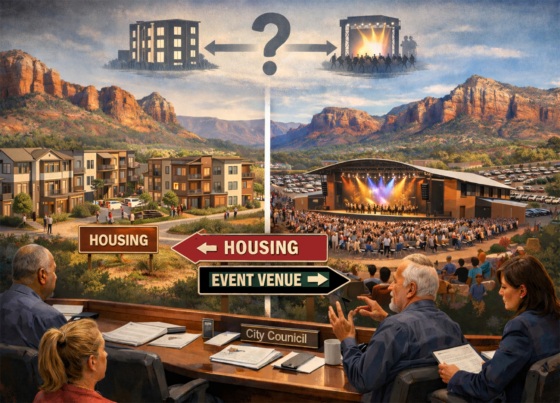
From the discussion, the central framing appeared to be something like this:
Do we want a 1,000, 2,000 to 5,000-seat outdoor event facility at the Western Gateway, or would we prefer housing?
Housing is already identified in Sedona’s Community Plan as a top priority. Housing proposals can be evaluated using concrete, understandable criteria: number of units, height, affordability levels, location, infrastructure needs, and neighborhood impacts.
And don’t forget, the whole incentive to consider buying the Western Gateway in the first place was to address the need for more affordable “rental” housing, acknowledging the difficulty of getting housing-zoning anywhere in Sedona near residential neighborhoods. This location on the far western edge of Sedona seemed to be insulated from that kind of public criticism. Hence, an expenditure of almost $22 million took place.
The proposed outdoor event facility, however, remains largely conceptual. While it may sound attractive, the details matter—and at this point, they are missing.
For more than twenty years, the remains of a failed outdoor theater have sat on this property. If the city is considering another large-scale event facility at the same site, the public cannot reasonably evaluate that idea without basic, verifiable information. Before the town creates a final “master plan” on the use of this property, proponents of an event facility should be required to submit a complete, public business and operations plan that addresses, at a minimum, the following questions:

- Is there a viable business plan with realistic revenue and expense projections?
- Who funds design and construction, and what are the guaranteed sources of that funding?
- What is the traffic and parking plan, including peak-event conditions and emergency access?
- Where will attendees stay, and how will that impact lodging, roads, and neighborhoods?
- What is the sound-management plan, and how will it be enforced?
- Who owns and operates the facility? Is there a qualified nonprofit or professional operator in place? And what is their historical reputation in other communities where they are “in charge” of facilities management, maintenance, and operations?
- What compensation will the city receive for the use of land purchased with borrowed funds? The Film Festival has already agreed that paying a lease fee for the use of the land they want to develop for their multi-theater complex is appropriate and acceptable. They acknowledge the city needs to get some of their $22 million investment back if they’re going to use this land for their own purpose.
- What financial or operational commitments would the city be expected to make, now or in the future?
- Who pays to build—or rebuild—core infrastructure such as the stage, restrooms, pathways, and utilities.
- How are the 1,000+ car parking lots scattered throughout the 40 acres to be improved? With city money or the event venue proponents’ money?
- What months would the facility realistically operate, and is “year-round” use feasible given weather and demand?
- How will monsoons and severe-weather cancellations be handled, financially and operationally?
- Who provides production staffing (stagehands, technicians, security, medical services, and cleanup), and at what cost?
- Most important: if the facility underperforms or loses money, who is responsible—the operator or Sedona taxpayers?
Without clear answers to these questions, how can the councilors make an intelligent decision?
Supporters of an event complex have had nearly three years to produce a credible, third-party-vetted plan. If such a plan doesn’t work, now is the time to put it on the table. If it does not, the city should pause further consideration of an event facility and allow staff and council to focus on other thoughtful uses of this important public land.
And here’s another issue to consider: in the past, the city told developers who considered buying the Western Gateway that it would not want it developed if it included a hotel. And what was the issue with hotels? Traffic! And we’re seriously considering building a venue that could accommodate up to 5,000 people at once in the Western Gateway? Where is the logic in that?
There is no urgency requiring a final decision on the Western Gateway in 2026. The land will still be there. Taking the time to require complete information before asking the city council to make final decisions on the use of this land seems to be prudent. Twenty years ago, enthusiasm outpaced planning, and Sedona is still living with the consequences.
I do encourage the council to move forward with a commercial building complex along Highway 89A for the future home of the Sedona International Film Festival, and to continue evaluating housing and community-oriented uses on the Western Gateway site. At that same meeting, they voted to proceed with SIFF to “fast-track” their business plan and, in effect, “carve out” this commercial-use land adjacent to SR 89A from the rest of Western Gateway’s master plan.
However, the city should not proceed with consideration of this aspirational event complex. They should set aside any decisions on rebuilding and restoring the old 5,000-seat outdoor amphitheater until all material facts are available—in writing—and accessible to the public.
And, in the end, the council does not have to ask every Sedonan how they feel about this issue. They were elected to make intelligent decisions based on their own research, study, and analysis, and on their capacity to make clear-thinking decisions. They don’t need to see how the wind is blowing for what the “residents” want. That’s a fool’s errand. One never knows what the collective “will” is. All you know is what the loudest voice’s “will” is.
That’s how I see the Western Gateway story.

5 Comments
Just who is going to pay for all this ? Not me
I find it very interesting and mind numbing questions around here sometimes.
Seeing that you hardly pay for a thing in town speaks volumes on your lack of understanding.
Tourists pay 78% of the city budget and your worried about your money? You dont even have city property tax yet your still whining?
Now that you know, will you post some silly things all worried about your money again Ebenezer Scrooge?
The well discussed high density housing project for the Cultural Park Property creates a huge increase in traffic, every day. Not just now and then. There lies the problem. High density, anything, housing or event venue, will cause a lot of traffic. The proposed November ballot issue on developing the Cultural Park Property seems to medicate the high density, high traffic problem. A public park, a home for the film festival and moderate development seems more in tune with the things we love about Sedona. Let the voters decide how they want the property developed.
Some months ago, councilor Fultz asked for more details. The venue promotors brought as much detail as they could. I was impressed by the amount of planning they brought. Yes, clearly more details are needed, but therein lies an impossible problem:
The highest priority goal is to get the city to commit to a partnership. What management company hosting national level entertainers would commit to a project if the local city wasn’t onboard? Even signing a letter of intent is a big ask if the city isn’t a partner. So this goes forward only with a city partner. Period. End of story.
Council members at the last meeting specifically on the Western Gateway asked some very hard questions about many aspects, and stated the city was not up for paying for any revenue shortfalls if things go sideways. So a business plan needs to pencil out how a phased approach (< 2000 seats up to 5000 seats) achieves self-sustaining economic viability. That's impossible without the city being a partner because only then will the big players with enough pedigree can planning capability come in with the details needed.
So it's a chicken and the egg problem. The city can't get confidence to commit to a partnership without details, and the small SCP 2.0 group can't provide a believable detailed plan.
I wish them luck. The path of least resistance would be to carve out something for the theater, which I totally support, and maybe do an art village, and give Parks and Rec the 2 or 3 flat acres they're asking for, and then build housing. I'd love to have a good conversation about a rec center with indoor pool too!
Why would national level entertainment do shows in po dunk Sedona when Maricopa County has numerous sporting and concert venues? Prescott has a few as well. And why would the cities tiny PD want to sign on as LE support for a Sedona venue that would bring traffic and parking nightmares not to mention security issues both inside and out of the venue that requires far more than unarmed rent a cops to do properly. Nobody wanted the Car Park for our unhoused employees because of all of the FOX News paranoia propaganda about Americas homeless citizens and insisted the park would end up full of drugs??? What do you think people take to concerts and sporting events? There’s plenty of logic in keeping it Natural vs full of people and insanity that large venues bring with them. Heck I’ll bet more drugs flow through Sedona’s resorts and hotels (brought in by people with money, cars, a home etc.) by far than what come through among the homeless passing through here. Think about it.