

By Bear Howard and Associates
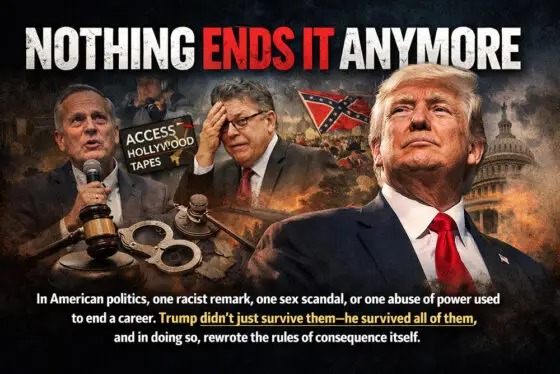
In American politics, one racist remark, one sex scandal, or one abuse of power used to end a career. Trump didn’t just survive them—he survived all of them, and in doing so, rewrote the rules of consequence itself.

Sedona AZ — The following is a historical account for those it affected. It’s real to most of us, but it’s been forgotten. I suggest that we acknowledge that the rules of the game have changed. And if this worked for the far right MAGA world of Donald Trump, maybe it’s going to work for the left or maybe even the radical left when, not if, they take control and redefine their reality based on their perception of what’s right and wrong.
Remember, what’s good for the goose is good for the gander.
Misogyny, sexual misconduct, and “women-as-props” scandals
“One comment about rape” ends a statewide race
- Todd Akin (2012): said victims of “legitimate rape” rarely get pregnant → became an instant national liability and is widely credited with sinking a winnable Senate race.
“Credible misconduct allegations” trigger resignation pressure
- Al Franken (2017): multiple allegations → mounting pressure from his own party → resignation from the Senate.
- Bob Packwood (1995): Senate Ethics Committee recommended expulsion over sexual harassment/misconduct findings →
Sex scandal/secrecy / ethics entanglement ends careers
- John Ensign (2011): affair plus actions that raised ethics/conflict issues → resigned during Ethics Committee investigation.
- Anthony Weiner (2011 onward): sexting scandal → resigned; attempted comeback cratered by more revelations.
Pattern (historically): sex scandal alone often ends it; sex scandal + dishonesty + ethics implications ends it faster.
Racism, bigotry, and “gaffes” that used to be disqualifying
One slur can kill a rise
- George Allen (2006): “macaca” remark became a defining racial incident; it damaged his standing and is widely treated as a turning point in his political trajectory.
Nostalgia for segregation can force leadership out
- Trent Lott (2002): praise of Strom Thurmond’s segregationist run triggered backlash and he stepped down from Senate leadership.
Pattern: even when officials survived electorally, leadership roles and presidential prospects often evaporated.
Grifting, bribery, “cash for access,” and pay-to-play
Straight bribery ends careers (fast)
- Duke Cunningham (2005): bribery/tax crimes → resigned, prison sentence; career obliterated.
Pay-to-play gets you removed or jailed
- Rod Blagojevich: “selling a Senate seat” / pay-to-play corruption → conviction and prison; political career effectively ended.
Lobbyist money scandals can end leadership eras
- Tom DeLay / Abramoff era: Abramoff scandal fallout helped drive DeLay’s exit from leadership and resignation from Congress.
Gifts + “helping a donor” can wreck a governor’s future (even when convictions don’t stick)
- Bob McDonnell (VA): high-value gifts/loans and alleged “official actions” to benefit a businessman → scandal consumed his post-office political viability; the Supreme Court later narrowed the legal definition of “official act,” but politically the damage was done.
Pattern: in the “normal” era, even the appearance of pay-to-play could end national ambitions.
Affairs that ended presidential trajectories
“Private morality” used to be politically fatal
- Gary Hart (1987): affair scandal (“Monkey Business”) → dropped out; became a classic example of a campaign-ending personal scandal.
- John Edwards (2008): affair + cover-up + campaign finance allegations → public collapse of a major national figure.
- Mark Sanford (2009): affair + disappearance/lying (“Appalachian Trail”) → near-total destruction of credibility and leadership viability.
Pattern: the cover-up (lying, secrecy, misuse of staff/resources) often kills the career more than the affair.
“Illegal initiatives” and abuse of executive machinery
This category is bigger than one scandal type—it includes using government power for personal/political purposes, bending agencies to protect allies/punish enemies, or pushing actions that trip legal/constitutional wires.
A few modern, concrete “career ender” examples (not exhaustive):
- Pay-to-play governance (Blagojevich) is the clearest “executive office as vending machine” case—criminal consequences, removed from power.
- Corruption via gifts tied to state action (McDonnell) shows how “soft corruption” investigations can detonate a future even when the legal case later narrows.
Pattern: historically, when the public believes the chief executive is using the machinery of government for self-interest, careers implode—often quickly.
What’s different in the Trump era (the meta-point you’re getting at)
In the pre-Trump pattern, politicians often fell for one of these:
- a misogynistic remark
- a racist remark
- a sex scandal
- a pay-to-play story
- a corruption investigation
- an ethics committee probe
Your “deeper dive” takeaway: Trump didn’t just survive one category—he survived multiple categories stacked, repeatedly, in a way that earlier politicians didn’t. (That’s the historical discontinuity you’re pointing to.)
“this would usually end it”
- Attacked a decorated POW/war hero (“I like people who weren’t captured”)—a third-rail insult in U.S. politics.
- Mocked / mimicked a disabled reporter on stage (the incident, and later disputes about it, became a defining norm-breaking moment).
- “Access Hollywood” tape: bragged about sexually aggressive behavior (“grab ’em…”), the kind of scandal that historically ends campaigns within days.
- Normalization of mass insult politics: opponents, judges, journalists, immigrants, “losers,” “animals,” etc.—a level of routine public degradation that earlier candidates usually couldn’t survive.
2017–2020: “President shouldn’t do this” governance dealbreakers
- Travel ban / “Muslim ban” executive action (EO 13769) that triggered immediate legal and civic backlash and redefined modern limits of executive power in immigration.
- Family separation under “zero tolerance”—a policy choice widely treated as morally disqualifying in prior eras (and a lasting legal/political scar).
- Relentless attacks on independent institutions: intelligence agencies, courts, inspectors general, DOJ/FBI norms, career civil service—behavior that previously would have been treated as authoritarian drift rather than “”
- Profiting/conflict-of-interest optics on an unprecedented scale (family roles, properties, branding, donors/foreign patronage controversies), in a way prior candidates were often forced to avoid just to remain viable.
2019–2021: Impeachments + election subversion (historically disqualifying)
- First impeachment (Ukraine): House formally impeached Trump for abuse of power and obstruction of Congress (the modern presidency’s “you can’t do that” line).
- Pressure campaign to overturn 2020 results (e.g., Georgia call asking officials to “find” votes) — the kind of direct, documented coercion that would have ended almost any prior national career.
- Second impeachment (Jan 6) for incitement of insurrection; Senate vote fell short of conviction but was still historically unprecedented.
2022–2025: Legal judgments that would normally end a public career
- Felony conviction (NY hush-money / falsifying business records) — first U.S. president convicted of a felony; later sentenced to an unconditional discharge (per court/coverage summaries).
- Civil liability for sexual abuse + defamation (E. Jean Carroll): found liable; damages including $5M and later $83.3M for defamation; appeals court later upheld the $83.3M judgment.
- NY civil fraud judgment: court found major financial fraud and imposed massive penalties (with later appeals activity).
- Classified documents prosecution (Mar-a-Lago): charged conduct included willful retention and obstruction; later procedural developments tied to DOJ policy and 2024 election outcome are extensively documented in timelines.
2026 continued norm-shattering conduct
- Racist imagery incident involving the Obamas: reporting describes Trump approving a post depicting Barack and Michelle Obama as apes, then refusing to apologize.
The “pattern” (why this list feels unreal)
In the last 56 years, campaigns often died from:
- one damning tape
- one ethics scandal
- one “unpresidential” insult
- one credible abuse-of-power finding
Trump’s era is defined by stacking multiple versions of those at once—tape + impeachments + criminal conviction + civil fraud finding + civil sexual-abuse liability + election-subversion allegations—without the normal electoral “ejection seat” firing.
Reality has been rearranged to suit the MAGA world that Donald Trump orchestrated. So be it! If the rules are different now, don’t be surprised when those who were challenged become the challengers!
************************************************
Career-Ender Then vs. Trump-Era Analogues Now
| Career-Ender (Then — Typical Outcome: Withdrawal, Resignation, Leadership Loss, or Defeat) | Trump-Era Analogue (Category Comparison) |
| Sexual misconduct allegations — multiple accusers typically forced resignation or ended national prospects (e.g., Franken, Packwood, Weiner) | Multiple sexual misconduct allegations + civil sexual abuse & defamation liability findings; continued political viability |
| One recorded misogynistic remark could sink a statewide race (e.g., Todd Akin rape comments) | Repeated public misogynistic remarks and insults toward women across years without career-ending effect |
| Affair + cover-up ended presidential trajectories (e.g., Gary Hart, John Edwards, Mark Sanford) | Personal conduct controversies + payoff/hush-money scheme leading to criminal conviction; political career continued |
| Racial slur or racially charged remark derailed leadership bids (e.g., George Allen “macaca,” Trent Lott segregation praise) | Pattern of racially charged statements and controversies; base support largely held |
| Mocking vulnerable individuals (disability, tragedy victims) historically disqualifying | Public mockery incidents and inflammatory rhetoric without campaign collapse |
| Bribery / pay-to-play corruption → resignation, prosecution (e.g., Cunningham, Blagojevich) | Ongoing accusations and findings in civil fraud and business practices; political viability persisted |
| Large gift / donor influence scandal (even if conviction later overturned) crippled careers (e.g., McDonnell) | Extensive business/conflict-of-interest controversies during and after presidency; remained politically viable |
| Ethics violations / misuse of office triggered resignations or leadership exits (e.g., DeLay, Ensign) | Repeated ethics and conflict-of-interest controversies; no career-ending effect with core supporters |
| Obstruction or abuse-of-power findings (Watergate-era standard) forced resignation (Nixon) | Two impeachments including abuse of power and incitement-related charges; remained viable candidate |
| Election interference or coercion of officials — historically treated as disqualifying | Documented pressure campaign on state officials regarding election outcomes; continued political leadership role |
| Criminal indictment alone usually ended major campaigns | Multiple indictments; one felony conviction; campaign viability continued |
| Serious campaign finance violations damaged or ended careers (various House/Senate cases) | Hush-money / records falsification conviction tied to campaign context; remained major political figure |
| Attacks on courts, intelligence agencies, or law enforcement legitimacy historically marginalized candidates | Sustained attacks on institutional legitimacy became normalized within political brand |
| Open hostility to allied nations / praise of adversarieshistorically disqualifying in Cold War–era politics | Repeated norm-breaking foreign policy rhetoric without automatic political disqualification |
| Nepotism / family enrichment optics previously forced distancing or withdrawals | Family business and appointment controversies without career-ending impact |
22 Comments
The only reason Trump has survived his numerous criminal scandals is because he had the entirety of the GOP either hog tied with retaliatory threats or they bought into his every lie. In both cases they continued and continue to support him despite knowing that he is in fact a convicted criminal and sex offender. They even look past his draft dodging which up until Trump was a kiss of death for a GOP candidate. Why do they do this? Simple, they love his hate and they know he is their best bet at achieving racial segregation, dominance and armed superiority over all others. Bottom line is they love hate and love to hate.Take the money out of politics and their hatred will fizzle out and go back into hiding like it was prior to Trump and MAGA.
Bear you left out the most serious of political crimes-
Vietnam
Watergate
Iran Contra
OKC Bombing
Lies abound WMD’s in Iraq
Iraq War II
Jan 6th
Renee Good
Alex Pretti
These all make the crimes and open misogyny and racial hatred seem minor and petty and yet they’re not on the list of political crimes. Nobody has forgotten any of the crimes committed by any political criminals past or present. But many seem to have forgotten which party was responsible for the worst crimes in American history. I have not and will not forget the fact that the GOP/MAGA are the perpetrators not the whiny innocent victims they portray themselves to be. Had any Democrat committed crimes even remotely similar to the ones the GOP/MAGA has they would’ve been publicly hung or shot dead on live TV.
Therein lies the hypocrisy of the GOP! They only care about crimes committed by Democrats not Republican criminals who they will protect to their last breaths. Name another POTUS who has been granted complete unfettered immunity and authority like Trump has been granted. You CANNOT! So let’s just be clear who the real criminals are in this country-MAGA!
Fascism? No thanks! Why Britain rejected extremism in the 1930s
https://www.historyextra.com/membership/fascism-no-thanks-why-britain-rejected-extremism-in-the-1930s/
If Americans would pay attention to history especially their own they’d realize that Trump represents everything they truly despise and long fought against.
Oklahoma, Texas, Kansas are ablaze-
https://www.directrelief.org/2026/02/oklahoma-texas-kansas-wildfires-evacuations/amp/
Imagine that! Red states burn too! Better get a rakin! And climate changes isn’t real? I don’t recall fires of this enormity in any of these 3 states occurring in my lifetime. Keep drinking the orange KoolAid MAGA, you’ve proven yourselves to be ridiculous.
Vietnam War veterans sue to block construction of Trump’s triumphal arch
The veterans argued the project would encroach on the nearby Arlington National Cemetery.
https://www.politico.com/news/2026/02/19/trump-arlington-arch-lawsuit-00789763
Hilariously, Vietnam War Veterans are suing the 8 deferment privileged draft dodger 😂
https://doctorzebra.com/prez/z_x45_trump_draft_card_g.htm
There’s 8 classifications on 8 separate dates. That’s 8 deferments. Every classification deemed Major Bone Spurs ineligible to serve his country while he played every organized sport his juvenile reform military school and college had to offer.
Of course he’ll get his way via one of the many courts he stacked (including SCOTUS) and will build himself a “Love Me” monument as a middle finger to those heroes who honorably served their country like the late Senator John McCain. After all those who serve their country are “losers and suckers” unless they pledge fealty to his hineyASS and are willing to break laws and commit war crimes on his behalf. And even then, deep down he has nothing but contempt for everyone other than himself.
“Nothing ends it”
Unless it involves $! Violations of the Constitution and human rights are okie dokie though!
Supreme Court strikes down Trump’s sweeping global tariffs
https://www.bbc.com/news/articles/cn8146l0n55o
The Fracturing of MAGA and I feel fine 👍🏻
7 key things to know about Trump’s tariffs after the Supreme Court decision
https://www.npr.org/2026/02/20/nx-s1-5677609/tariffs-economy-trump-supreme-court
Sung to the tune of Spider-Man:
Tariff Con-Man, Tariff Con-Man
Does whatever a Con-Man can!
Spins a Lie, any size
hangs with thieves just like flies!
Look out!
Here comes the Tariff Con-Man
Is he strong? Listen, bud:
He’s got Chicken and Beef Fat for blood
Can he swing from a thread?
Ramos and Stairs frighten him!
Hey look out
There goes the Tariff Con-Man
In the chill of night
Sitting upon his gold commode
Like a streak of light
He flushes National Secrets, just in time!
Tariff Con-Man, Tariff Con-Man
Scary Orange Convicted Felon Tariff Con-Man
Wealth and fame, is all he wants
Grift and Complete Immunity is his reward!
To him, life is a great big Con-Job
Wherever there’s a grift to be had
You’ll find the Tariff Con-Man!
Ohio mayor arrested on voyeurism charges after allegedly sniffing girl’s underwear
Claims against Wesley Dingus came from teen who had been staying at his residence and hid camera in bedroom
https://www.theguardian.com/us-news/2026/feb/20/ohio-mayor-arrested-voyeurism-wesley-dingus
Are all MAGA politicians paedophiles? Sure seems like it. What a literal Dingus Wanker!
Good question deserve good answers-
The Situation: Just Asking Questions II
Ten questions that will condition the next several months of American life
https://www.lawfaremedia.org/article/the-situation–just-asking-questions-ii
South Carolina Hospitals Aren’t Required to Disclose Measles-Related Admissions. That Leaves Doctors in the Dark
https://www.propublica.org/article/south-carolina-measles-hospital-admissions
Making M’erica Healthy Again by covering up contagious disease outbreaks and lying about vaccines! Nothing like killing ignorant people I guess? There’s no other explanation for it!
The Two Beer Justice System of MAGA a Judge-
This Federal Judge Hid His DUI for Four Months. Now What?
https://fixthecourt.com/2026/02/this-federal-judge-hid-his-dui-for-four-months-now-what/
Ted Cruz Saying “Let’s Stop Attacking Pedophiles” –
https://www.c-span.org/clip/senate-committee/user-clip-ted-cruz-saying-lets-stop-attacking-pedophiles-trump-admin-response-to-crime-in-cities-9-30-25/5173903
Fat chance bear boy! Exposing Epstein and the UN REDACTED DOJ files on Epstein and all of his numerous Epstein Class fellow pedos is what Trump ran on until the reality of an un abided by Congressional ruling that ALL the files be released bitch slapped MAGA into reality. And no he DID NOT misspeak!
Ted Cruz Saying “Let’s Stop Attacking Pedophiles” –
https://www.c-span.org/clip/senate-committee/user-clip-ted-cruz-saying-lets-stop-attacking-pedophiles-trump-admin-response-to-crime-in-cities-9-30-25/5173903
Fat chance beard boy! Exposing Epstein and the UN REDACTED DOJ files on Epstein and all of his numerous Epstein Class fellow pedos is what Trump ran on until the reality of an un abided by Congressional ruling that ALL the files be released bitch slapped MAGA into reality. And no he DID NOT misspeak!
This one’s for Mr JB-
Draft-Dodging Trump Thirsts Over Awarding Himself Military Medal
https://www.thedailybeast.com/draft-dodging-donald-trump-thirsts-over-awarding-himself-medal-of-honor/
Let’s just give him a Boy Scout Merit Badge, Blue Bird Badge and tell him they’re the militaries highest honors. He’s too dense to know any different.
TJ,
he couldn’t even legitimately qualify for either of those scouting badges. He’s too dumb and corrupt to follow their rules. Just keep giving him made up awards like FIFA did and keep telling him he’s the Bigliest Bestest Smartest Man on earth. Ego and Megalomaniacs love being stroked even if it’s all lies!
Large banner featuring Trump’s face is displayed on Justice Department headquarters
https://apnews.com/article/donald-trump-banner-justice-department-pam-bondi-13f3d901c9bd6d179e206475adadc28a
As of February 2026, Donald Trump’s name and face are prominently displayed at several D.C. locations, including massive banners on the Justice Department, Department of Agriculture, and Labor Department. His name is on the Kennedy Center and US Institute of Peace, while his portrait is in the National Portrait Gallery.
The New York Times
The New York Times
+5
Department of Justice (DOJ) Headquarters: A massive banner with Trump’s photo and the slogan “Make America Safe Again” was hung in Feb. 2026, signaling influence over the department.
Department of Labor and Department of Agriculture: Similar large banners featuring Trump’s face were displayed on these federal buildings.
Kennedy Center for the Performing Arts: Following a board takeover, Trump’s name was added to the exterior of the building in Dec. 2025.
U.S. Institute of Peace: Trump’s name was chiseled into the wall of this headquarters as part of a restructuring.
National Portrait Gallery: A photographic portrait of Trump by Pari Dukovic is included in the “America’s Presidents” exhibition.
National Mall: A sculpture titled “Best Friends Forever” (depicting Trump and Jeffrey Epstein) was briefly installed in Sept. 😜.
Just like his BFF’s in N Koreaer and Chyyyna, The Great Eaters Orange Face must be publicly posted everywhere or the sycophants fear being flogged for their INFIDELity of his every bowel movement . “They have nothing but love for Big Brother!”
MAGA world deflates after Minnesota ‘fraud’ influencer’s antisemitic post
Influencer Nick Shirley, whose bogus “fraud” investigations kicked off the Trump administration’s attacks on Somali immigrants, is facing backlash for promoting an antisemitic video.
https://www.ms.now/opinion/maga-world-deflates-after-minnesota-fraud-influencers-antisemitic-post
MAGA seems conflicted over traditional fascism vs its own fascism. In traditional fascism the Jews were hate target number one! While most MAGA fascist are more beholden to Israel and the Jews because of Trump’s acceptance of Jews into MAGA likely as a result of his belusted daughter Ivanka’s marriage to Jerod not because he has any inkling as to what any organized religion is truly about especially when it comes to the word of Christ which he grifts his constituents for $99.99 in his Chyyyner made TRUMP Bible. Heaven forbid someone gets caught with “The Holy” Bible instead of a TRUMP Bible. That would be blasphemy! 😜
White House Explodes at MAGA’s New Enemy Over State of the Union Rebuttal
https://www.thedailybeast.com/white-house-explodes-at-magas-new-enemy-over-state-of-the-union-rebuttal/
Oh how they hate the truth!
America lied about the Iraq war. Then they weren’t believed about Ukraine
https://www.theguardian.com/commentisfree/2026/feb/26/us-intelligence-iraq-war-ukraine
Enough said
Nothing stops it because megalomaniac America focuses on bullshit like this rather than being a good people’s and country for the world to envy rather than fear-
HULK HOGAN SETS POSTHUMOUS AUCTION RECORD
https://www.vice.com/en/article/hulk-hogans-bloody-wrestlemania-1-boots-sell-at-auction-for-1-million/
‘I don’t care’: Trump blasts polling on Iran — and makes stunning claim
https://www.nj.com/politics/2026/03/i-dont-care-trump-blasts-polling-on-iran-and-makes-stunning-claim.html
During the interview, the president also did not rule out sending U.S. troops to the ground in Iran “if they were necessary.”
“I don’t have the yips with respect to boots on the ground,” Trump said. “Like every president says, ‘There will be no boots on the ground.’ I don’t say it.”
He predicted that the conflict will “go pretty quickly.”
He doesn’t have the “yips” because he’s never been and never will go to war. He’s a coward who lied to his own people to achieve his hateful elimination of Muslims and other minorities. He’s hiding behind our young men and women in the armed forces to achieve his tyrannical power grab upon the US and the world. And he doesn’t give a crap about US Casualties who he calls losers and suckers who “just get headaches” from enemy heavy weapons fire! He got GI’s killed in Yemen and Africa during his first term and openly attacked one of our fallen in Africa for being black. He’s viciously verbally attacked a Muslim Gold Star family and insulted our war dead, disabled veterans and a sitting US Congressman who was in fact a POW and War Hero (which obviously makes him rage with envy since his entire family throughout written history have been too cowardly to don a uniform and fight for their country. All facts! And yet he thinks somehow getting nicked in the ear from a bullet fired by someone he obviously pissed off! And flying under heavily armed escort into the Green Zone of Iraq (while ISIS was on the run thanks to our armed forces and allies and NOT him) where he was escorted by brigades of armored vehicles and attack jets and helicopters makes him a hero worthy of the Congressional Medal of Honor??? I bet if Audie Murphy heard his lies and nonsense he too would have likely fired a shot in anger at the dolt pretending to be a tough guy. I’ve participated in security missions for Reagan, Weinberger, Clinton and Holbrook. They had Secret Service, State Department, Delta Force, host nation police and all the US forces stationed where they visited armed to the teeth and ready to protect them. It takes little bravery to run one’s mouth when surrounded by such lethality. And yet somehow this clown figures he deserves the nation’s highest award for “bravery in combat” which is usually granted posthumously or to a severely disfigured and disabled (which he has openly stated is disgusting and does not want to see) for life recipient.
During his first crime spree he suckered a Vietnam Veteran (who likely fell for the con man’s lies about no more wars) into selling him his Purple Heart Medal-
The Stolen Valor Act of 2013 makes it a federal crime to fraudulently claim receipt of military valor awards—specifically the Medal of Honor, Purple Heart, and other top decorations—to obtain money, property, or other tangible benefits. Violations can result in fines, imprisonment for up to one year, or both.
homeofheroes.com
Key Aspects of Stolen Valor Laws
Constitutional Limits: The 2013 Act replaced a 2005 version struck down by the Supreme Court in 2012 (United States v. Alvarez), which ruled that lying about military honors is generally protected by the First Amendment unless it involves fraudulent intent for gain.
Covered Awards: The law specifically protects the Medal of Honor, Distinguished Service Cross, Navy Cross, Air Force Cross, Silver Star, Purple Heart, Combat Action Ribbon, and Combat Action Badge.
Definition of Crime: It is illegal to falsely represent yourself as a recipient of these, or other, authorized military decorations with the intent to defraud.
Penalties: Fines and/or imprisonment of up to six months for general offenses, with enhanced penalties for the Medal of Honor (up to one year).
Verification: Agencies and individuals can verify awards through the Department of Defense’s Valor.Defense.gov database.
homeofheroes.com
Too bad the original Stolen Valor Law W Bush past is not still in affect thanks to Alvarez another con man and liar who took his right to claim being an Iraq war veteran in order to gain for profit donations to the illegal for profit Iraq War Veterans organization he set up with lies. Lies that are somehow protected by the first Amendment despite the severe damage these criminals do to the credibility of those of us who put blood sweat and tears ahead of their awards and decorations.
MAGA and their uber “Patriot” defense of the Draft Dodger and thief at all costs does severe damage to our Armed Forces, Veterans our nation and the world as a whole. They have made patriotism embarrassing with their White Nationalist m/Supremacist Agendas. I can’t tell you how many legitimate combat veterans I’ve spoken with since this nightmare of hatred began in 2015 who are embarrassed of their service, the flag, wearing veteran logo clothing etc. We fought against Tyranny, Oppression and and Tyrants only to have that very scourge sitting in the White House today!
And for the record- I have zero love for Bill Clinstone or Obama for their dodging service to their country by hiding out in a University . But neither of them claimed to be a no wars priveledged draft dodging POTUS who bought a Purple Heart and thinks to merit a MoH! And neither of them called out service members “losers and suckers!”
MAGA you voted for the lies and now you had best hope your little Billy Bob and Susie Q don’t get drafted and killed because of it because it’s looking more and more probable than improbable.
What a perfect time for Rusher and Chyyner to attack the America First Country while 90% of its fighting capabilities are tied up in the Middle East and Caribbean. Better hope the masked gestapo knows how to use the weapons (they obviously cannot even properly use handguns and less lethal weapons) needed to defend this country from such an attack. But then again perhaps that was the Manchurian Candidates plan all along? Decimate the US Government, deploy the majority of our military far overseas, eliminate Intelligence monitoring of Russia apparatuses that have been in place since the start of the Cold War and leave America and Americans defenseless? Time will tell! Hopefully for you all, I am wrong!
Pentagon Pete fancies committing war crimes. A military vessel outside the war zone posing zero threat at the time is not a legitimate killing of the enemy. In fact it’s very much akin to Germany shooting and killing US sailors in the water like sitting ducks during WWII (America raised hell about it and rightfully so). Now here we are blowing ships up and killing peoples. During the Gulf War of 91 several Iraqi military ships were in ports throughout Europe. European militaries didn’t blow them up for sport they took possession of them and permitted their crews to either return home or live on board their ships. That’s how it’s done yanks! Not the way of the Nazi’s!
Middle East crisis live: US submarine sank Iranian warship, Hegseth says; Israel launches fresh strikes on Tehran
More than 80 people killed and 32 crew members rescued alive from the 180-crew frigate Iris Dena
https://www.theguardian.com/world/live/2026/mar/04/iran-war-live-updates-us-israel-latest-news-strait-of-hormuz-middle-east-crisis?page=with%3Ablock-69a8495f8f087bc3885fce08