

By David Stephen —
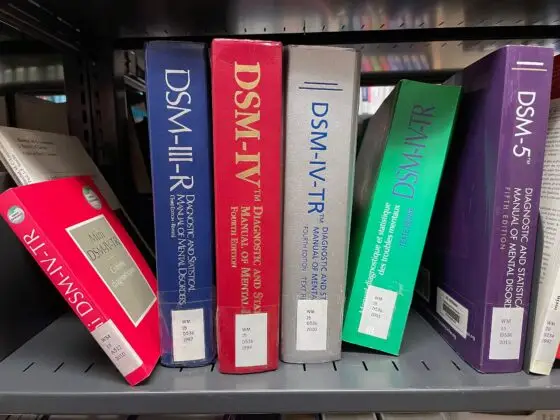
Sedona, AZ –By 2030, it is possible that there will be a new Diagnostic and Statistical Manual of Mental Disorders [DSM], updating from the current fifth edition, text revised [DSM-5-TR]. But what should be the new leap for the next iteration?
In the current edition, there are lots of circular labeling where defining a condition mentions something else. And defining something else mentions what may indicate the first label and so forth. There are so many intertwined labels that it is actually conspicuous that the nosology is quite limited.
Progress for the next DSM aligns first with moving from labels to defining and displaying conditions moving from labels to defining and displaying conditions. Simply, it is no longer enough to have the DSM like a dictionary, or a piece of literature when the subject matter is the brain.
What is happening in the brain, because of a condition? What’s the difference between when a condition is present or not? What components are central to functions? What are their mechanisms?
Even if these questions seem tough, a better approach is to ask, what can be used in the brain for now, to make progress on these? Like, amid the progress in neuroscience, what components are responsible, transdiagnostic and universal enough, to explain mental disorders and other functions of the brain including intelligence?
Artificial intelligence continues to have coverage over valuable labor tasks. Artificial intelligence is showing that when there are job vacancies, it may not necessarily be for humans, but for whatever possesses intelligence. Because humans bear the most intelligence for productivity, humans were a natural fit.
However, AI is already competing and questioning that default, which is that it is possible to have an intelligence do something, and if it is machine, then it applies, so long the task is completed.
This means that human intelligence needs to continue to improve and get better. It means that it is the time to seek a major definition for human intelligence, its types and their mechanisms in the brain, to structure for problem-solving.
In the brain, neurons are involved in all functions. But it can be said that work is done on neurons, for functions. Simply, for all that neurons do, electrical and chemical signals make those determinations. So, they relay across and between neurons. Neurons are active by the actions of signals.
This means that it is doable to build a model of how functions are mechanized by the interactions and attributes of electrical and chemical signals.
This is the postulation in Conceptual Biomarkers and Theoretical Biological Factors for Psychiatric and Intelligence Nosology.
The objective is to buoy psychiatry and human intelligence nosology to components and their mechanisms in the brain. Then have this open the path towards developing biomarkers for mental disorders before decade is out.
It likely to make progress on this effort before August 31, 2026
There is a recent [January 28, 2026] press release, APA Releases Roadmap for the Future of the DSM, stating that, “The American Psychiatric Association (APA) has released a series of papers offering a proposed roadmap for the future of the Diagnostic and Statistical Manual of Mental Disorders (DSM). The five papers, including the Initial Strategy for the Future of the DSM and four accompanying commentaries, are the result of the committee’s year of structured debate and consideration of long-standing critiques and rapid scientific advances. They propose a forward-looking model for the evolution of the DSM. They also suggest changing the name from Diagnostic and Statistical Manual to Diagnostic and Scientific Manual to better reflect its scientific and global scope. The four accompanying papers address structure and dimensions of the DSM; the role of biomarkers and biological factors in diagnosis; vision for incorporating socioeconomic, cultural and environmental determinants of health and intersectionality; and the role of functioning and quality of life in psychiatric diagnosis.”